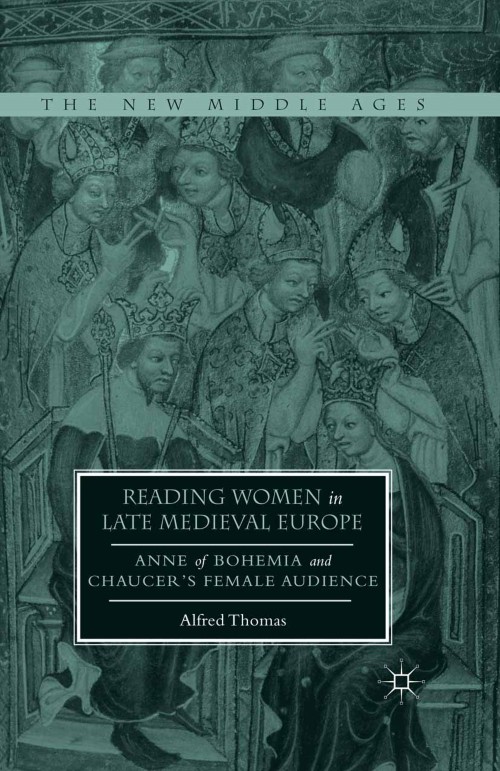
LEADER 02327nam a22005535i 4500
001 826891
003 TR_AnAIT
005 20260131071442
007 cr nn 008mamaa
008 160112s2015 xxu| s |||| 0|eng d
020 |a9781137542601|9978-1-137-54260-1
024 7 |a10.1057/9781137542601|2doi
041 |aeng
049 |aTürk Tarih Kurumu Kütüphanesi
050 4|aPN849.E87-.E872
072 7|aDS|2bicssc
072 7|a1D|2bicssc
072 7|aLIT004130|2bisacsh
072 7|aDS|x1D|2thema
082 04|a809.894|223
090 |aDK/27992
100 1 |aThomas, Alfred.|eauthor.|4aut|4http://id.loc.gov/vocabulary/relators/aut
245 10|aReading Women in Late Medieval Europe|h[electronic resource] :|bAnne of Bohemia and Chaucer’s Female Audience /|cby Alfred Thomas.
250 |a1st ed. 2015.
264 1|aNew York :|bPalgrave Macmillan US :|bImprint: Palgrave Macmillan,|c2015.
300 |aXVII, 251 p.|bonline resource.
336 |atext|btxt|2rdacontent
337 |acomputer|bc|2rdamedia
338 |aonline resource|bcr|2rdacarrier
347 |atext file|bPDF|2rda
490 1 |aThe New Middle Ages,|x2945-5944
520 |aAlthough Chaucer is typically labeled as the "Father of English Literature," evidence shows that his work appealed to Europe and specifically European women. Rereading the Canterbury Tales , Thomas argues that Chaucer imagined Anne of Bohemia, wife of famed Richard II, as an ideal reader, an aspect that came to greatly affect his writing.
650 0|aEuropean literature.
650 0|aEurope|xHistory|x476-1492.
650 0|aLiterature, Medieval.
650 0|aClassical literature.
650 0|aLiterature, Ancient.
650 14|aEuropean Literature.
650 24|aHistory of Medieval Europe.
650 24|aMedieval Literature.
650 24|aClassical and Antique Literature.
710 2 |aSpringerLink (Online service)
773 0 |tSpringer Nature eBook
776 08|iPrinted edition:|z9781137544193
776 08|iPrinted edition:|z9781349570645
776 08|iPrinted edition:|z9781349570652
830 0|aThe New Middle Ages,|x2945-5944
856 40|uhttps://doi.org/10.1057/9781137542601
912 |aZDB-2-PCC
912 |aZDB-2-SXL
950 |aPalgrave Media & Culture Collection (SpringerNature-41142)
950 |aLiterature, Cultural and Media Studies (R0) (SpringerNature-43723)