LEADER 03631nam a22005895i 4500
001 829736
003 TR_AnAIT
005 20260131050801
007 cr nn 008mamaa
008 160308s2005 xxu| s |||| 0|eng d
020 |a9781137098535|9978-1-137-09853-5
024 7 |a10.1007/978-1-137-09853-5|2doi
041 |aeng
049 |aTürk Tarih Kurumu Kütüphanesi
050 4|aPN849.E87-.E872
072 7|aDS|2bicssc
072 7|a1D|2bicssc
072 7|aLIT004130|2bisacsh
072 7|aDS|x1D|2thema
082 04|a809.894|223
090 |aDK/30827
100 1 |aHeydt-Stevenson, J.|eauthor.|4aut|4http://id.loc.gov/vocabulary/relators/aut
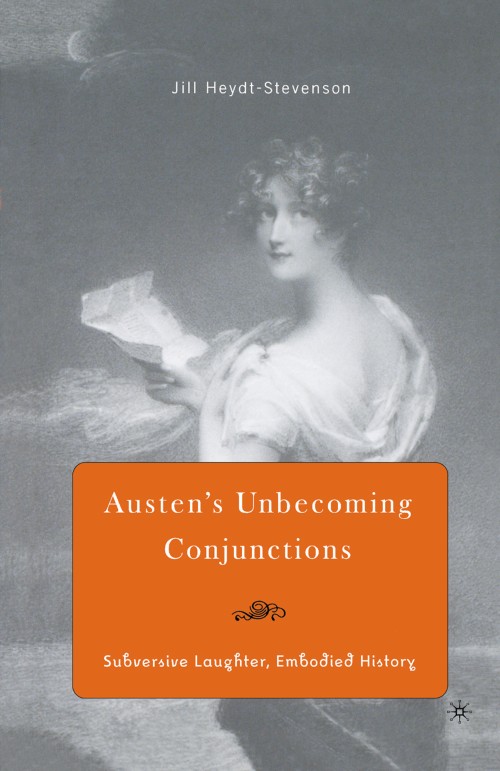
245 10|aAusten's Unbecoming Conjunctions|h[electronic resource] :|bSubversive Laughter, Embodied History /|cby J. Heydt-Stevenson.
250 |a1st ed. 2005.
264 1|aNew York :|bPalgrave Macmillan US :|bImprint: Palgrave Macmillan,|c2005.
300 |aX, 275 p.|bonline resource.
336 |atext|btxt|2rdacontent
337 |acomputer|bc|2rdamedia
338 |aonline resource|bcr|2rdacarrier
347 |atext file|bPDF|2rda
520 |aAusten'sUnbecomingConjunctions is a contemporary study of all Jane Austen's writings focusing on her representation of women, sexuality, the material objects, and linguistic patterns by which this sexuality was expressed. Heydt-Stevenson demonstrates the subtle, vulgar, and humorous ways Austen uses human bodies, objects, and activities (fashion, jewelry, crafts, popular literature, travel and tourism, money, and courtship rituals) to convey sexuality and sexual appetites. Through the sexual subtext, Heydt-Stevenson proposes, Austen satirized contemporary sexual hypocrisy; overcame the stereotypes of women authors as sexually inhibited, sheltered, or repressed; and addressed as sophisticated and worldly an audience as Byron's. Thus through her careful reading of all the Austen texts in light of the language of eroticism, both traditional and contemporary, Heydt-Stevenson re-evaluates Austen's audience, the novels, and her role as a writer.
532 8 |aAccessibility summary: This PDF is not accessible. It is based on scanned pages and does not support features such as screen reader compatibility or described non-text content (images, graphs etc). However, it likely supports searchable and selectable text based on OCR (Optical Character Recognition). Users with accessibility needs may not be able to use this content effectively. Please contact us at accessibilitysupport@springernature.com if you require assistance or an alternative format.
532 8 |aInaccessible, or known limited accessibility
532 8 |aNo reading system accessibility options actively disabled
532 8 |aPublisher contact for further accessibility information: accessibilitysupport@springernature.com
650 0|aEuropean literature.
650 0|aLiterature, Modern|x19th century.
650 0|aLiterature, Modern|x18th century.
650 0|aLiterature|xPhilosophy.
650 0|aFiction.
650 14|aEuropean Literature.
650 24|aNineteenth-Century Literature.
650 24|aEighteenth-Century Literature.
650 24|aLiterary Theory.
650 24|aFiction Literature.
710 2 |aSpringerLink (Online service)
773 0 |tSpringer Nature eBook
776 08|iPrinted edition:|z9781403964106
776 08|iPrinted edition:|z9780230602489
776 08|iPrinted edition:|z9781349732333
856 40|uhttps://doi.org/10.1007/978-1-137-09853-5
912 |aZDB-2-PSD
912 |aZDB-2-SXS
950 |aPalgrave Social & Cultural Studies Collection (SpringerNature-41148)
950 |aSocial Sciences (R0) (SpringerNature-43726)