

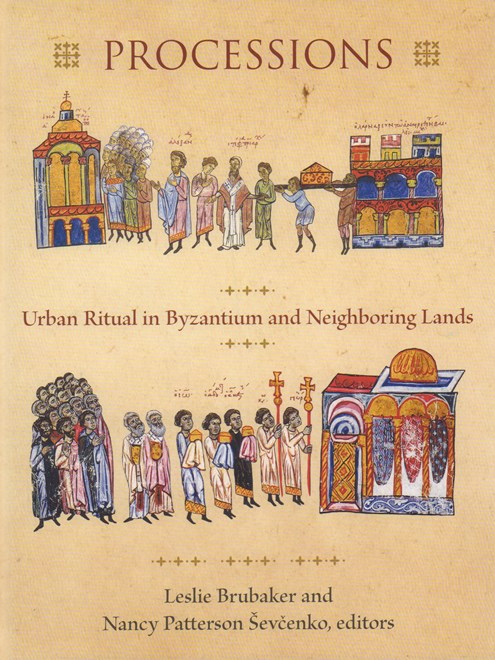
Processions : urban ritual in Byzantium and neighboring lands / edited by Leslie Brubaker and Nancy Patterson Ševčenko.
Yer Numarası
B.II/0681
ISBN
9780884025269 (hardcover)
9780884025368 (ebook)
9780884025368 (ebook)
Dil Kodu
İngilizce
Kütüphane
Türk Tarih Kurumu Kütüphanesi
Eser Adının Farklı Biçimi
Urban ritual in Byzantium and neighboring lands
Yayın Bilgisi
Washington, D.C. : Dumbarton Oaks Research Library and Collection, ©2025.
Fiziksel Niteleme
viii, 263 sayfa : resim, harita, plan, kroki, tıpkıbasım, tablo ; 29 cm.
Dizi
Dumbarton Oaks Byzantine symposia and colloquia
Genel Not
İndeks s. 251-263.
Bibliyografi, vb. Notu
Bibliyografik bilgi içerir.
İçindekiler Notu
Processions : an introduction / Leslie Brubaker -- “The things they carried“ : religious processions in early Byzantium / Georgia Frank -- Controlling material and semiotic landscapes : processions in the Late Antique Roman east / Nathanael Andrade -- Bridging the gap : processions in early medieval Constantinople, 400-900 / Leslie Brubaker -- Some notes on liturgical processions / Vasileios Marinis -- Public processions in middle Byzantine Constantinople / Michael Featherstone -- Sparkling creations, threads of tradition : Marian processions in medieval Constantinople / Christine Angelidi -- Between urban conflict and civic integration : processions in Rome and Milan, ca. 1050-1150 / James Norrie -- Relics, processions, and the ceremonial of legitimacy under the Fatimids and Almohads / Paula Sanders -- Latin processions in crusader Jerusalem : Melkite influence, change, and the Templum Domini / Sebastián Salvadó -- Processions in early Palaiologan Constantinople : from Michael Palaiologos's theatrical spectacles to participatory performances under Andronikos II and Patriarch Athanasios I / Niels Gaul.
Özet, vb.
“Processions of all kinds-military, civic, religious, and more-were hallmarks of the ancient and medieval world. Yet urban processions in Byzantine culture have never been thoroughly studied, even though there were as many as two processions a week in Constantinople alone, often featuring eminent individuals like the emperor and the patriarch (and less prominent people, like the teams who decorated the streets). In an introduction and ten chapters, this volume examines a millennium of medieval processions through analysis of texts, artifacts, and images. Byzantium did not, of course, exist in a vacuum. Byzantine processions are here set alongside those occurring at the borders of the Byzantine world: the Latin West, the Islamic East, and, of course, Jerusalem, the center of the Mediterranean's sacred world. This comparative approach lets us better see how the Byzantines operated in a complex global network defined by local contexts, how the Byzantines positioned themselves within this network, and the nature of the Byzantine legacy to their Islamic, Catholic, and Orthodox inheritors“ -- Arka kapak.
Konu
Geçit törenleri__Bizans İmparatorluğu__Tarih__Kongreler.
Geçit törenleri__Akdeniz Bölgesi__Tarih__Kongreler.
Dini geçit törenleri__Bizans İmparatorluğu__Tarih__Kongreler.
Ayinler ve törenler__Bizans İmparatorluğu__Tarih__Kongreler.
Bizans İmparatorluğu__Sosyal yaşam ve gelenekler__Kongreler.
Bizans İmparatorluğu__Dini yaşam ve gelenekler__Kongreler.
Geçit törenleri__Akdeniz Bölgesi__Tarih__Kongreler.
Dini geçit törenleri__Bizans İmparatorluğu__Tarih__Kongreler.
Ayinler ve törenler__Bizans İmparatorluğu__Tarih__Kongreler.
Bizans İmparatorluğu__Sosyal yaşam ve gelenekler__Kongreler.
Bizans İmparatorluğu__Dini yaşam ve gelenekler__Kongreler.
Emeği Geçenler
Brubaker, Leslie, editör.
Ševčenko, Nancy Patterson, editör.
Ševčenko, Nancy Patterson, editör.
Eseri Alıntıla
Referansları kullanmadan önce gözden geçirmeniz ve varsa gerekli düzeltmeleri yapmanız önerilir.
Dijital Kaynak
MARC Görünümü
LEADER 03816naaaa2200385aa54500
001 835193
003 TR_AnAIT
005 20260401121200
006 aobede |||| 001 0d
007 ta
008 260330s2025 xxuobede |||| 001 0deng c
020 |a9780884025269|q(hardcover)
020 |a9780884025368|q(ebook)
040 |aTTK
041 |aeng
049 |aTürk Tarih Kurumu Kütüphanesi
090 |aB.II/0681
245 00|aProcessions :|burban ritual in Byzantium and neighboring lands /|cedited by Leslie Brubaker and Nancy Patterson Ševčenko.
246 1 |aUrban ritual in Byzantium and neighboring lands
260 |aWashington, D.C. :|bDumbarton Oaks Research Library and Collection,|c©2025.
300 |aviii, 263 sayfa :|bresim, harita, plan, kroki, tıpkıbasım, tablo ;|c29 cm.
490 0 |aDumbarton Oaks Byzantine symposia and colloquia
500 |aİndeks s. 251-263.
504 |aBibliyografik bilgi içerir.
505 |tProcessions : an introduction /|rLeslie Brubaker --|t“The things they carried“ : religious processions in early Byzantium /|rGeorgia Frank --|tControlling material and semiotic landscapes : processions in the Late Antique Roman east /|rNathanael Andrade --|tBridging the gap : processions in early medieval Constantinople, 400-900 /|rLeslie Brubaker --|tSome notes on liturgical processions /|rVasileios Marinis --|tPublic processions in middle Byzantine Constantinople /|rMichael Featherstone --|tSparkling creations, threads of tradition : Marian processions in medieval Constantinople /|rChristine Angelidi --|tBetween urban conflict and civic integration : processions in Rome and Milan, ca. 1050-1150 /|rJames Norrie --|tRelics, processions, and the ceremonial of legitimacy under the Fatimids and Almohads /|rPaula Sanders --|tLatin processions in crusader Jerusalem : Melkite influence, change, and the Templum Domini /|rSebastián Salvadó --|tProcessions in early Palaiologan Constantinople : from Michael Palaiologos's theatrical spectacles to participatory performances under Andronikos II and Patriarch Athanasios I /|rNiels Gaul.
520 |a“Processions of all kinds-military, civic, religious, and more-were hallmarks of the ancient and medieval world. Yet urban processions in Byzantine culture have never been thoroughly studied, even though there were as many as two processions a week in Constantinople alone, often featuring eminent individuals like the emperor and the patriarch (and less prominent people, like the teams who decorated the streets). In an introduction and ten chapters, this volume examines a millennium of medieval processions through analysis of texts, artifacts, and images. Byzantium did not, of course, exist in a vacuum. Byzantine processions are here set alongside those occurring at the borders of the Byzantine world: the Latin West, the Islamic East, and, of course, Jerusalem, the center of the Mediterranean's sacred world. This comparative approach lets us better see how the Byzantines operated in a complex global network defined by local contexts, how the Byzantines positioned themselves within this network, and the nature of the Byzantine legacy to their Islamic, Catholic, and Orthodox inheritors“ --|cArka kapak.
650 4|aGeçit törenleri|zBizans İmparatorluğu|xTarih|vKongreler.
650 4|aGeçit törenleri|zAkdeniz Bölgesi|xTarih|vKongreler.
650 4|aDini geçit törenleri|zBizans İmparatorluğu|xTarih|vKongreler.
650 4|aAyinler ve törenler|zBizans İmparatorluğu|xTarih|vKongreler.
651 4|aBizans İmparatorluğu|xSosyal yaşam ve gelenekler|vKongreler.
651 4|aBizans İmparatorluğu|xDini yaşam ve gelenekler|vKongreler.
700 1 |aBrubaker, Leslie,|eeditör.
700 1 |aŠevčenko, Nancy Patterson,|eeditör.
001 835193
003 TR_AnAIT
005 20260401121200
006 aobede |||| 001 0d
007 ta
008 260330s2025 xxuobede |||| 001 0deng c
020 |a9780884025269|q(hardcover)
020 |a9780884025368|q(ebook)
040 |aTTK
041 |aeng
049 |aTürk Tarih Kurumu Kütüphanesi
090 |aB.II/0681
245 00|aProcessions :|burban ritual in Byzantium and neighboring lands /|cedited by Leslie Brubaker and Nancy Patterson Ševčenko.
246 1 |aUrban ritual in Byzantium and neighboring lands
260 |aWashington, D.C. :|bDumbarton Oaks Research Library and Collection,|c©2025.
300 |aviii, 263 sayfa :|bresim, harita, plan, kroki, tıpkıbasım, tablo ;|c29 cm.
490 0 |aDumbarton Oaks Byzantine symposia and colloquia
500 |aİndeks s. 251-263.
504 |aBibliyografik bilgi içerir.
505 |tProcessions : an introduction /|rLeslie Brubaker --|t“The things they carried“ : religious processions in early Byzantium /|rGeorgia Frank --|tControlling material and semiotic landscapes : processions in the Late Antique Roman east /|rNathanael Andrade --|tBridging the gap : processions in early medieval Constantinople, 400-900 /|rLeslie Brubaker --|tSome notes on liturgical processions /|rVasileios Marinis --|tPublic processions in middle Byzantine Constantinople /|rMichael Featherstone --|tSparkling creations, threads of tradition : Marian processions in medieval Constantinople /|rChristine Angelidi --|tBetween urban conflict and civic integration : processions in Rome and Milan, ca. 1050-1150 /|rJames Norrie --|tRelics, processions, and the ceremonial of legitimacy under the Fatimids and Almohads /|rPaula Sanders --|tLatin processions in crusader Jerusalem : Melkite influence, change, and the Templum Domini /|rSebastián Salvadó --|tProcessions in early Palaiologan Constantinople : from Michael Palaiologos's theatrical spectacles to participatory performances under Andronikos II and Patriarch Athanasios I /|rNiels Gaul.
520 |a“Processions of all kinds-military, civic, religious, and more-were hallmarks of the ancient and medieval world. Yet urban processions in Byzantine culture have never been thoroughly studied, even though there were as many as two processions a week in Constantinople alone, often featuring eminent individuals like the emperor and the patriarch (and less prominent people, like the teams who decorated the streets). In an introduction and ten chapters, this volume examines a millennium of medieval processions through analysis of texts, artifacts, and images. Byzantium did not, of course, exist in a vacuum. Byzantine processions are here set alongside those occurring at the borders of the Byzantine world: the Latin West, the Islamic East, and, of course, Jerusalem, the center of the Mediterranean's sacred world. This comparative approach lets us better see how the Byzantines operated in a complex global network defined by local contexts, how the Byzantines positioned themselves within this network, and the nature of the Byzantine legacy to their Islamic, Catholic, and Orthodox inheritors“ --|cArka kapak.
650 4|aGeçit törenleri|zBizans İmparatorluğu|xTarih|vKongreler.
650 4|aGeçit törenleri|zAkdeniz Bölgesi|xTarih|vKongreler.
650 4|aDini geçit törenleri|zBizans İmparatorluğu|xTarih|vKongreler.
650 4|aAyinler ve törenler|zBizans İmparatorluğu|xTarih|vKongreler.
651 4|aBizans İmparatorluğu|xSosyal yaşam ve gelenekler|vKongreler.
651 4|aBizans İmparatorluğu|xDini yaşam ve gelenekler|vKongreler.
700 1 |aBrubaker, Leslie,|eeditör.
700 1 |aŠevčenko, Nancy Patterson,|eeditör.
Materyaller
Depodan talep edilen materyal sadece kütüphane içerisinde kullanılmaktadır.
Materyal dışarıya ödünç verilmemektedir.
Materyal dışarıya ödünç verilmemektedir.
