

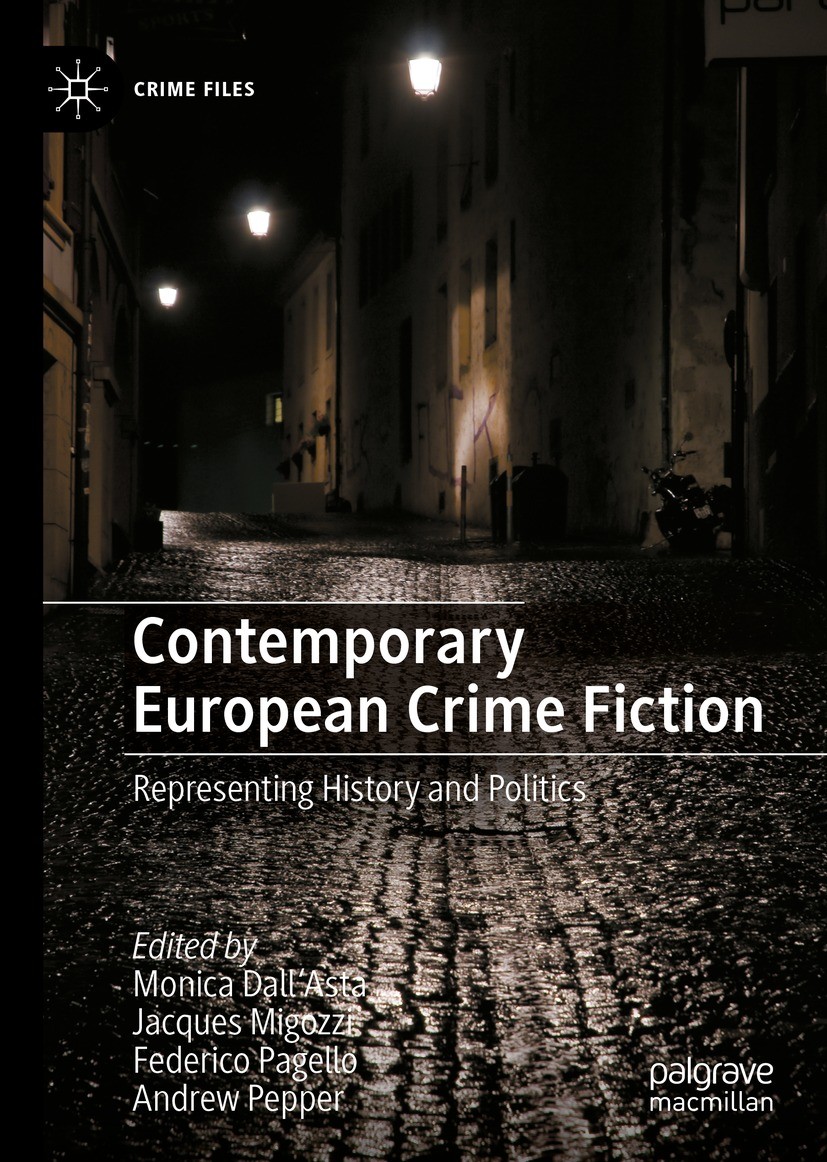
Contemporary European Crime Fiction [electronic resource] : Representing History and Politics / edited by Monica Dall'Asta, Jacques Migozzi, Federico Pagello, Andrew Pepper.
Erişim Adresi
ISBN
9783031219795
Dil Kodu
İngilizce
Yer Numarası
EK/5678
Basım Bildirimi
1st ed. 2023.
Yayın Bilgisi
Cham : Springer International Publishing : Imprint: Palgrave Macmillan, 2023.
Fiziksel Niteleme
XIV, 295 p. online resource.
Dizi
Crime Files, 2947-8359
İçindekiler Notu
1. Where’s the Empire? Loss, Geopolitical Agency and Imperial Longing in Jacqueline Winspear’s Maisie Dobbs Series -- 2. The Fingerprints of Fascism: Phillip Kerr’s Bernie Gunther Novels, Nazi Noir, and the Continuing Presence of the Past -- 3. Noir Bearing Gifts: The Greek Shoah and its memory in Philip Kerr’s Greeks Bearing Gifts -- 4. Confronting Memories: The Case of Babylon Berlin -- 5. Crime for a Higher Cause: The Baader Meinhof Complex and The Left Wing Gang -- 6. No Future and Spectrality in David Peace’s Red Riding Quartet -- 7. The Trails of a Counter-Narrative: The Representation of the Years of Lead in Loriano Macchiavelli’s Sarti Antonio’s Series -- 8. Didier Daeninckx, Le roman noir de l’Histoire (2019): Dismantling the Tale of French History through Disseminated Micro-Histories -- 9. Revisioning the Past to Build the Democratic Future: The Cases of Italian and Spanish Crime Fiction -- 10. How does Crime Fiction ‘talk politics’? Figures of Political Action in Contemporary French Crime Writing -- 11. Shadow Economies: The Financial Crisis and European TV Crime Series -- 12. A ‘Bottom-Up’ Approach to Transcultural Identities: Petra and Women Detectives in Italian TV Crime Drama -- 13. The Excavation of History and the Quest for Identity in Contemporary Polish Crime Fiction -- 14. Euroscapes: Space, Place and Multi-Level Governance in European Television Crime Series.
Özet, vb.
This book represents the first extended consideration of contemporary crime fiction as a European phenomenon. Understanding crime fiction in its broadest sense, as a transmedia practice, and offering unique insights into this practice in specific European countries and as a genuinely transcontinental endeavour, this book argues that the distinctiveness of the form can be found in its related historical and political inquiries. It asks how the genre’s excavation of Europe’s history of violence and protest in the twentieth century is informed by contemporary political questions. It also considers how the genre’s progressive reimagining of new identities forged at the crossroads of ethnicity, gender, and sexuality is offset by its bleaker assessment of the corrosive effects of entrenched social inequalities, political corruption, and state violence. The result is a rich, vibrant collection that shows how crime fiction can help us better understand the complex relationship between Europe’spast, present, and future. Seven chapters are available open access under a Creative Commons Attribution 4.0 International License via link.springer.com. Monica Dall’Asta is Professor of Film and Media Studies at the University of Bologna, Italy. She is one of the founding editors of the Women Film Pioneers Project, based at Columbia University, and served as Coordinator of the DETECt-Detecting Transcultural Identity in European Popular Crime Narratives project (2018–21). Jacques Migozzi is Professor of French Literature at the University of Limoges, France, where he leads the Groupe de recherches sur les Littératures Populaires et Cultures Médiatiques. He published a synthetical essay in 2005, Boulevards du Populaire, and has edited or co-edited 12 volumes or journal special issues. Federico Pagello teaches Film and Media Studies at the University of Chieti-Pescara, Italy. His research focuses on popular serial narratives and their transmedia and transmedia circulation. His most recent monograph is entitled Quentin Tarantino and Film Theory: Aesthetics and Dialectics in Late Postmodernity (Palgrave 2020). Andrew Pepper is Professor of English at Queen’s University Belfast, Northern Ireland. He is author of Unwilling Executioner: Crime Fiction and the State (2016) and co-editor of Globalization and the State in Contemporary Crime Fiction (2016) and The Routledge Companion to Crime Fiction (2020). .
Konu
European literature.
Comparative literature.
Literature __ History and criticism.
Motion picture plays, European.
Popular Culture.
Europe __ History.
European Literature.
Comparative Literature.
Literary History.
European Film and TV.
Popular Culture.
European History.
Comparative literature.
Literature __ History and criticism.
Motion picture plays, European.
Popular Culture.
Europe __ History.
European Literature.
Comparative Literature.
Literary History.
European Film and TV.
Popular Culture.
European History.
Kurum Adı
Eseri Alıntıla
Referansları kullanmadan önce gözden geçirmeniz ve varsa gerekli düzeltmeleri yapmanız önerilir.
Dijital Kaynak
MARC Görünümü
LEADER 07412nam a22007455i 4500
001 839851
003 TR_AnAIT
005 20260715041800
007 cr nn 008mamaa
008 230420s2023 sz | s |||| 0|eng d
020 |a9783031219795|9978-3-031-21979-5
024 7 |a10.1007/978-3-031-21979-5|2doi
041 |aeng
049 |aTürk Dil Kurumu Kütüphanesi
050 4|aPN849.E87-.E872
072 7|aDS|2bicssc
072 7|a1D|2bicssc
072 7|aLIT004130|2bisacsh
072 7|aDS|x1D|2thema
082 04|a809.894|223
090 |aEK/5678
245 10|aContemporary European Crime Fiction|h[electronic resource] :|bRepresenting History and Politics /|cedited by Monica Dall'Asta, Jacques Migozzi, Federico Pagello, Andrew Pepper.
250 |a1st ed. 2023.
264 1|aCham :|bSpringer International Publishing :|bImprint: Palgrave Macmillan,|c2023.
300 |aXIV, 295 p.|bonline resource.
336 |atext|btxt|2rdacontent
337 |acomputer|bc|2rdamedia
338 |aonline resource|bcr|2rdacarrier
341 0 |bTable of contents navigation|2onix
341 0 |bSingle logical reading order|2onix
341 0 |bUse of color is not sole means of conveying information|2onix
341 0 |bUse of high contrast between text and background color|2onix
341 0 |bNext / Previous structural navigation|2onix
341 0 |bAll non-decorative content supports reading without sight|2onix
347 |atext file|bPDF|2rda
490 1 |aCrime Files,|x2947-8359
505 0 |a1. Where’s the Empire? Loss, Geopolitical Agency and Imperial Longing in Jacqueline Winspear’s Maisie Dobbs Series -- 2. The Fingerprints of Fascism: Phillip Kerr’s Bernie Gunther Novels, Nazi Noir, and the Continuing Presence of the Past -- 3. Noir Bearing Gifts: The Greek Shoah and its memory in Philip Kerr’s Greeks Bearing Gifts -- 4. Confronting Memories: The Case of Babylon Berlin -- 5. Crime for a Higher Cause: The Baader Meinhof Complex and The Left Wing Gang -- 6. No Future and Spectrality in David Peace’s Red Riding Quartet -- 7. The Trails of a Counter-Narrative: The Representation of the Years of Lead in Loriano Macchiavelli’s Sarti Antonio’s Series -- 8. Didier Daeninckx, Le roman noir de l’Histoire (2019): Dismantling the Tale of French History through Disseminated Micro-Histories -- 9. Revisioning the Past to Build the Democratic Future: The Cases of Italian and Spanish Crime Fiction -- 10. How does Crime Fiction ‘talk politics’? Figures of Political Action in Contemporary French Crime Writing -- 11. Shadow Economies: The Financial Crisis and European TV Crime Series -- 12. A ‘Bottom-Up’ Approach to Transcultural Identities: Petra and Women Detectives in Italian TV Crime Drama -- 13. The Excavation of History and the Quest for Identity in Contemporary Polish Crime Fiction -- 14. Euroscapes: Space, Place and Multi-Level Governance in European Television Crime Series.
520 |aThis book represents the first extended consideration of contemporary crime fiction as a European phenomenon. Understanding crime fiction in its broadest sense, as a transmedia practice, and offering unique insights into this practice in specific European countries and as a genuinely transcontinental endeavour, this book argues that the distinctiveness of the form can be found in its related historical and political inquiries. It asks how the genre’s excavation of Europe’s history of violence and protest in the twentieth century is informed by contemporary political questions. It also considers how the genre’s progressive reimagining of new identities forged at the crossroads of ethnicity, gender, and sexuality is offset by its bleaker assessment of the corrosive effects of entrenched social inequalities, political corruption, and state violence. The result is a rich, vibrant collection that shows how crime fiction can help us better understand the complex relationship between Europe’spast, present, and future. Seven chapters are available open access under a Creative Commons Attribution 4.0 International License via link.springer.com. Monica Dall’Asta is Professor of Film and Media Studies at the University of Bologna, Italy. She is one of the founding editors of the Women Film Pioneers Project, based at Columbia University, and served as Coordinator of the DETECt-Detecting Transcultural Identity in European Popular Crime Narratives project (2018–21). Jacques Migozzi is Professor of French Literature at the University of Limoges, France, where he leads the Groupe de recherches sur les Littératures Populaires et Cultures Médiatiques. He published a synthetical essay in 2005, Boulevards du Populaire, and has edited or co-edited 12 volumes or journal special issues. Federico Pagello teaches Film and Media Studies at the University of Chieti-Pescara, Italy. His research focuses on popular serial narratives and their transmedia and transmedia circulation. His most recent monograph is entitled Quentin Tarantino and Film Theory: Aesthetics and Dialectics in Late Postmodernity (Palgrave 2020). Andrew Pepper is Professor of English at Queen’s University Belfast, Northern Ireland. He is author of Unwilling Executioner: Crime Fiction and the State (2016) and co-editor of Globalization and the State in Contemporary Crime Fiction (2016) and The Routledge Companion to Crime Fiction (2020). .
532 8 |aAccessibility summary: This PDF does not fully comply with PDF/UA standards, but does feature limited screen reader support, bookmarks for easy navigation and searchable, selectable text. Users of assistive technologies may experience difficulty navigating or interpreting content in this document. We recognize the importance of accessibility, and we welcome queries about accessibility for any of our products. If you have a question or an access need, please get in touch with us at accessibilitysupport@springernature.com.
532 8 |aNo reading system accessibility options actively disabled
532 8 |aPublisher contact for further accessibility information: accessibilitysupport@springernature.com
650 0|aEuropean literature.
650 0|aComparative literature.
650 0|aLiterature|xHistory and criticism.
650 0|aMotion picture plays, European.
650 0|aPopular Culture.
650 0|aEurope|xHistory.
650 14|aEuropean Literature.
650 24|aComparative Literature.
650 24|aLiterary History.
650 24|aEuropean Film and TV.
650 24|aPopular Culture.
650 24|aEuropean History.
700 1 |aDall'Asta, Monica.|eeditor.|4edt|4http://id.loc.gov/vocabulary/relators/edt
700 1 |aMigozzi, Jacques.|eeditor.|4edt|4http://id.loc.gov/vocabulary/relators/edt
700 1 |aPagello, Federico.|eeditor.|4edt|4http://id.loc.gov/vocabulary/relators/edt
700 1 |aPepper, Andrew.|eeditor.|4edt|4http://id.loc.gov/vocabulary/relators/edt
710 2 |aSpringerLink (Online service)
773 0 |tSpringer Nature eBook
776 08|iPrinted edition:|z9783031219788
776 08|iPrinted edition:|z9783031219801
776 08|iPrinted edition:|z9783031219818
830 0|aCrime Files,|x2947-8359
856 40|uhttps://doi.org/10.1007/978-3-031-21979-5
912 |aZDB-2-LCM
912 |aZDB-2-SXL
950 |aLiterature, Cultural and Media Studies (SpringerNature-41173)
950 |aLiterature, Cultural and Media Studies (R0) (SpringerNature-43723)
001 839851
003 TR_AnAIT
005 20260715041800
007 cr nn 008mamaa
008 230420s2023 sz | s |||| 0|eng d
020 |a9783031219795|9978-3-031-21979-5
024 7 |a10.1007/978-3-031-21979-5|2doi
041 |aeng
049 |aTürk Dil Kurumu Kütüphanesi
050 4|aPN849.E87-.E872
072 7|aDS|2bicssc
072 7|a1D|2bicssc
072 7|aLIT004130|2bisacsh
072 7|aDS|x1D|2thema
082 04|a809.894|223
090 |aEK/5678
245 10|aContemporary European Crime Fiction|h[electronic resource] :|bRepresenting History and Politics /|cedited by Monica Dall'Asta, Jacques Migozzi, Federico Pagello, Andrew Pepper.
250 |a1st ed. 2023.
264 1|aCham :|bSpringer International Publishing :|bImprint: Palgrave Macmillan,|c2023.
300 |aXIV, 295 p.|bonline resource.
336 |atext|btxt|2rdacontent
337 |acomputer|bc|2rdamedia
338 |aonline resource|bcr|2rdacarrier
341 0 |bTable of contents navigation|2onix
341 0 |bSingle logical reading order|2onix
341 0 |bUse of color is not sole means of conveying information|2onix
341 0 |bUse of high contrast between text and background color|2onix
341 0 |bNext / Previous structural navigation|2onix
341 0 |bAll non-decorative content supports reading without sight|2onix
347 |atext file|bPDF|2rda
490 1 |aCrime Files,|x2947-8359
505 0 |a1. Where’s the Empire? Loss, Geopolitical Agency and Imperial Longing in Jacqueline Winspear’s Maisie Dobbs Series -- 2. The Fingerprints of Fascism: Phillip Kerr’s Bernie Gunther Novels, Nazi Noir, and the Continuing Presence of the Past -- 3. Noir Bearing Gifts: The Greek Shoah and its memory in Philip Kerr’s Greeks Bearing Gifts -- 4. Confronting Memories: The Case of Babylon Berlin -- 5. Crime for a Higher Cause: The Baader Meinhof Complex and The Left Wing Gang -- 6. No Future and Spectrality in David Peace’s Red Riding Quartet -- 7. The Trails of a Counter-Narrative: The Representation of the Years of Lead in Loriano Macchiavelli’s Sarti Antonio’s Series -- 8. Didier Daeninckx, Le roman noir de l’Histoire (2019): Dismantling the Tale of French History through Disseminated Micro-Histories -- 9. Revisioning the Past to Build the Democratic Future: The Cases of Italian and Spanish Crime Fiction -- 10. How does Crime Fiction ‘talk politics’? Figures of Political Action in Contemporary French Crime Writing -- 11. Shadow Economies: The Financial Crisis and European TV Crime Series -- 12. A ‘Bottom-Up’ Approach to Transcultural Identities: Petra and Women Detectives in Italian TV Crime Drama -- 13. The Excavation of History and the Quest for Identity in Contemporary Polish Crime Fiction -- 14. Euroscapes: Space, Place and Multi-Level Governance in European Television Crime Series.
520 |aThis book represents the first extended consideration of contemporary crime fiction as a European phenomenon. Understanding crime fiction in its broadest sense, as a transmedia practice, and offering unique insights into this practice in specific European countries and as a genuinely transcontinental endeavour, this book argues that the distinctiveness of the form can be found in its related historical and political inquiries. It asks how the genre’s excavation of Europe’s history of violence and protest in the twentieth century is informed by contemporary political questions. It also considers how the genre’s progressive reimagining of new identities forged at the crossroads of ethnicity, gender, and sexuality is offset by its bleaker assessment of the corrosive effects of entrenched social inequalities, political corruption, and state violence. The result is a rich, vibrant collection that shows how crime fiction can help us better understand the complex relationship between Europe’spast, present, and future. Seven chapters are available open access under a Creative Commons Attribution 4.0 International License via link.springer.com. Monica Dall’Asta is Professor of Film and Media Studies at the University of Bologna, Italy. She is one of the founding editors of the Women Film Pioneers Project, based at Columbia University, and served as Coordinator of the DETECt-Detecting Transcultural Identity in European Popular Crime Narratives project (2018–21). Jacques Migozzi is Professor of French Literature at the University of Limoges, France, where he leads the Groupe de recherches sur les Littératures Populaires et Cultures Médiatiques. He published a synthetical essay in 2005, Boulevards du Populaire, and has edited or co-edited 12 volumes or journal special issues. Federico Pagello teaches Film and Media Studies at the University of Chieti-Pescara, Italy. His research focuses on popular serial narratives and their transmedia and transmedia circulation. His most recent monograph is entitled Quentin Tarantino and Film Theory: Aesthetics and Dialectics in Late Postmodernity (Palgrave 2020). Andrew Pepper is Professor of English at Queen’s University Belfast, Northern Ireland. He is author of Unwilling Executioner: Crime Fiction and the State (2016) and co-editor of Globalization and the State in Contemporary Crime Fiction (2016) and The Routledge Companion to Crime Fiction (2020). .
532 8 |aAccessibility summary: This PDF does not fully comply with PDF/UA standards, but does feature limited screen reader support, bookmarks for easy navigation and searchable, selectable text. Users of assistive technologies may experience difficulty navigating or interpreting content in this document. We recognize the importance of accessibility, and we welcome queries about accessibility for any of our products. If you have a question or an access need, please get in touch with us at accessibilitysupport@springernature.com.
532 8 |aNo reading system accessibility options actively disabled
532 8 |aPublisher contact for further accessibility information: accessibilitysupport@springernature.com
650 0|aEuropean literature.
650 0|aComparative literature.
650 0|aLiterature|xHistory and criticism.
650 0|aMotion picture plays, European.
650 0|aPopular Culture.
650 0|aEurope|xHistory.
650 14|aEuropean Literature.
650 24|aComparative Literature.
650 24|aLiterary History.
650 24|aEuropean Film and TV.
650 24|aPopular Culture.
650 24|aEuropean History.
700 1 |aDall'Asta, Monica.|eeditor.|4edt|4http://id.loc.gov/vocabulary/relators/edt
700 1 |aMigozzi, Jacques.|eeditor.|4edt|4http://id.loc.gov/vocabulary/relators/edt
700 1 |aPagello, Federico.|eeditor.|4edt|4http://id.loc.gov/vocabulary/relators/edt
700 1 |aPepper, Andrew.|eeditor.|4edt|4http://id.loc.gov/vocabulary/relators/edt
710 2 |aSpringerLink (Online service)
773 0 |tSpringer Nature eBook
776 08|iPrinted edition:|z9783031219788
776 08|iPrinted edition:|z9783031219801
776 08|iPrinted edition:|z9783031219818
830 0|aCrime Files,|x2947-8359
856 40|uhttps://doi.org/10.1007/978-3-031-21979-5
912 |aZDB-2-LCM
912 |aZDB-2-SXL
950 |aLiterature, Cultural and Media Studies (SpringerNature-41173)
950 |aLiterature, Cultural and Media Studies (R0) (SpringerNature-43723)
Materyaller
Depodan talep edilen materyal sadece kütüphane içerisinde kullanılmaktadır.
Materyal dışarıya ödünç verilmemektedir.
Materyal dışarıya ödünç verilmemektedir.
