

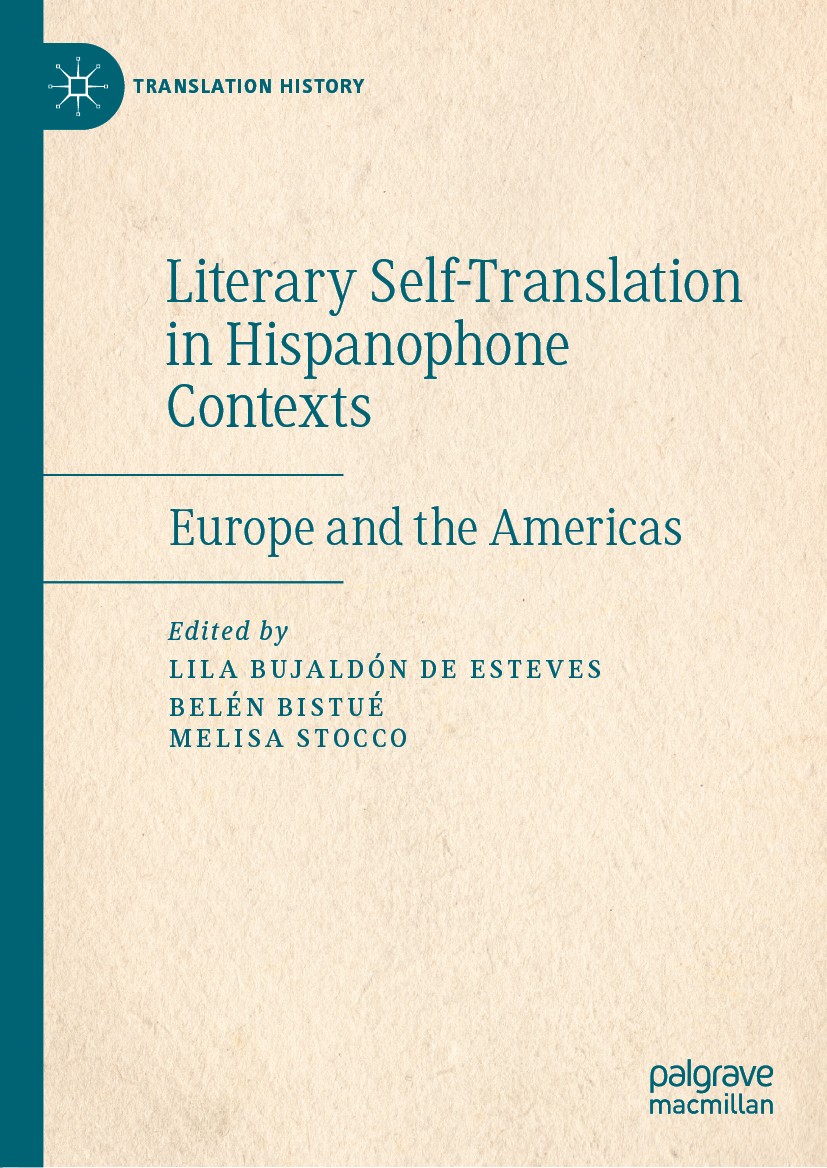
Literary Self-Translation in Hispanophone Contexts - La autotraducción literaria en contextos de habla hispana [electronic resource] : Europe and the Americas - Europa y América / edited by Lila Bujaldón de Esteves, Belén Bistué, Melisa Stocco.
Erişim Adresi
ISBN
9783030236250
Dil Kodu
İngilizce
Yer Numarası
EK/3254
Basım Bildirimi
1st ed. 2019.
Yayın Bilgisi
Cham : Springer International Publishing : Imprint: Palgrave Macmillan, 2019.
Fiziksel Niteleme
XIV, 378 p. 1 illus. online resource.
Dizi
Translation History, 2523-871X
İçindekiler Notu
Introduction (Lila Bujaldón, Belén Bistué, and Melisa Stocco) -- Part I: Negotiating Linguistic and Literary Identity in Self-Translations Between Indigenous Languages and Spanish -- Autotraducción y resurgimiento literario indígena en Hispanoamérica (Julio- César Santoyo). Self-Translation and Indigenous Literary Revival in Spanish America (translated by Ana Roby) -- I.2 Self-Translation in Contemporary Indigenous Literatures in Mexico (Eva Gentes) -- I.3 Identidades 'reescritas': autotraducción y retraducción en la poesía mapuche contemporánea (Melisa Stocco). 'Rewritten' identities: self-translation and retranslation in contemporary Mapuche poetry (translated by Melisa Stocco) -- Part II: Incorporating Self-Translation and Multilingualism into the History of Spanish American Literatures -- II.1 Self-Translation as a Model for Multilingual Writing in Sor Juana's Villancicos de la Asunción (1676) (Belén Bistué) -- II.2 La asincronicidad de las lenguas: la autotraducción yla búsqueda de la modernidad en la obra de Vicente Huidobro (Marcos Eymar). The Asynchrony of Languages: Self-Translation and the Search for Modernity in the Work of Vicente Huidobro (translated by Anne Roberts) -- II.3 Self-Translation and Exile in the work of Catalan writer Agustí Bartra. Some notes on Xabola (1943), Cristo de 200.000 brazos (1958) and Crist de 200.000 braços (1968) (Paula Simón) -- Part III: The Choice of Self-Translation and the Conditions of Linguistic Multiplicity in the Iberian Peninsula -- III.1. No a la autotraducción. Razones para renunciar a la traducción de obra propia en el contexto de las relaciones asimétricas entre el castellano y el euskera, Garazi Arrula Ruiz and Elizabete Manterola Agirrezabalaga. Saying 'No' to Self-Translation: Reasons for Renouncing to Translate One's Work in the Context of Asymmetric Relations between Spanish and Basque (translated by Ana Roby) -- III.2. La autotraducción del texto traducido alógrafamente. Nos pagos de Huinca Loo, de Xavier Alcalá (Xosé Manuel Dasilva). Self-Translation of the Allographically Translated Text. Nos pagos de Huinca Loo, Xavier Alcalá (translated by Anne Roberts) -- La direccionalidad de las autotraducciones en la literatura catalana: ejemplos y repercusiones (Josep Ramis). Directionality of Self-Translations in Catalan Literature: Examples and Repercussions (translated by Ana Roby). .
Özet, vb.
This edited book contributes to the growing field of self-translation studies by exploring the diversity of roles the practice has in Spanish-speaking contexts of production on both sides of the Atlantic. Part I surveys the presence of self-translation in contemporary Indigenous literatures in Spanish America, with a focus on Mexico and the Mapuche poetry of Chile and Argentina. Part II proposes to incorporate self-translation into the history of Spanish-American literatures- including its relation with colonial multilingual-translation practices, the transfers it allowed between the French and Spanish-American avant-gardes, and the insertion it offered for exiled Republicans in Mexico. Part III develops new reflections on the Iberian realm: on the choice between self and allograph translation Basque writers must face, a new category in Xosé Dasilva’s typology, based on the Galician context, and the need to expand the analysis of directionality in Catalan self-translations. This book brings together contributions from some of the leading international experts in translation and self-translation, and it will be of interest to scholars and students in the fields of Translation Studies, Cultural Studies, Comparative Literature, Spanish Literature, Spanish American and Latin American Literature, and Amerindian Literatures. Lila Bujaldón is Professor of German and Austrian Literature at the Universidad Nacional de Cuyo, Argentina, and tenured member of the Argentine Research Council (CONICET). Belén Bistué is Assistant Professor of English at the Universidad Nacional de Cuyo, Argentina, and Associate Researcher in Comparative Literature at CONICET. Melisa Stocco is Fellow Researcher for CONICET at the Universidad Nacional de Cuyo, Argentina.
Konu
Comparative literature.
Translating and interpreting.
Literature __ History and criticism.
Romance languages.
Latin America __ History.
Comparative Literature.
Language Translation.
Literary History.
Romance Languages.
Latin American History.
Translating and interpreting.
Literature __ History and criticism.
Romance languages.
Latin America __ History.
Comparative Literature.
Language Translation.
Literary History.
Romance Languages.
Latin American History.
Diğer Yazarlar
Kurum Adı
Eseri Alıntıla
Referansları kullanmadan önce gözden geçirmeniz ve varsa gerekli düzeltmeleri yapmanız önerilir.
Dijital Kaynak
MARC Görünümü
LEADER 06519nam a22005895i 4500
001 840014
003 TR_AnAIT
005 20260715041615
007 cr nn 008mamaa
008 191217s2019 sz | s |||| 0|eng d
020 |a9783030236250|9978-3-030-23625-0
024 7 |a10.1007/978-3-030-23625-0|2doi
041 |aeng
049 |aTürk Dil Kurumu Kütüphanesi
050 4|aPN851-884
072 7|aDS|2bicssc
072 7|aLIT020000|2bisacsh
072 7|aDSM|2thema
082 04|a809|223
090 |aEK/3254
245 10|aLiterary Self-Translation in Hispanophone Contexts - La autotraducción literaria en contextos de habla hispana|h[electronic resource] :|bEurope and the Americas - Europa y América /|cedited by Lila Bujaldón de Esteves, Belén Bistué, Melisa Stocco.
250 |a1st ed. 2019.
264 1|aCham :|bSpringer International Publishing :|bImprint: Palgrave Macmillan,|c2019.
300 |aXIV, 378 p. 1 illus.|bonline resource.
336 |atext|btxt|2rdacontent
337 |acomputer|bc|2rdamedia
338 |aonline resource|bcr|2rdacarrier
347 |atext file|bPDF|2rda
490 1 |aTranslation History,|x2523-871X
505 0 |aIntroduction (Lila Bujaldón, Belén Bistué, and Melisa Stocco) -- Part I: Negotiating Linguistic and Literary Identity in Self-Translations Between Indigenous Languages and Spanish -- Autotraducción y resurgimiento literario indígena en Hispanoamérica (Julio- César Santoyo). Self-Translation and Indigenous Literary Revival in Spanish America (translated by Ana Roby) -- I.2 Self-Translation in Contemporary Indigenous Literatures in Mexico (Eva Gentes) -- I.3 Identidades 'reescritas': autotraducción y retraducción en la poesía mapuche contemporánea (Melisa Stocco). 'Rewritten' identities: self-translation and retranslation in contemporary Mapuche poetry (translated by Melisa Stocco) -- Part II: Incorporating Self-Translation and Multilingualism into the History of Spanish American Literatures -- II.1 Self-Translation as a Model for Multilingual Writing in Sor Juana's Villancicos de la Asunción (1676) (Belén Bistué) -- II.2 La asincronicidad de las lenguas: la autotraducción yla búsqueda de la modernidad en la obra de Vicente Huidobro (Marcos Eymar). The Asynchrony of Languages: Self-Translation and the Search for Modernity in the Work of Vicente Huidobro (translated by Anne Roberts) -- II.3 Self-Translation and Exile in the work of Catalan writer Agustí Bartra. Some notes on Xabola (1943), Cristo de 200.000 brazos (1958) and Crist de 200.000 braços (1968) (Paula Simón) -- Part III: The Choice of Self-Translation and the Conditions of Linguistic Multiplicity in the Iberian Peninsula -- III.1. No a la autotraducción. Razones para renunciar a la traducción de obra propia en el contexto de las relaciones asimétricas entre el castellano y el euskera, Garazi Arrula Ruiz and Elizabete Manterola Agirrezabalaga. Saying 'No' to Self-Translation: Reasons for Renouncing to Translate One's Work in the Context of Asymmetric Relations between Spanish and Basque (translated by Ana Roby) -- III.2. La autotraducción del texto traducido alógrafamente. Nos pagos de Huinca Loo, de Xavier Alcalá (Xosé Manuel Dasilva). Self-Translation of the Allographically Translated Text. Nos pagos de Huinca Loo, Xavier Alcalá (translated by Anne Roberts) -- La direccionalidad de las autotraducciones en la literatura catalana: ejemplos y repercusiones (Josep Ramis). Directionality of Self-Translations in Catalan Literature: Examples and Repercussions (translated by Ana Roby). .
520 |aThis edited book contributes to the growing field of self-translation studies by exploring the diversity of roles the practice has in Spanish-speaking contexts of production on both sides of the Atlantic. Part I surveys the presence of self-translation in contemporary Indigenous literatures in Spanish America, with a focus on Mexico and the Mapuche poetry of Chile and Argentina. Part II proposes to incorporate self-translation into the history of Spanish-American literatures- including its relation with colonial multilingual-translation practices, the transfers it allowed between the French and Spanish-American avant-gardes, and the insertion it offered for exiled Republicans in Mexico. Part III develops new reflections on the Iberian realm: on the choice between self and allograph translation Basque writers must face, a new category in Xosé Dasilva’s typology, based on the Galician context, and the need to expand the analysis of directionality in Catalan self-translations. This book brings together contributions from some of the leading international experts in translation and self-translation, and it will be of interest to scholars and students in the fields of Translation Studies, Cultural Studies, Comparative Literature, Spanish Literature, Spanish American and Latin American Literature, and Amerindian Literatures. Lila Bujaldón is Professor of German and Austrian Literature at the Universidad Nacional de Cuyo, Argentina, and tenured member of the Argentine Research Council (CONICET). Belén Bistué is Assistant Professor of English at the Universidad Nacional de Cuyo, Argentina, and Associate Researcher in Comparative Literature at CONICET. Melisa Stocco is Fellow Researcher for CONICET at the Universidad Nacional de Cuyo, Argentina.
650 0|aComparative literature.
650 0|aTranslating and interpreting.
650 0|aLiterature|xHistory and criticism.
650 0|aRomance languages.
650 0|aLatin America|xHistory.
650 14|aComparative Literature.
650 24|aLanguage Translation.
650 24|aLiterary History.
650 24|aRomance Languages.
650 24|aLatin American History.
700 1 |aBujaldón de Esteves, Lila.|eeditor.|4edt|4http://id.loc.gov/vocabulary/relators/edt
700 1 |aBistué, Belén.|eeditor.|4edt|4http://id.loc.gov/vocabulary/relators/edt
700 1 |aStocco, Melisa.|eeditor.|4edt|4http://id.loc.gov/vocabulary/relators/edt
710 2 |aSpringerLink (Online service)
773 0 |tSpringer Nature eBook
776 08|iPrinted edition:|z9783030236243
776 08|iPrinted edition:|z9783030236267
776 08|iPrinted edition:|z9783030236274
830 0|aTranslation History,|x2523-871X
856 40|uhttps://doi.org/10.1007/978-3-030-23625-0
912 |aZDB-2-LCM
912 |aZDB-2-SXL
950 |aLiterature, Cultural and Media Studies (SpringerNature-41173)
950 |aLiterature, Cultural and Media Studies (R0) (SpringerNature-43723)
001 840014
003 TR_AnAIT
005 20260715041615
007 cr nn 008mamaa
008 191217s2019 sz | s |||| 0|eng d
020 |a9783030236250|9978-3-030-23625-0
024 7 |a10.1007/978-3-030-23625-0|2doi
041 |aeng
049 |aTürk Dil Kurumu Kütüphanesi
050 4|aPN851-884
072 7|aDS|2bicssc
072 7|aLIT020000|2bisacsh
072 7|aDSM|2thema
082 04|a809|223
090 |aEK/3254
245 10|aLiterary Self-Translation in Hispanophone Contexts - La autotraducción literaria en contextos de habla hispana|h[electronic resource] :|bEurope and the Americas - Europa y América /|cedited by Lila Bujaldón de Esteves, Belén Bistué, Melisa Stocco.
250 |a1st ed. 2019.
264 1|aCham :|bSpringer International Publishing :|bImprint: Palgrave Macmillan,|c2019.
300 |aXIV, 378 p. 1 illus.|bonline resource.
336 |atext|btxt|2rdacontent
337 |acomputer|bc|2rdamedia
338 |aonline resource|bcr|2rdacarrier
347 |atext file|bPDF|2rda
490 1 |aTranslation History,|x2523-871X
505 0 |aIntroduction (Lila Bujaldón, Belén Bistué, and Melisa Stocco) -- Part I: Negotiating Linguistic and Literary Identity in Self-Translations Between Indigenous Languages and Spanish -- Autotraducción y resurgimiento literario indígena en Hispanoamérica (Julio- César Santoyo). Self-Translation and Indigenous Literary Revival in Spanish America (translated by Ana Roby) -- I.2 Self-Translation in Contemporary Indigenous Literatures in Mexico (Eva Gentes) -- I.3 Identidades 'reescritas': autotraducción y retraducción en la poesía mapuche contemporánea (Melisa Stocco). 'Rewritten' identities: self-translation and retranslation in contemporary Mapuche poetry (translated by Melisa Stocco) -- Part II: Incorporating Self-Translation and Multilingualism into the History of Spanish American Literatures -- II.1 Self-Translation as a Model for Multilingual Writing in Sor Juana's Villancicos de la Asunción (1676) (Belén Bistué) -- II.2 La asincronicidad de las lenguas: la autotraducción yla búsqueda de la modernidad en la obra de Vicente Huidobro (Marcos Eymar). The Asynchrony of Languages: Self-Translation and the Search for Modernity in the Work of Vicente Huidobro (translated by Anne Roberts) -- II.3 Self-Translation and Exile in the work of Catalan writer Agustí Bartra. Some notes on Xabola (1943), Cristo de 200.000 brazos (1958) and Crist de 200.000 braços (1968) (Paula Simón) -- Part III: The Choice of Self-Translation and the Conditions of Linguistic Multiplicity in the Iberian Peninsula -- III.1. No a la autotraducción. Razones para renunciar a la traducción de obra propia en el contexto de las relaciones asimétricas entre el castellano y el euskera, Garazi Arrula Ruiz and Elizabete Manterola Agirrezabalaga. Saying 'No' to Self-Translation: Reasons for Renouncing to Translate One's Work in the Context of Asymmetric Relations between Spanish and Basque (translated by Ana Roby) -- III.2. La autotraducción del texto traducido alógrafamente. Nos pagos de Huinca Loo, de Xavier Alcalá (Xosé Manuel Dasilva). Self-Translation of the Allographically Translated Text. Nos pagos de Huinca Loo, Xavier Alcalá (translated by Anne Roberts) -- La direccionalidad de las autotraducciones en la literatura catalana: ejemplos y repercusiones (Josep Ramis). Directionality of Self-Translations in Catalan Literature: Examples and Repercussions (translated by Ana Roby). .
520 |aThis edited book contributes to the growing field of self-translation studies by exploring the diversity of roles the practice has in Spanish-speaking contexts of production on both sides of the Atlantic. Part I surveys the presence of self-translation in contemporary Indigenous literatures in Spanish America, with a focus on Mexico and the Mapuche poetry of Chile and Argentina. Part II proposes to incorporate self-translation into the history of Spanish-American literatures- including its relation with colonial multilingual-translation practices, the transfers it allowed between the French and Spanish-American avant-gardes, and the insertion it offered for exiled Republicans in Mexico. Part III develops new reflections on the Iberian realm: on the choice between self and allograph translation Basque writers must face, a new category in Xosé Dasilva’s typology, based on the Galician context, and the need to expand the analysis of directionality in Catalan self-translations. This book brings together contributions from some of the leading international experts in translation and self-translation, and it will be of interest to scholars and students in the fields of Translation Studies, Cultural Studies, Comparative Literature, Spanish Literature, Spanish American and Latin American Literature, and Amerindian Literatures. Lila Bujaldón is Professor of German and Austrian Literature at the Universidad Nacional de Cuyo, Argentina, and tenured member of the Argentine Research Council (CONICET). Belén Bistué is Assistant Professor of English at the Universidad Nacional de Cuyo, Argentina, and Associate Researcher in Comparative Literature at CONICET. Melisa Stocco is Fellow Researcher for CONICET at the Universidad Nacional de Cuyo, Argentina.
650 0|aComparative literature.
650 0|aTranslating and interpreting.
650 0|aLiterature|xHistory and criticism.
650 0|aRomance languages.
650 0|aLatin America|xHistory.
650 14|aComparative Literature.
650 24|aLanguage Translation.
650 24|aLiterary History.
650 24|aRomance Languages.
650 24|aLatin American History.
700 1 |aBujaldón de Esteves, Lila.|eeditor.|4edt|4http://id.loc.gov/vocabulary/relators/edt
700 1 |aBistué, Belén.|eeditor.|4edt|4http://id.loc.gov/vocabulary/relators/edt
700 1 |aStocco, Melisa.|eeditor.|4edt|4http://id.loc.gov/vocabulary/relators/edt
710 2 |aSpringerLink (Online service)
773 0 |tSpringer Nature eBook
776 08|iPrinted edition:|z9783030236243
776 08|iPrinted edition:|z9783030236267
776 08|iPrinted edition:|z9783030236274
830 0|aTranslation History,|x2523-871X
856 40|uhttps://doi.org/10.1007/978-3-030-23625-0
912 |aZDB-2-LCM
912 |aZDB-2-SXL
950 |aLiterature, Cultural and Media Studies (SpringerNature-41173)
950 |aLiterature, Cultural and Media Studies (R0) (SpringerNature-43723)
Materyaller
Depodan talep edilen materyal sadece kütüphane içerisinde kullanılmaktadır.
Materyal dışarıya ödünç verilmemektedir.
Materyal dışarıya ödünç verilmemektedir.
