

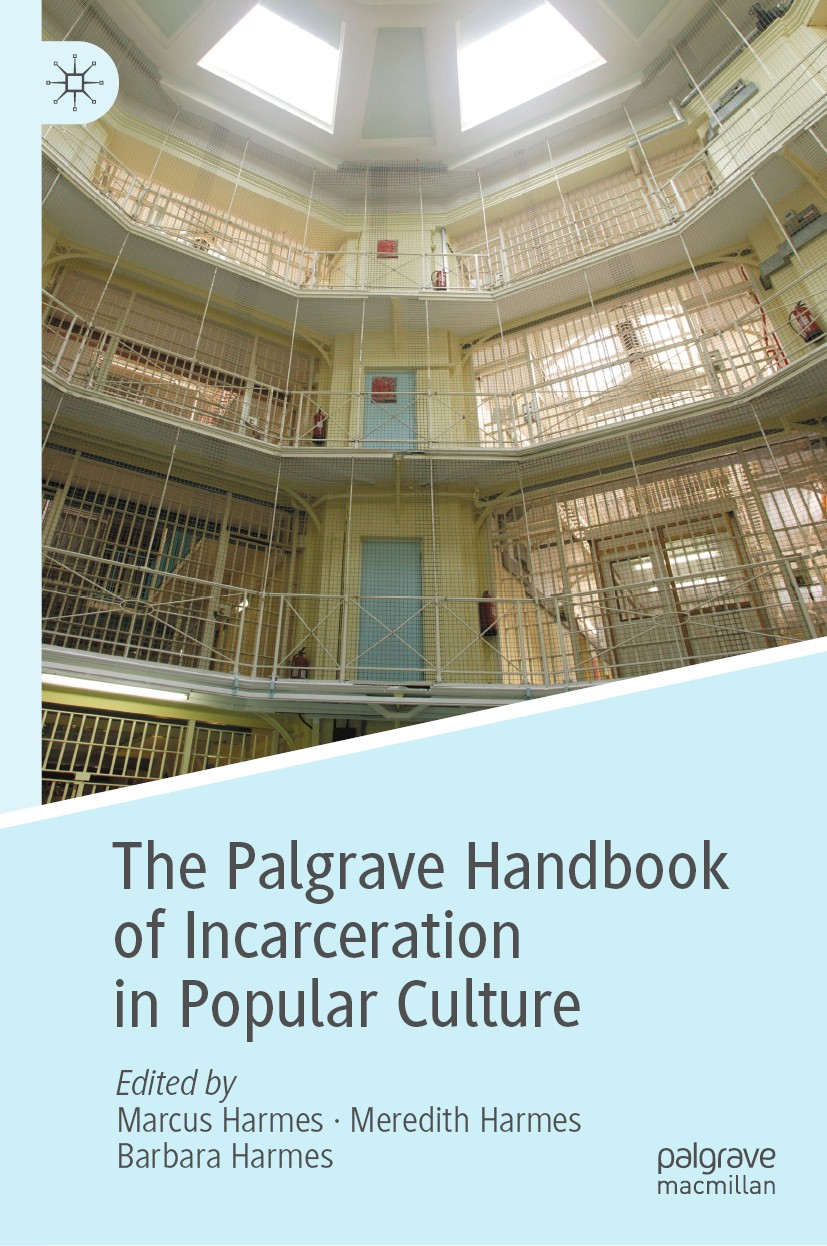
The Palgrave Handbook of Incarceration in Popular Culture [electronic resource] / edited by Marcus Harmes, Meredith Harmes, Barbara Harmes.
Erişim Adresi
ISBN
9783030360597
Dil Kodu
İngilizce
Yer Numarası
EK/3617
Basım Bildirimi
1st ed. 2020.
Yayın Bilgisi
Cham : Springer International Publishing : Imprint: Palgrave Macmillan, 2020.
Fiziksel Niteleme
XXXI, 788 p. 24 illus., 23 illus. in color. online resource.
İçindekiler Notu
Editors’ Introduction -- Preface - Professor Jeffrey Ross, University of Baltimore -- Chapter one: Unlocking Prisons: Toward a Carceral Taxonomy - Associate Professor James Oleson, University of Auckland -- Section One: Prison and prisoner representations -- Chapter two: The 1980s behind Bars: the Punitive System in Prison (1987) and Lock Up (1989) - Fernando Gabriel Pagnoni Berns, Juan Juvé and Mariana Zárate, Universidad de Buenos Aires -- Chapter three: Freeing every Last man of Shawshank: a Reading of Frank Darabont’s The Shawshank Redemption - Debaditya Mukhopadhyay, Manikchak College -- Chapter four: Incarceration as a Dated Badge of Honour: The Sopranos and the Screen Gangster in a Time of Flux - Robert Hensley-King, Ghent University -- Chapter five: ‘So Neglect Becomes Our Ally’: Strategy and Tactics in the Chateau D'If in Kevin Reynolds' The Count of Monte Cristo (2002) - DrKwasu D Tembo, University of Edinburgh -- Chapter six: Prisons on Screen in 1970s Britain - Dr Marcus K Harmes, Meredith A Harmes, Dr Barbara Harmes, University of Southern Queensland -- Chapter seven: Porridge Reheated: Rewriting the Prison Sitcom - Eleanor March, University of Surrey -- Chapter eight: In the Name of the Father: (Re)Framing the Guildford Four - Dr Fran Pheasant-Kelly, University of Wolverhampton, UK -- Chapter nine: ‘You’re in trouble mate’: Prison and Screen Practice - Dr Lewis Fitz-Gerald, University of New England -- Chapter ten: How Does the Design of the Prison in Paddington 2 (2017) Convey Character, Story and Visual Concept? - Jane Barnwell, University of Westminster -- Section Two: Prisoner reactions to representation -- Chapter eleven: Reading Bronson from Deep on the Inside: An Exploration of Prisoners Watching Prison Films - Dr Victoria Knight, De Montfort University, UK and Dr Jamie Bennett, University of Oxford, UK -- Chapter twelve: Voices from the Inside: Prison Podcasts - Dr Dawn K. Cecil, University of South Florida, St. Petersburg -- Chapter thirteen: A Place to Stand: the Importance of Inmate Narratives in Media - Nathan Young, Arizona State University -- Chapter fourteen: Mediated Representations of Prisoner Experience and Public Empathy - Dr Katrina Clifford, Deakin University and Professor Rob White, University of Tasmania -- Section Three: Out of the depths: media creations from inside prison -- Chapter fifteen: Prison on Screen in Italy: From ‘Shame Therapy’ Propaganda to Citizenship Programs - Dr Nicoletta Policek, University of Cumbria, UK -- Chapter sixteen: Make Do and Mend: Images and Realities of Prisoners’ Positive Creativity - Charlotte Bilby, Reader in Criminology, Northumbria University -- Chapter seventeen: ‘O Prison Darkness … Lions in the Cage’; The ‘Peculiar’ Prison Narratives of Guantánamo Bay - Dr Josephine Metcalf, University of Hull -- Chapter eighteen: Ghost Ships in the Sea: Guantánamo Bay Detainee Art and a Torturous Exhibition - Emilee Grunow, University of Minnesota--Twin Cities -- Section Four: Learning from prison: ethics, education, and audiences -- Chapter nineteen: The Lord of the Flies in Palo Alto - Professor James Oleson, Auckland University -- Chapter twenty: Story as ‘Freedom,’ Story as ‘Prison’: Narrative Invention and Human Rights Interventions in Camp 14: Total Control Zone - Professor David Scott Diffrient, Colorado State University -- Chapter twenty-one: An Evaluation of the Effect of Prison Break on Youth Perception of Prison - Dr Okechukwu Chukwuma, Islamic University in Uganda, Kampala Campus and Julius Omokhunu, Edo State, Nigeria -- Section Five: Sensational prisons: incarceration and punishment as reality TV -- Chapter twenty-two: Tacumbú in the News: Non-Sensational Reporting of a Perpetually Unfolding Real-Life Prison Drama - Timothy Revett, New Orleans Baptist Theological Seminary -- Chapter twenty-three: Bad Teens, Smug Hacks & Good TV: The success and legacy of Scared Straight! - Catherine Harrington, Northwestern University, Evanston, IL -- Chapter twenty-four: The Same, but Different: Discourses of Familiarity and Fear in 60 Days In - Dr Faye Davies, Birmingham City University, UK -- Chapter twenty-five: Reality TV: Instilling Fear to Avoid Prison - Dr Erin DiCesare, Johnson C. Smith University -- Chapter twenty-six: The Queen without a Kingdom: Vulnerability, Martyrization, Monolingualism and Injury Towards a Quechua Speaking Woman Imprisoned in Argentina - Dr Sergio Rodríguez-Blanco, Universidad Iberoamericana, Mexico City -- Chapter twenty-seven: Women Behind Bars: Dissecting Social Constructs Mediated by News and Reality TV - Jennifer Thomas, Howard University -- Chapter twenty-eight: Monstrous Celebrity and Train-Wreck Femininity: The Tabloid-isation of Prisons and Prisoners - Dr Susan Hopkins, University of Southern Queensland -- Section Six: Genre and prisons: Black Mirror and beyond -- Chapter twenty-nine: Speculative Punishment, Incarceration, and Control in Black Mirror - Dr David Pierson, University of Southern Maine -- Chapter thirty: Carceral Imaginaries in Science Fiction: Toward a Palimpsestic Understanding of Penality - Kaitlyn Quinn, Department of Sociology, University of Toronto, Erika Canossini, Department of Sociology, University of Toronto Vanessa Evans, Department of English, York University -- Chapter thirty-one: ‘It's more like an eternal waking nightmare from which there is no escape’: Media and Technologies as (Digital) Prison in Black Mirror - Julie Escurignan, University of Roehampton and Dr François Allard-Huver, University of Lorraine -- Chapter thirty-two: Dark Fantasies: The Prisoner and the Futureof Imprisonment - Dr Marcus Harmes, Meredith Harmes, Dr Barbara Harmes, University of Southern Queensland -- Chapter thirty-three: Minority Report, Abjection and Surveillance: Futuristic Control in the Scientific Imaginary - Dr Fran Pheasant-Kelly, University of Wolverhampton, UK -- Chapter thirty-four: Moral Ambivalence and the Executioner’s Hood – Averting the Retributive Gaze in Dystopian Fiction - Dr Francine Rochford, La Trobe University, Australia -- Section Seven: Creative and commercial transformations: dark tourism in dark places -- Chapter thirty-five: Dark Tours: Prison Museums and Hotels - Associate Professor James Oleson, Auckland University -- Chapter thirty-six: ‘Pack of thieves?’: The visual representation of prisoners in dark tourist sites - Dr Jenny Wise and Dr Lesley McLean, University of New England, Australia -- Chapter thirty-seven: The Legend of Madman’s Hill: Incarceration, Madness and Dark Tourism on the Goldfields - Dr David Waldron, Federation University Australia -- Chapter thirty-eight: Three Related Danish Narratives: the Film ‘R’, the Penal Museum at Horsens and the Replacement Prison of East Jutland - Dr Jack Dyce -- Chapter thirty-nine: ‘Ulucanlar from Prison to Museum: Struggle on Memory and the Future in Turkey’ - Dr Mine Gencel Bek, University of Siegen -- Section Eight: Orange is the New Black: race and gender in a television phenomenon -- Chapter forty: Introduction to Imprisonment by the ‘Nice White Lady’: Piper Chapman as the Ideal Racialised and Classed Neoliberal Subject - Kate Meakin, University of Sussex -- Chapter forty-one: Can Prison be a Feminist Space?: Interrogating Television Representations of Women’s Prisons - Jessica Ford, University of New South Wales, Australia -- Chapter forty-two: Advocating Prisoners’ Human Rights: A Textual Analysis of Orange is the New Black - Dr Alina Thiemann, Institute of Sociology, the RomanianAcademy -- Chapter forty-three: Is Yellow the New Orange? Vis a Vis: The Transnational Phenomenon of Female Prison Dramas and the Rise of Spanish Television - Julia Echeverría, University of Zaragoza, Spain -- Section Nine: Varieties of incarceration: from Wentworth to Bitch Planet -- Chapter forty-four: Wentworth and the Politics and Aesthetics of Representing Female Embodiment in Prison - Cornelia Wächter, Ruhr University Bochum, Germany -- Chapter forty-five: From the Stony Ground Up: the Unique Affordances of the Gaol as ‘Hub’ for Transgressive Female Representations in Women-in-Prison Dramas - Stayci Taylor (RMIT University, Melbourne), Craig Batty (University of Technology, Sydney), Tessa Dwyer (Monash University, Melbourne), Radha O’Meara (University of Melbourne) -- Chapter forty-six: ‘Are You Woman Enough to Survive?’: Bitch Planet’s Collaborative Critique of the Neo-Liberal Prison-Industrial Complex - Dr Martin Zeller-Jacques, Queen Margaret University -- Chapter forty-seven: The Pleasure Politics of Prison Erotica - Dr Nicoletta Policek, University of Cumbria, UK -- Chapter forty-eight: Let’s Have Redemption! Women, Religion and Sexploitation on Screen - Dr Marcus Harmes, Meredith Harmes, Dr Barbara Harmes, University of Southern Queensland -- Section Ten: Exploitation and racialization in prison: film, memoirs and music -- Chapter forty-nine: Screening Fear and Anxiety: African American Incarceration and the Dawning of the Prison-Industrial Complex - Assistant Professor Keith Corson, University of Central Arkansas -- Chapter fifty: ‘If These Walls Could Talk’: The Prison Motif in the Work of Kendrick Lamar - Chelsea Roden, Universität Heidelberg, Germany -- Chapter fifty-one: How Race and Criminality Interface Through Memoir, Drawing & Film: an Investigation of Austin Reed, Frank Jones Jamaa Fanaka - Ravi Shankar, University of Sydney, Australia.
Özet, vb.
The Handbook of Incarceration in Popular Culture will be an essential reference point, providing international coverage and thematic richness. The chapters examine the real and imagined spaces of the prison and, perhaps more importantly, dwell in the uncertain space between them. The modern fixation with ‘seeing inside’ prison from the outside has prompted a proliferation of media visions of incarceration, from high-minded and worthy to voyeuristic and unrealistic. In this handbook, the editors bring together a huge breadth of disparate issues including women in prison, the view from ‘inside’, prisons as a source of entertainment, the real worlds of prison, and issues of race and gender. The handbook will inform students and lecturers of media, film, popular culture, gender, and cultural studies, as well as scholars of criminology and justice.
Konu
Popular Culture.
Mass media and crime.
Motion pictures.
Television broadcasting.
Corrections.
Punishment.
Popular Culture.
Crime and the Media.
Film and Television Studies.
Prison and Punishment.
Mass media and crime.
Motion pictures.
Television broadcasting.
Corrections.
Punishment.
Popular Culture.
Crime and the Media.
Film and Television Studies.
Prison and Punishment.
Diğer Yazarlar
Kurum Adı
Eseri Alıntıla
Referansları kullanmadan önce gözden geçirmeniz ve varsa gerekli düzeltmeleri yapmanız önerilir.
Dijital Kaynak
MARC Görünümü
LEADER 13700nam a22006855i 4500
001 840332
003 TR_AnAIT
005 20260715040918
007 cr nn 008mamaa
008 200203s2020 sz | s |||| 0|eng d
020 |a9783030360597|9978-3-030-36059-7
024 7 |a10.1007/978-3-030-36059-7|2doi
041 |aeng
049 |aTürk Dil Kurumu Kütüphanesi
050 4|aHM621-656
072 7|aJFCA|2bicssc
072 7|aSOC022000|2bisacsh
072 7|aJBCC1|2thema
082 04|a306|223
090 |aEK/3617
245 14|aThe Palgrave Handbook of Incarceration in Popular Culture|h[electronic resource] /|cedited by Marcus Harmes, Meredith Harmes, Barbara Harmes.
250 |a1st ed. 2020.
264 1|aCham :|bSpringer International Publishing :|bImprint: Palgrave Macmillan,|c2020.
300 |aXXXI, 788 p. 24 illus., 23 illus. in color.|bonline resource.
336 |atext|btxt|2rdacontent
337 |acomputer|bc|2rdamedia
338 |aonline resource|bcr|2rdacarrier
341 0 |bTable of contents navigation|2onix
341 0 |bSingle logical reading order|2onix
341 0 |bShort alternative textual descriptions|2onix
341 0 |bUse of color is not sole means of conveying information|2onix
341 0 |bUse of high contrast between text and background color|2onix
341 0 |bNext / Previous structural navigation|2onix
341 0 |bAll non-decorative content supports reading without sight|2onix
347 |atext file|bPDF|2rda
505 0 |aEditors’ Introduction -- Preface - Professor Jeffrey Ross, University of Baltimore -- Chapter one: Unlocking Prisons: Toward a Carceral Taxonomy - Associate Professor James Oleson, University of Auckland -- Section One: Prison and prisoner representations -- Chapter two: The 1980s behind Bars: the Punitive System in Prison (1987) and Lock Up (1989) - Fernando Gabriel Pagnoni Berns, Juan Juvé and Mariana Zárate, Universidad de Buenos Aires -- Chapter three: Freeing every Last man of Shawshank: a Reading of Frank Darabont’s The Shawshank Redemption - Debaditya Mukhopadhyay, Manikchak College -- Chapter four: Incarceration as a Dated Badge of Honour: The Sopranos and the Screen Gangster in a Time of Flux - Robert Hensley-King, Ghent University -- Chapter five: ‘So Neglect Becomes Our Ally’: Strategy and Tactics in the Chateau D'If in Kevin Reynolds' The Count of Monte Cristo (2002) - DrKwasu D Tembo, University of Edinburgh -- Chapter six: Prisons on Screen in 1970s Britain - Dr Marcus K Harmes, Meredith A Harmes, Dr Barbara Harmes, University of Southern Queensland -- Chapter seven: Porridge Reheated: Rewriting the Prison Sitcom - Eleanor March, University of Surrey -- Chapter eight: In the Name of the Father: (Re)Framing the Guildford Four - Dr Fran Pheasant-Kelly, University of Wolverhampton, UK -- Chapter nine: ‘You’re in trouble mate’: Prison and Screen Practice - Dr Lewis Fitz-Gerald, University of New England -- Chapter ten: How Does the Design of the Prison in Paddington 2 (2017) Convey Character, Story and Visual Concept? - Jane Barnwell, University of Westminster -- Section Two: Prisoner reactions to representation -- Chapter eleven: Reading Bronson from Deep on the Inside: An Exploration of Prisoners Watching Prison Films - Dr Victoria Knight, De Montfort University, UK and Dr Jamie Bennett, University of Oxford, UK -- Chapter twelve: Voices from the Inside: Prison Podcasts - Dr Dawn K. Cecil, University of South Florida, St. Petersburg -- Chapter thirteen: A Place to Stand: the Importance of Inmate Narratives in Media - Nathan Young, Arizona State University -- Chapter fourteen: Mediated Representations of Prisoner Experience and Public Empathy - Dr Katrina Clifford, Deakin University and Professor Rob White, University of Tasmania -- Section Three: Out of the depths: media creations from inside prison -- Chapter fifteen: Prison on Screen in Italy: From ‘Shame Therapy’ Propaganda to Citizenship Programs - Dr Nicoletta Policek, University of Cumbria, UK -- Chapter sixteen: Make Do and Mend: Images and Realities of Prisoners’ Positive Creativity - Charlotte Bilby, Reader in Criminology, Northumbria University -- Chapter seventeen: ‘O Prison Darkness … Lions in the Cage’; The ‘Peculiar’ Prison Narratives of Guantánamo Bay - Dr Josephine Metcalf, University of Hull -- Chapter eighteen: Ghost Ships in the Sea: Guantánamo Bay Detainee Art and a Torturous Exhibition - Emilee Grunow, University of Minnesota--Twin Cities -- Section Four: Learning from prison: ethics, education, and audiences -- Chapter nineteen: The Lord of the Flies in Palo Alto - Professor James Oleson, Auckland University -- Chapter twenty: Story as ‘Freedom,’ Story as ‘Prison’: Narrative Invention and Human Rights Interventions in Camp 14: Total Control Zone - Professor David Scott Diffrient, Colorado State University -- Chapter twenty-one: An Evaluation of the Effect of Prison Break on Youth Perception of Prison - Dr Okechukwu Chukwuma, Islamic University in Uganda, Kampala Campus and Julius Omokhunu, Edo State, Nigeria -- Section Five: Sensational prisons: incarceration and punishment as reality TV -- Chapter twenty-two: Tacumbú in the News: Non-Sensational Reporting of a Perpetually Unfolding Real-Life Prison Drama - Timothy Revett, New Orleans Baptist Theological Seminary -- Chapter twenty-three: Bad Teens, Smug Hacks & Good TV: The success and legacy of Scared Straight! - Catherine Harrington, Northwestern University, Evanston, IL -- Chapter twenty-four: The Same, but Different: Discourses of Familiarity and Fear in 60 Days In - Dr Faye Davies, Birmingham City University, UK -- Chapter twenty-five: Reality TV: Instilling Fear to Avoid Prison - Dr Erin DiCesare, Johnson C. Smith University -- Chapter twenty-six: The Queen without a Kingdom: Vulnerability, Martyrization, Monolingualism and Injury Towards a Quechua Speaking Woman Imprisoned in Argentina - Dr Sergio Rodríguez-Blanco, Universidad Iberoamericana, Mexico City -- Chapter twenty-seven: Women Behind Bars: Dissecting Social Constructs Mediated by News and Reality TV - Jennifer Thomas, Howard University -- Chapter twenty-eight: Monstrous Celebrity and Train-Wreck Femininity: The Tabloid-isation of Prisons and Prisoners - Dr Susan Hopkins, University of Southern Queensland -- Section Six: Genre and prisons: Black Mirror and beyond -- Chapter twenty-nine: Speculative Punishment, Incarceration, and Control in Black Mirror - Dr David Pierson, University of Southern Maine -- Chapter thirty: Carceral Imaginaries in Science Fiction: Toward a Palimpsestic Understanding of Penality - Kaitlyn Quinn, Department of Sociology, University of Toronto, Erika Canossini, Department of Sociology, University of Toronto Vanessa Evans, Department of English, York University -- Chapter thirty-one: ‘It's more like an eternal waking nightmare from which there is no escape’: Media and Technologies as (Digital) Prison in Black Mirror - Julie Escurignan, University of Roehampton and Dr François Allard-Huver, University of Lorraine -- Chapter thirty-two: Dark Fantasies: The Prisoner and the Futureof Imprisonment - Dr Marcus Harmes, Meredith Harmes, Dr Barbara Harmes, University of Southern Queensland -- Chapter thirty-three: Minority Report, Abjection and Surveillance: Futuristic Control in the Scientific Imaginary - Dr Fran Pheasant-Kelly, University of Wolverhampton, UK -- Chapter thirty-four: Moral Ambivalence and the Executioner’s Hood – Averting the Retributive Gaze in Dystopian Fiction - Dr Francine Rochford, La Trobe University, Australia -- Section Seven: Creative and commercial transformations: dark tourism in dark places -- Chapter thirty-five: Dark Tours: Prison Museums and Hotels - Associate Professor James Oleson, Auckland University -- Chapter thirty-six: ‘Pack of thieves?’: The visual representation of prisoners in dark tourist sites - Dr Jenny Wise and Dr Lesley McLean, University of New England, Australia -- Chapter thirty-seven: The Legend of Madman’s Hill: Incarceration, Madness and Dark Tourism on the Goldfields - Dr David Waldron, Federation University Australia -- Chapter thirty-eight: Three Related Danish Narratives: the Film ‘R’, the Penal Museum at Horsens and the Replacement Prison of East Jutland - Dr Jack Dyce -- Chapter thirty-nine: ‘Ulucanlar from Prison to Museum: Struggle on Memory and the Future in Turkey’ - Dr Mine Gencel Bek, University of Siegen -- Section Eight: Orange is the New Black: race and gender in a television phenomenon -- Chapter forty: Introduction to Imprisonment by the ‘Nice White Lady’: Piper Chapman as the Ideal Racialised and Classed Neoliberal Subject - Kate Meakin, University of Sussex -- Chapter forty-one: Can Prison be a Feminist Space?: Interrogating Television Representations of Women’s Prisons - Jessica Ford, University of New South Wales, Australia -- Chapter forty-two: Advocating Prisoners’ Human Rights: A Textual Analysis of Orange is the New Black - Dr Alina Thiemann, Institute of Sociology, the RomanianAcademy -- Chapter forty-three: Is Yellow the New Orange? Vis a Vis: The Transnational Phenomenon of Female Prison Dramas and the Rise of Spanish Television - Julia Echeverría, University of Zaragoza, Spain -- Section Nine: Varieties of incarceration: from Wentworth to Bitch Planet -- Chapter forty-four: Wentworth and the Politics and Aesthetics of Representing Female Embodiment in Prison - Cornelia Wächter, Ruhr University Bochum, Germany -- Chapter forty-five: From the Stony Ground Up: the Unique Affordances of the Gaol as ‘Hub’ for Transgressive Female Representations in Women-in-Prison Dramas - Stayci Taylor (RMIT University, Melbourne), Craig Batty (University of Technology, Sydney), Tessa Dwyer (Monash University, Melbourne), Radha O’Meara (University of Melbourne) -- Chapter forty-six: ‘Are You Woman Enough to Survive?’: Bitch Planet’s Collaborative Critique of the Neo-Liberal Prison-Industrial Complex - Dr Martin Zeller-Jacques, Queen Margaret University -- Chapter forty-seven: The Pleasure Politics of Prison Erotica - Dr Nicoletta Policek, University of Cumbria, UK -- Chapter forty-eight: Let’s Have Redemption! Women, Religion and Sexploitation on Screen - Dr Marcus Harmes, Meredith Harmes, Dr Barbara Harmes, University of Southern Queensland -- Section Ten: Exploitation and racialization in prison: film, memoirs and music -- Chapter forty-nine: Screening Fear and Anxiety: African American Incarceration and the Dawning of the Prison-Industrial Complex - Assistant Professor Keith Corson, University of Central Arkansas -- Chapter fifty: ‘If These Walls Could Talk’: The Prison Motif in the Work of Kendrick Lamar - Chelsea Roden, Universität Heidelberg, Germany -- Chapter fifty-one: How Race and Criminality Interface Through Memoir, Drawing & Film: an Investigation of Austin Reed, Frank Jones Jamaa Fanaka - Ravi Shankar, University of Sydney, Australia.
520 |aThe Handbook of Incarceration in Popular Culture will be an essential reference point, providing international coverage and thematic richness. The chapters examine the real and imagined spaces of the prison and, perhaps more importantly, dwell in the uncertain space between them. The modern fixation with ‘seeing inside’ prison from the outside has prompted a proliferation of media visions of incarceration, from high-minded and worthy to voyeuristic and unrealistic. In this handbook, the editors bring together a huge breadth of disparate issues including women in prison, the view from ‘inside’, prisons as a source of entertainment, the real worlds of prison, and issues of race and gender. The handbook will inform students and lecturers of media, film, popular culture, gender, and cultural studies, as well as scholars of criminology and justice.
532 8 |aAccessibility summary: This PDF does not fully comply with PDF/UA standards, but does feature limited screen reader support, described non-text content (images, graphs), bookmarks for easy navigation and searchable, selectable text. Users of assistive technologies may experience difficulty navigating or interpreting content in this document. We recognize the importance of accessibility, and we welcome queries about accessibility for any of our products. If you have a question or an access need, please get in touch with us at accessibilitysupport@springernature.com.
532 8 |aNo reading system accessibility options actively disabled
532 8 |aPublisher contact for further accessibility information: accessibilitysupport@springernature.com
650 0|aPopular Culture.
650 0|aMass media and crime.
650 0|aMotion pictures.
650 0|aTelevision broadcasting.
650 0|aCorrections.
650 0|aPunishment.
650 14|aPopular Culture.
650 24|aCrime and the Media.
650 24|aFilm and Television Studies.
650 24|aPrison and Punishment.
700 1 |aHarmes, Marcus.|eeditor.|4edt|4http://id.loc.gov/vocabulary/relators/edt
700 1 |aHarmes, Meredith.|eeditor.|4edt|4http://id.loc.gov/vocabulary/relators/edt
700 1 |aHarmes, Barbara.|eeditor.|4edt|4http://id.loc.gov/vocabulary/relators/edt
710 2 |aSpringerLink (Online service)
773 0 |tSpringer Nature eBook
776 08|iPrinted edition:|z9783030360580
776 08|iPrinted edition:|z9783030360603
776 08|iPrinted edition:|z9783030360610
856 40|uhttps://doi.org/10.1007/978-3-030-36059-7
912 |aZDB-2-LCM
912 |aZDB-2-SXL
950 |aLiterature, Cultural and Media Studies (SpringerNature-41173)
950 |aLiterature, Cultural and Media Studies (R0) (SpringerNature-43723)
001 840332
003 TR_AnAIT
005 20260715040918
007 cr nn 008mamaa
008 200203s2020 sz | s |||| 0|eng d
020 |a9783030360597|9978-3-030-36059-7
024 7 |a10.1007/978-3-030-36059-7|2doi
041 |aeng
049 |aTürk Dil Kurumu Kütüphanesi
050 4|aHM621-656
072 7|aJFCA|2bicssc
072 7|aSOC022000|2bisacsh
072 7|aJBCC1|2thema
082 04|a306|223
090 |aEK/3617
245 14|aThe Palgrave Handbook of Incarceration in Popular Culture|h[electronic resource] /|cedited by Marcus Harmes, Meredith Harmes, Barbara Harmes.
250 |a1st ed. 2020.
264 1|aCham :|bSpringer International Publishing :|bImprint: Palgrave Macmillan,|c2020.
300 |aXXXI, 788 p. 24 illus., 23 illus. in color.|bonline resource.
336 |atext|btxt|2rdacontent
337 |acomputer|bc|2rdamedia
338 |aonline resource|bcr|2rdacarrier
341 0 |bTable of contents navigation|2onix
341 0 |bSingle logical reading order|2onix
341 0 |bShort alternative textual descriptions|2onix
341 0 |bUse of color is not sole means of conveying information|2onix
341 0 |bUse of high contrast between text and background color|2onix
341 0 |bNext / Previous structural navigation|2onix
341 0 |bAll non-decorative content supports reading without sight|2onix
347 |atext file|bPDF|2rda
505 0 |aEditors’ Introduction -- Preface - Professor Jeffrey Ross, University of Baltimore -- Chapter one: Unlocking Prisons: Toward a Carceral Taxonomy - Associate Professor James Oleson, University of Auckland -- Section One: Prison and prisoner representations -- Chapter two: The 1980s behind Bars: the Punitive System in Prison (1987) and Lock Up (1989) - Fernando Gabriel Pagnoni Berns, Juan Juvé and Mariana Zárate, Universidad de Buenos Aires -- Chapter three: Freeing every Last man of Shawshank: a Reading of Frank Darabont’s The Shawshank Redemption - Debaditya Mukhopadhyay, Manikchak College -- Chapter four: Incarceration as a Dated Badge of Honour: The Sopranos and the Screen Gangster in a Time of Flux - Robert Hensley-King, Ghent University -- Chapter five: ‘So Neglect Becomes Our Ally’: Strategy and Tactics in the Chateau D'If in Kevin Reynolds' The Count of Monte Cristo (2002) - DrKwasu D Tembo, University of Edinburgh -- Chapter six: Prisons on Screen in 1970s Britain - Dr Marcus K Harmes, Meredith A Harmes, Dr Barbara Harmes, University of Southern Queensland -- Chapter seven: Porridge Reheated: Rewriting the Prison Sitcom - Eleanor March, University of Surrey -- Chapter eight: In the Name of the Father: (Re)Framing the Guildford Four - Dr Fran Pheasant-Kelly, University of Wolverhampton, UK -- Chapter nine: ‘You’re in trouble mate’: Prison and Screen Practice - Dr Lewis Fitz-Gerald, University of New England -- Chapter ten: How Does the Design of the Prison in Paddington 2 (2017) Convey Character, Story and Visual Concept? - Jane Barnwell, University of Westminster -- Section Two: Prisoner reactions to representation -- Chapter eleven: Reading Bronson from Deep on the Inside: An Exploration of Prisoners Watching Prison Films - Dr Victoria Knight, De Montfort University, UK and Dr Jamie Bennett, University of Oxford, UK -- Chapter twelve: Voices from the Inside: Prison Podcasts - Dr Dawn K. Cecil, University of South Florida, St. Petersburg -- Chapter thirteen: A Place to Stand: the Importance of Inmate Narratives in Media - Nathan Young, Arizona State University -- Chapter fourteen: Mediated Representations of Prisoner Experience and Public Empathy - Dr Katrina Clifford, Deakin University and Professor Rob White, University of Tasmania -- Section Three: Out of the depths: media creations from inside prison -- Chapter fifteen: Prison on Screen in Italy: From ‘Shame Therapy’ Propaganda to Citizenship Programs - Dr Nicoletta Policek, University of Cumbria, UK -- Chapter sixteen: Make Do and Mend: Images and Realities of Prisoners’ Positive Creativity - Charlotte Bilby, Reader in Criminology, Northumbria University -- Chapter seventeen: ‘O Prison Darkness … Lions in the Cage’; The ‘Peculiar’ Prison Narratives of Guantánamo Bay - Dr Josephine Metcalf, University of Hull -- Chapter eighteen: Ghost Ships in the Sea: Guantánamo Bay Detainee Art and a Torturous Exhibition - Emilee Grunow, University of Minnesota--Twin Cities -- Section Four: Learning from prison: ethics, education, and audiences -- Chapter nineteen: The Lord of the Flies in Palo Alto - Professor James Oleson, Auckland University -- Chapter twenty: Story as ‘Freedom,’ Story as ‘Prison’: Narrative Invention and Human Rights Interventions in Camp 14: Total Control Zone - Professor David Scott Diffrient, Colorado State University -- Chapter twenty-one: An Evaluation of the Effect of Prison Break on Youth Perception of Prison - Dr Okechukwu Chukwuma, Islamic University in Uganda, Kampala Campus and Julius Omokhunu, Edo State, Nigeria -- Section Five: Sensational prisons: incarceration and punishment as reality TV -- Chapter twenty-two: Tacumbú in the News: Non-Sensational Reporting of a Perpetually Unfolding Real-Life Prison Drama - Timothy Revett, New Orleans Baptist Theological Seminary -- Chapter twenty-three: Bad Teens, Smug Hacks & Good TV: The success and legacy of Scared Straight! - Catherine Harrington, Northwestern University, Evanston, IL -- Chapter twenty-four: The Same, but Different: Discourses of Familiarity and Fear in 60 Days In - Dr Faye Davies, Birmingham City University, UK -- Chapter twenty-five: Reality TV: Instilling Fear to Avoid Prison - Dr Erin DiCesare, Johnson C. Smith University -- Chapter twenty-six: The Queen without a Kingdom: Vulnerability, Martyrization, Monolingualism and Injury Towards a Quechua Speaking Woman Imprisoned in Argentina - Dr Sergio Rodríguez-Blanco, Universidad Iberoamericana, Mexico City -- Chapter twenty-seven: Women Behind Bars: Dissecting Social Constructs Mediated by News and Reality TV - Jennifer Thomas, Howard University -- Chapter twenty-eight: Monstrous Celebrity and Train-Wreck Femininity: The Tabloid-isation of Prisons and Prisoners - Dr Susan Hopkins, University of Southern Queensland -- Section Six: Genre and prisons: Black Mirror and beyond -- Chapter twenty-nine: Speculative Punishment, Incarceration, and Control in Black Mirror - Dr David Pierson, University of Southern Maine -- Chapter thirty: Carceral Imaginaries in Science Fiction: Toward a Palimpsestic Understanding of Penality - Kaitlyn Quinn, Department of Sociology, University of Toronto, Erika Canossini, Department of Sociology, University of Toronto Vanessa Evans, Department of English, York University -- Chapter thirty-one: ‘It's more like an eternal waking nightmare from which there is no escape’: Media and Technologies as (Digital) Prison in Black Mirror - Julie Escurignan, University of Roehampton and Dr François Allard-Huver, University of Lorraine -- Chapter thirty-two: Dark Fantasies: The Prisoner and the Futureof Imprisonment - Dr Marcus Harmes, Meredith Harmes, Dr Barbara Harmes, University of Southern Queensland -- Chapter thirty-three: Minority Report, Abjection and Surveillance: Futuristic Control in the Scientific Imaginary - Dr Fran Pheasant-Kelly, University of Wolverhampton, UK -- Chapter thirty-four: Moral Ambivalence and the Executioner’s Hood – Averting the Retributive Gaze in Dystopian Fiction - Dr Francine Rochford, La Trobe University, Australia -- Section Seven: Creative and commercial transformations: dark tourism in dark places -- Chapter thirty-five: Dark Tours: Prison Museums and Hotels - Associate Professor James Oleson, Auckland University -- Chapter thirty-six: ‘Pack of thieves?’: The visual representation of prisoners in dark tourist sites - Dr Jenny Wise and Dr Lesley McLean, University of New England, Australia -- Chapter thirty-seven: The Legend of Madman’s Hill: Incarceration, Madness and Dark Tourism on the Goldfields - Dr David Waldron, Federation University Australia -- Chapter thirty-eight: Three Related Danish Narratives: the Film ‘R’, the Penal Museum at Horsens and the Replacement Prison of East Jutland - Dr Jack Dyce -- Chapter thirty-nine: ‘Ulucanlar from Prison to Museum: Struggle on Memory and the Future in Turkey’ - Dr Mine Gencel Bek, University of Siegen -- Section Eight: Orange is the New Black: race and gender in a television phenomenon -- Chapter forty: Introduction to Imprisonment by the ‘Nice White Lady’: Piper Chapman as the Ideal Racialised and Classed Neoliberal Subject - Kate Meakin, University of Sussex -- Chapter forty-one: Can Prison be a Feminist Space?: Interrogating Television Representations of Women’s Prisons - Jessica Ford, University of New South Wales, Australia -- Chapter forty-two: Advocating Prisoners’ Human Rights: A Textual Analysis of Orange is the New Black - Dr Alina Thiemann, Institute of Sociology, the RomanianAcademy -- Chapter forty-three: Is Yellow the New Orange? Vis a Vis: The Transnational Phenomenon of Female Prison Dramas and the Rise of Spanish Television - Julia Echeverría, University of Zaragoza, Spain -- Section Nine: Varieties of incarceration: from Wentworth to Bitch Planet -- Chapter forty-four: Wentworth and the Politics and Aesthetics of Representing Female Embodiment in Prison - Cornelia Wächter, Ruhr University Bochum, Germany -- Chapter forty-five: From the Stony Ground Up: the Unique Affordances of the Gaol as ‘Hub’ for Transgressive Female Representations in Women-in-Prison Dramas - Stayci Taylor (RMIT University, Melbourne), Craig Batty (University of Technology, Sydney), Tessa Dwyer (Monash University, Melbourne), Radha O’Meara (University of Melbourne) -- Chapter forty-six: ‘Are You Woman Enough to Survive?’: Bitch Planet’s Collaborative Critique of the Neo-Liberal Prison-Industrial Complex - Dr Martin Zeller-Jacques, Queen Margaret University -- Chapter forty-seven: The Pleasure Politics of Prison Erotica - Dr Nicoletta Policek, University of Cumbria, UK -- Chapter forty-eight: Let’s Have Redemption! Women, Religion and Sexploitation on Screen - Dr Marcus Harmes, Meredith Harmes, Dr Barbara Harmes, University of Southern Queensland -- Section Ten: Exploitation and racialization in prison: film, memoirs and music -- Chapter forty-nine: Screening Fear and Anxiety: African American Incarceration and the Dawning of the Prison-Industrial Complex - Assistant Professor Keith Corson, University of Central Arkansas -- Chapter fifty: ‘If These Walls Could Talk’: The Prison Motif in the Work of Kendrick Lamar - Chelsea Roden, Universität Heidelberg, Germany -- Chapter fifty-one: How Race and Criminality Interface Through Memoir, Drawing & Film: an Investigation of Austin Reed, Frank Jones Jamaa Fanaka - Ravi Shankar, University of Sydney, Australia.
520 |aThe Handbook of Incarceration in Popular Culture will be an essential reference point, providing international coverage and thematic richness. The chapters examine the real and imagined spaces of the prison and, perhaps more importantly, dwell in the uncertain space between them. The modern fixation with ‘seeing inside’ prison from the outside has prompted a proliferation of media visions of incarceration, from high-minded and worthy to voyeuristic and unrealistic. In this handbook, the editors bring together a huge breadth of disparate issues including women in prison, the view from ‘inside’, prisons as a source of entertainment, the real worlds of prison, and issues of race and gender. The handbook will inform students and lecturers of media, film, popular culture, gender, and cultural studies, as well as scholars of criminology and justice.
532 8 |aAccessibility summary: This PDF does not fully comply with PDF/UA standards, but does feature limited screen reader support, described non-text content (images, graphs), bookmarks for easy navigation and searchable, selectable text. Users of assistive technologies may experience difficulty navigating or interpreting content in this document. We recognize the importance of accessibility, and we welcome queries about accessibility for any of our products. If you have a question or an access need, please get in touch with us at accessibilitysupport@springernature.com.
532 8 |aNo reading system accessibility options actively disabled
532 8 |aPublisher contact for further accessibility information: accessibilitysupport@springernature.com
650 0|aPopular Culture.
650 0|aMass media and crime.
650 0|aMotion pictures.
650 0|aTelevision broadcasting.
650 0|aCorrections.
650 0|aPunishment.
650 14|aPopular Culture.
650 24|aCrime and the Media.
650 24|aFilm and Television Studies.
650 24|aPrison and Punishment.
700 1 |aHarmes, Marcus.|eeditor.|4edt|4http://id.loc.gov/vocabulary/relators/edt
700 1 |aHarmes, Meredith.|eeditor.|4edt|4http://id.loc.gov/vocabulary/relators/edt
700 1 |aHarmes, Barbara.|eeditor.|4edt|4http://id.loc.gov/vocabulary/relators/edt
710 2 |aSpringerLink (Online service)
773 0 |tSpringer Nature eBook
776 08|iPrinted edition:|z9783030360580
776 08|iPrinted edition:|z9783030360603
776 08|iPrinted edition:|z9783030360610
856 40|uhttps://doi.org/10.1007/978-3-030-36059-7
912 |aZDB-2-LCM
912 |aZDB-2-SXL
950 |aLiterature, Cultural and Media Studies (SpringerNature-41173)
950 |aLiterature, Cultural and Media Studies (R0) (SpringerNature-43723)
Materyaller
Depodan talep edilen materyal sadece kütüphane içerisinde kullanılmaktadır.
Materyal dışarıya ödünç verilmemektedir.
Materyal dışarıya ödünç verilmemektedir.
