

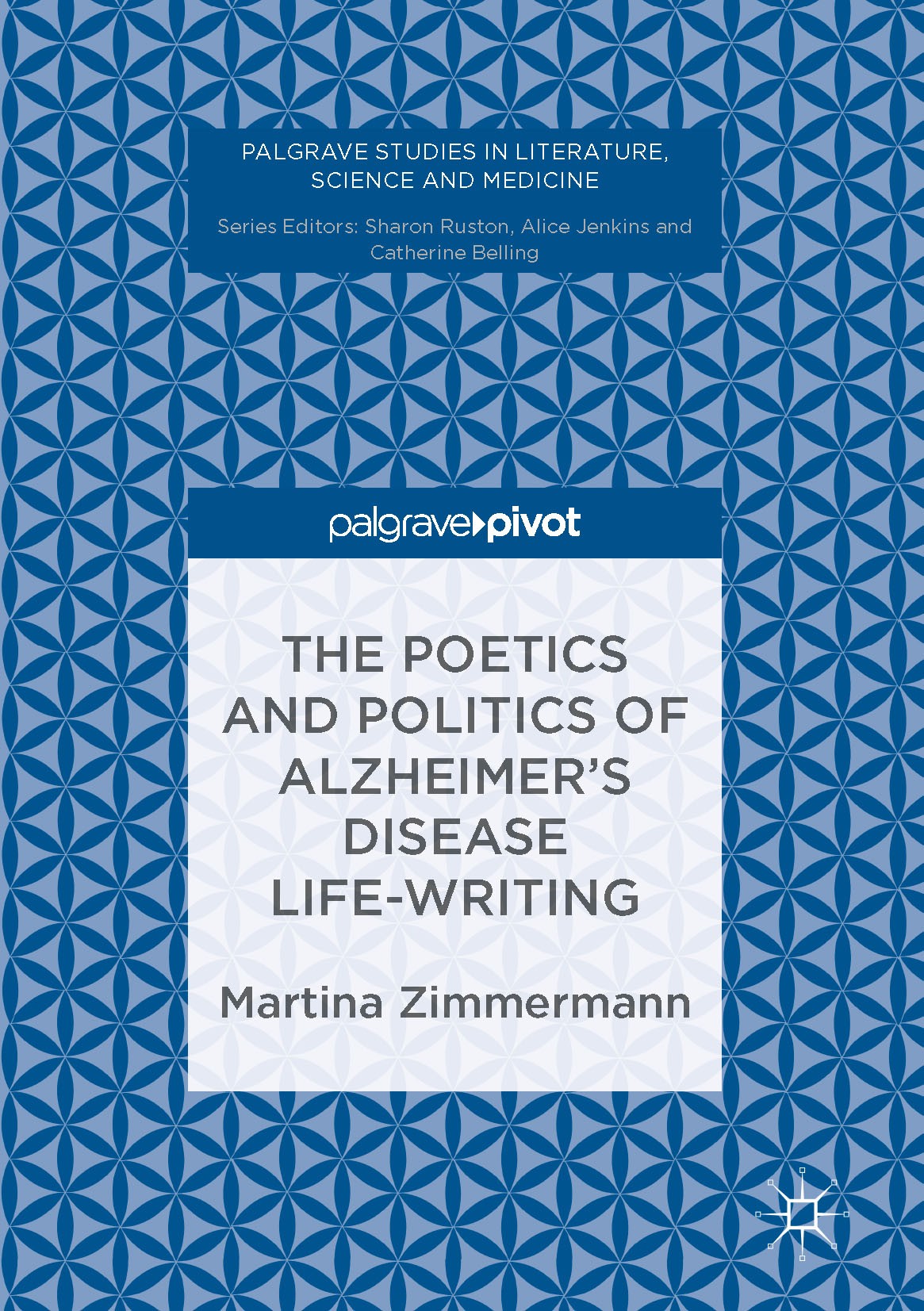
The Poetics and Politics of Alzheimer’s Disease Life-Writing [electronic resource] / by Martina Zimmermann.
Erişim Adresi
ISBN
9783319443881
Dil Kodu
İngilizce
Yer Numarası
EK/3812
Yazar
Basım Bildirimi
1st ed. 2017.
Yayın Bilgisi
Cham : Springer International Publishing : Imprint: Palgrave Macmillan, 2017.
Fiziksel Niteleme
VIII, 167 p. online resource.
Dizi
Palgrave Studies in Literature, Science and Medicine, 2634-6443
İçindekiler Notu
Introduction: Critically Reading Dementia Narratives: Amplifying Advocacy -- Chapter 1: Of Wives and Daughters: The Stereotype of Caring Females? -- Chapter 2: From a “Care-Free” Distance: Sons Talking About Cultural Concepts -- Chapter 3: About Tradition and Triumph: Patients Popularise Dementia Narrative -- Chapter 4: On Reclaiming Authority: The Enabling Discourse of Alzheimer’s Disease -- Conclusion: Dementia Narratives – Shifter of Perspectives and Values -- Bibliography -- Works Cited -- Index.
Özet, vb.
This book is open access under a CC BY 4.0 license. 'Despite the recent spate of books about Alzheimer’s disease by doctors, patients, and caregivers, no other writer to my knowledge has attempted to do what the humanities scholar and research scientist Martina Zimmermann has accomplished here: an analysis of dementia narratives attuned to the medical, political, sociological, ethical, and poetic aspects—that is, the full human experience—of living with inexorable, unforgiving cognitive decline.' - Eileen Gillooly, Columbia University, USA ‘This very fine study reflects capacious knowledge and insight into a condition that, as the author suggests, is one of the most complex and fraught for patients and caregivers, and one of the most misunderstood by policy makers. The Poetics and Politics of Alzheimer’s Disease Life-Writing offers an important intervention at a critical time, and deserves to meet with awide readership.’ - Jane F. Thrailkill, University of North Carolina, USA This is the first book-length exploration of the thoughts and experiences expressed by dementia patients in published narratives over the last thirty years. It contrasts third-person caregiver and first-person patient accounts from different languages and a range of media, focusing on the poetical and political questions these narratives raise: what images do narrators appropriate; what narrative plot do they adapt; and how do they draw on established strategies of life-writing. It also analyses how these accounts engage with the culturally dominant Alzheimer’s narrative that centres on dependence and vulnerability, and addresses how they relate to discourses of gender and aging. Linking literary scholarship to the medico-scientific understanding of dementia as a neurodegenerative condition, this book argues that, first, patients’ articulations must be made central to dementia discourse; and second, committed alleviation of caregiver burden through social support systems and altered healthcare policies requires significantly altered views about aging, dementia, and Alzheimer’s patients. Martina Zimmermann has fifteen years of research and teaching experience in Pharmacology, and is Privatdozentin at Goethe University Frankfurt, Germany. Her scholarly interests have increasingly shifted towards the Health Humanities: with an MA in Literature and Medicine, she currently researches for a book on dementia in Science, Medicine and Literature of the 20th Century at King’s College London, UK, funded by the Wellcome Trust.
Konu
Literature, Modern __ 20th century.
European literature.
Twentieth-Century Literature.
European Literature.
European literature.
Twentieth-Century Literature.
European Literature.
Kurum Adı
Eseri Alıntıla
Referansları kullanmadan önce gözden geçirmeniz ve varsa gerekli düzeltmeleri yapmanız önerilir.
Dijital Kaynak
MARC Görünümü
LEADER 04966nam a22005175i 4500
001 840686
003 TR_AnAIT
005 20260715035449
007 cr nn 008mamaa
008 170607s2017 sz | s |||| 0|eng d
020 |a9783319443881|9978-3-319-44388-1
024 7 |a10.1007/978-3-319-44388-1|2doi
041 |aeng
049 |aTürk Dil Kurumu Kütüphanesi
050 4|aPN770-779
072 7|aDSBH|2bicssc
072 7|aLIT024050|2bisacsh
072 7|aDSBH|2thema
082 04|a809.04|223
090 |aEK/3812
100 1 |aZimmermann, Martina.|eauthor.|4aut|4http://id.loc.gov/vocabulary/relators/aut
245 14|aThe Poetics and Politics of Alzheimer’s Disease Life-Writing|h[electronic resource] /|cby Martina Zimmermann.
250 |a1st ed. 2017.
264 1|aCham :|bSpringer International Publishing :|bImprint: Palgrave Macmillan,|c2017.
300 |aVIII, 167 p.|bonline resource.
336 |atext|btxt|2rdacontent
337 |acomputer|bc|2rdamedia
338 |aonline resource|bcr|2rdacarrier
347 |atext file|bPDF|2rda
490 1 |aPalgrave Studies in Literature, Science and Medicine,|x2634-6443
505 0 |aIntroduction: Critically Reading Dementia Narratives: Amplifying Advocacy -- Chapter 1: Of Wives and Daughters: The Stereotype of Caring Females? -- Chapter 2: From a “Care-Free” Distance: Sons Talking About Cultural Concepts -- Chapter 3: About Tradition and Triumph: Patients Popularise Dementia Narrative -- Chapter 4: On Reclaiming Authority: The Enabling Discourse of Alzheimer’s Disease -- Conclusion: Dementia Narratives – Shifter of Perspectives and Values -- Bibliography -- Works Cited -- Index.
506 0 |aOpen Access
520 |aThis book is open access under a CC BY 4.0 license. 'Despite the recent spate of books about Alzheimer’s disease by doctors, patients, and caregivers, no other writer to my knowledge has attempted to do what the humanities scholar and research scientist Martina Zimmermann has accomplished here: an analysis of dementia narratives attuned to the medical, political, sociological, ethical, and poetic aspects—that is, the full human experience—of living with inexorable, unforgiving cognitive decline.' - Eileen Gillooly, Columbia University, USA ‘This very fine study reflects capacious knowledge and insight into a condition that, as the author suggests, is one of the most complex and fraught for patients and caregivers, and one of the most misunderstood by policy makers. The Poetics and Politics of Alzheimer’s Disease Life-Writing offers an important intervention at a critical time, and deserves to meet with awide readership.’ - Jane F. Thrailkill, University of North Carolina, USA This is the first book-length exploration of the thoughts and experiences expressed by dementia patients in published narratives over the last thirty years. It contrasts third-person caregiver and first-person patient accounts from different languages and a range of media, focusing on the poetical and political questions these narratives raise: what images do narrators appropriate; what narrative plot do they adapt; and how do they draw on established strategies of life-writing. It also analyses how these accounts engage with the culturally dominant Alzheimer’s narrative that centres on dependence and vulnerability, and addresses how they relate to discourses of gender and aging. Linking literary scholarship to the medico-scientific understanding of dementia as a neurodegenerative condition, this book argues that, first, patients’ articulations must be made central to dementia discourse; and second, committed alleviation of caregiver burden through social support systems and altered healthcare policies requires significantly altered views about aging, dementia, and Alzheimer’s patients. Martina Zimmermann has fifteen years of research and teaching experience in Pharmacology, and is Privatdozentin at Goethe University Frankfurt, Germany. Her scholarly interests have increasingly shifted towards the Health Humanities: with an MA in Literature and Medicine, she currently researches for a book on dementia in Science, Medicine and Literature of the 20th Century at King’s College London, UK, funded by the Wellcome Trust.
650 0|aLiterature, Modern|x20th century.
650 0|aEuropean literature.
650 14|aTwentieth-Century Literature.
650 24|aEuropean Literature.
710 2 |aSpringerLink (Online service)
773 0 |tSpringer Nature eBook
776 08|iPrinted edition:|z9783319443874
776 08|iPrinted edition:|z9783319443898
776 08|iPrinted edition:|z9783319830469
830 0|aPalgrave Studies in Literature, Science and Medicine,|x2634-6443
856 40|uhttps://doi.org/10.1007/978-3-319-44388-1
912 |aZDB-2-LCM
912 |aZDB-2-SXL
912 |aZDB-2-SOB
950 |aLiterature, Cultural and Media Studies (SpringerNature-41173)
950 |aLiterature, Cultural and Media Studies (R0) (SpringerNature-43723)
001 840686
003 TR_AnAIT
005 20260715035449
007 cr nn 008mamaa
008 170607s2017 sz | s |||| 0|eng d
020 |a9783319443881|9978-3-319-44388-1
024 7 |a10.1007/978-3-319-44388-1|2doi
041 |aeng
049 |aTürk Dil Kurumu Kütüphanesi
050 4|aPN770-779
072 7|aDSBH|2bicssc
072 7|aLIT024050|2bisacsh
072 7|aDSBH|2thema
082 04|a809.04|223
090 |aEK/3812
100 1 |aZimmermann, Martina.|eauthor.|4aut|4http://id.loc.gov/vocabulary/relators/aut
245 14|aThe Poetics and Politics of Alzheimer’s Disease Life-Writing|h[electronic resource] /|cby Martina Zimmermann.
250 |a1st ed. 2017.
264 1|aCham :|bSpringer International Publishing :|bImprint: Palgrave Macmillan,|c2017.
300 |aVIII, 167 p.|bonline resource.
336 |atext|btxt|2rdacontent
337 |acomputer|bc|2rdamedia
338 |aonline resource|bcr|2rdacarrier
347 |atext file|bPDF|2rda
490 1 |aPalgrave Studies in Literature, Science and Medicine,|x2634-6443
505 0 |aIntroduction: Critically Reading Dementia Narratives: Amplifying Advocacy -- Chapter 1: Of Wives and Daughters: The Stereotype of Caring Females? -- Chapter 2: From a “Care-Free” Distance: Sons Talking About Cultural Concepts -- Chapter 3: About Tradition and Triumph: Patients Popularise Dementia Narrative -- Chapter 4: On Reclaiming Authority: The Enabling Discourse of Alzheimer’s Disease -- Conclusion: Dementia Narratives – Shifter of Perspectives and Values -- Bibliography -- Works Cited -- Index.
506 0 |aOpen Access
520 |aThis book is open access under a CC BY 4.0 license. 'Despite the recent spate of books about Alzheimer’s disease by doctors, patients, and caregivers, no other writer to my knowledge has attempted to do what the humanities scholar and research scientist Martina Zimmermann has accomplished here: an analysis of dementia narratives attuned to the medical, political, sociological, ethical, and poetic aspects—that is, the full human experience—of living with inexorable, unforgiving cognitive decline.' - Eileen Gillooly, Columbia University, USA ‘This very fine study reflects capacious knowledge and insight into a condition that, as the author suggests, is one of the most complex and fraught for patients and caregivers, and one of the most misunderstood by policy makers. The Poetics and Politics of Alzheimer’s Disease Life-Writing offers an important intervention at a critical time, and deserves to meet with awide readership.’ - Jane F. Thrailkill, University of North Carolina, USA This is the first book-length exploration of the thoughts and experiences expressed by dementia patients in published narratives over the last thirty years. It contrasts third-person caregiver and first-person patient accounts from different languages and a range of media, focusing on the poetical and political questions these narratives raise: what images do narrators appropriate; what narrative plot do they adapt; and how do they draw on established strategies of life-writing. It also analyses how these accounts engage with the culturally dominant Alzheimer’s narrative that centres on dependence and vulnerability, and addresses how they relate to discourses of gender and aging. Linking literary scholarship to the medico-scientific understanding of dementia as a neurodegenerative condition, this book argues that, first, patients’ articulations must be made central to dementia discourse; and second, committed alleviation of caregiver burden through social support systems and altered healthcare policies requires significantly altered views about aging, dementia, and Alzheimer’s patients. Martina Zimmermann has fifteen years of research and teaching experience in Pharmacology, and is Privatdozentin at Goethe University Frankfurt, Germany. Her scholarly interests have increasingly shifted towards the Health Humanities: with an MA in Literature and Medicine, she currently researches for a book on dementia in Science, Medicine and Literature of the 20th Century at King’s College London, UK, funded by the Wellcome Trust.
650 0|aLiterature, Modern|x20th century.
650 0|aEuropean literature.
650 14|aTwentieth-Century Literature.
650 24|aEuropean Literature.
710 2 |aSpringerLink (Online service)
773 0 |tSpringer Nature eBook
776 08|iPrinted edition:|z9783319443874
776 08|iPrinted edition:|z9783319443898
776 08|iPrinted edition:|z9783319830469
830 0|aPalgrave Studies in Literature, Science and Medicine,|x2634-6443
856 40|uhttps://doi.org/10.1007/978-3-319-44388-1
912 |aZDB-2-LCM
912 |aZDB-2-SXL
912 |aZDB-2-SOB
950 |aLiterature, Cultural and Media Studies (SpringerNature-41173)
950 |aLiterature, Cultural and Media Studies (R0) (SpringerNature-43723)
Materyaller
Depodan talep edilen materyal sadece kütüphane içerisinde kullanılmaktadır.
Materyal dışarıya ödünç verilmemektedir.
Materyal dışarıya ödünç verilmemektedir.
