

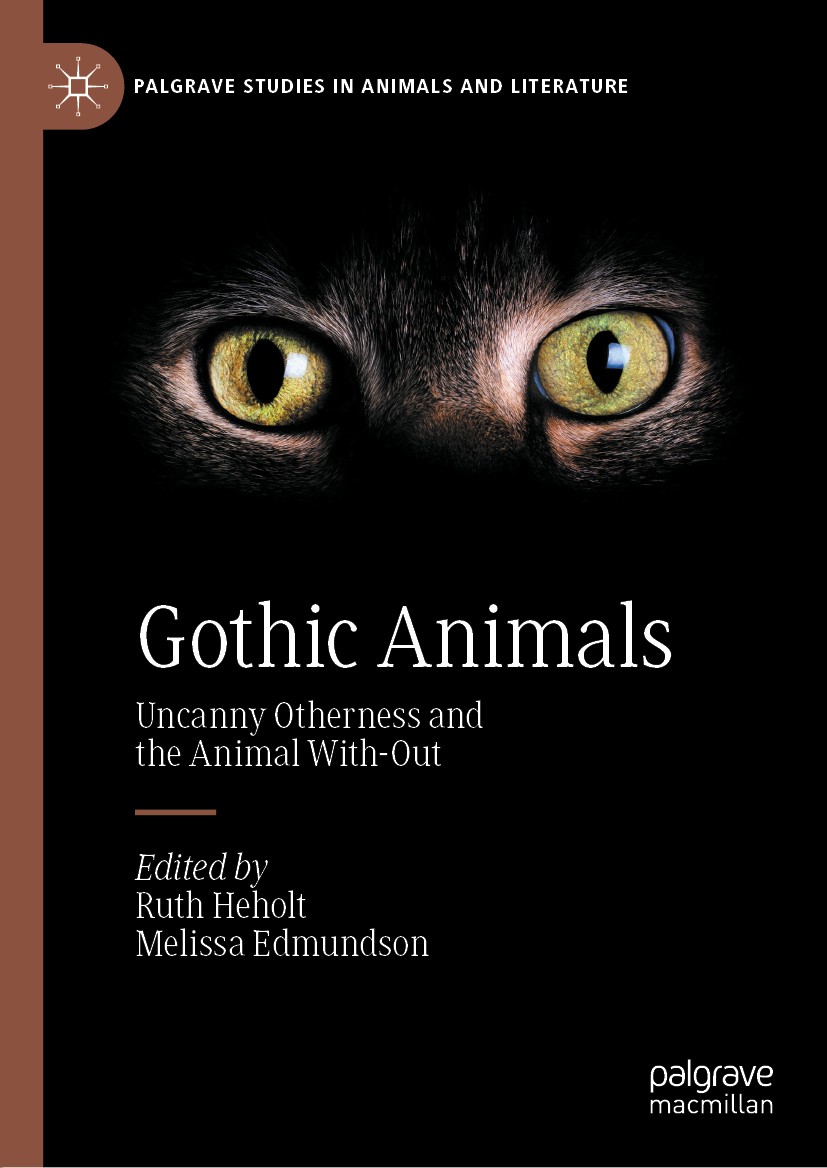
Gothic Animals [electronic resource] : Uncanny Otherness and the Animal With-Out / edited by Ruth Heholt, Melissa Edmundson.
Erişim Adresi
ISBN
9783030345402
Dil Kodu
İngilizce
Yer Numarası
EK/3762
Basım Bildirimi
1st ed. 2020.
Yayın Bilgisi
Cham : Springer International Publishing : Imprint: Palgrave Macmillan, 2020.
Fiziksel Niteleme
XIX, 310 p. 6 illus., 2 illus. in color. online resource.
Dizi
Palgrave Studies in Animals and Literature, 2634-6346
İçindekiler Notu
Chapter 1. Introduction -- Part I. Hell-Beasts and Haunting -- Chapter 2. ‘Like a Madd Dogge’: Demonic Animals and Animal Demoniacs in Early Modern English Possession Narratives -- Chapter 3. ‘Most Hideous of Gaolers’: The Spider in Ernest G. Henham’s Tenebrae -- Chapter 4. Devouring the Animal Within: Uncanny Otherness in Richard Adams’s Plague Dogs -- Chapter 5. Hunted, Now Haunting: The Figure of the Thylacine in Tasmanian Gothic Fiction -- Chapter 6. ‘What Do I Use to Make Them Afraid?’: The Gothic Animal and the Problem of Legitimacy in American Superhero Comics -- Chapter 7. The Monster Shark Still Lives: The Lazarus Taxon and Spectral Animal Bodies -- Chapter 8. ‘Rats is Bogies I Tell You, and Bogies is Rats’: Rats, Repression, and the Gothic Mode -- Chapter 9. At Home with Miniature Sea-monsters: Philip Henry Gosse -- Chapter 10. Uncanny Snails: Patricia Highsmith and the Allure of the Gastropod -- Chapter 11. ‘I Have Flyophobia’: Jane Rice’s ‘The Idol of the Flies’ and Evil as Unwelcome Houseguest -- Chapter 12. ‘Encircled by Minute, Evilly-Intentioned Airplanes’: The Uncanny Biopolitics of Robotic Bees -- Part III. Cultural Anxiety, Violence, and the Non-Human Body -- Chapter 13. A Bark and Stormy Night: Ann Radcliffe’s Animals -- Chapter 14. Hellish Horses and Monstrous Men: Gothic Horsemanship in Washington Irving and Edgar Allan Poe -- Chapter 15. The Colonial Idol, the Animalistic, and the New Woman in the Imperial Gothic of Richard Marsh -- Chapter 16. Victor Hugo’s Pieuvre and the Marine EcoGothic -- Chapter 17. The Human Within and the Animal Without?: Rats and Mr Bunnsy in Terry Pratchett’s The Amazing Maurice and His Educated Rodents -- Chapter 18. Companion Animals in Contemporary Scottish Women’s Gothic.
Özet, vb.
This book begins with the assumption that the presence of non-human creatures causes an always-already uncanny rift in human assumptions about reality. Exploring the dark side of animal nature and the ‘otherness’ of animals as viewed by humans, and employing cutting-edge theory on non-human animals, eco-criticism, literary and cultural theory, this book takes the Gothic genre into new territory. After the dissemination of Darwin’s theories of evolution, nineteenth-century fiction quickly picked up on the idea of the ‘animal within’. Here, the fear explored was of an unruly, defiant, degenerate and entirely amoral animality lying (mostly) dormant within all of us. However, non-humans and humans have other sorts of encounters, too, and even before Darwin, humans have often had an uneasy relationship with animals, which, as Donna Haraway puts it, have a way of ‘looking back’ at us. In this book, the focus is not on the ‘animal within’ but rather on the animal ‘with-out’: otherand entirely incomprehensible. Ruth Heholt is a senior lecturer in English at Falmouth University. She has published widely on the topics of the Gothic, crime, gender and the supernatural. She is currently completing a monograph on the Victorian writer Catherine Crowe and is editor of the journal Revenant: Critical and Creative Studies of the Supernatural. Melissa Edmundson is a lecturer in English at Clemson University and specializes in nineteenth- and twentieth-century women writers and supernatural fiction. She is the author of Women’s Ghost Literature in Nineteenth-Century Britain (University of Wales Press, 2013) and Women’s Colonial Gothic Writing, 1850-1930: Haunted Empire (Palgrave Macmillan, 2018).
Konu
Fiction.
Literature, Modern __ 19th century.
Literature, Modern __ 18th century.
European literature __ Renaissance, 1450-1600.
Fiction Literature.
Nineteenth-Century Literature.
Eighteenth-Century Literature.
Early Modern and Renaissance Literature.
Literature, Modern __ 19th century.
Literature, Modern __ 18th century.
European literature __ Renaissance, 1450-1600.
Fiction Literature.
Nineteenth-Century Literature.
Eighteenth-Century Literature.
Early Modern and Renaissance Literature.
Diğer Yazarlar
Kurum Adı
Eseri Alıntıla
Referansları kullanmadan önce gözden geçirmeniz ve varsa gerekli düzeltmeleri yapmanız önerilir.
Dijital Kaynak
MARC Görünümü
LEADER 06916nam a22006735i 4500
001 840730
003 TR_AnAIT
005 20260715035329
007 cr nn 008mamaa
008 191210s2020 sz | s |||| 0|eng d
020 |a9783030345402|9978-3-030-34540-2
024 7 |a10.1007/978-3-030-34540-2|2doi
041 |aeng
049 |aTürk Dil Kurumu Kütüphanesi
050 4|aPN3311-3503
072 7|aF|2bicssc
072 7|aFIC000000|2bisacsh
072 7|aF|2thema
082 04|a809.3|223
090 |aEK/3762
245 10|aGothic Animals|h[electronic resource] :|bUncanny Otherness and the Animal With-Out /|cedited by Ruth Heholt, Melissa Edmundson.
250 |a1st ed. 2020.
264 1|aCham :|bSpringer International Publishing :|bImprint: Palgrave Macmillan,|c2020.
300 |aXIX, 310 p. 6 illus., 2 illus. in color.|bonline resource.
336 |atext|btxt|2rdacontent
337 |acomputer|bc|2rdamedia
338 |aonline resource|bcr|2rdacarrier
341 0 |bTable of contents navigation|2onix
341 0 |bSingle logical reading order|2onix
341 0 |bShort alternative textual descriptions|2onix
341 0 |bUse of color is not sole means of conveying information|2onix
341 0 |bUse of high contrast between text and background color|2onix
341 0 |bNext / Previous structural navigation|2onix
341 0 |bAll non-decorative content supports reading without sight|2onix
347 |atext file|bPDF|2rda
490 1 |aPalgrave Studies in Animals and Literature,|x2634-6346
505 0 |aChapter 1. Introduction -- Part I. Hell-Beasts and Haunting -- Chapter 2. ‘Like a Madd Dogge’: Demonic Animals and Animal Demoniacs in Early Modern English Possession Narratives -- Chapter 3. ‘Most Hideous of Gaolers’: The Spider in Ernest G. Henham’s Tenebrae -- Chapter 4. Devouring the Animal Within: Uncanny Otherness in Richard Adams’s Plague Dogs -- Chapter 5. Hunted, Now Haunting: The Figure of the Thylacine in Tasmanian Gothic Fiction -- Chapter 6. ‘What Do I Use to Make Them Afraid?’: The Gothic Animal and the Problem of Legitimacy in American Superhero Comics -- Chapter 7. The Monster Shark Still Lives: The Lazarus Taxon and Spectral Animal Bodies -- Chapter 8. ‘Rats is Bogies I Tell You, and Bogies is Rats’: Rats, Repression, and the Gothic Mode -- Chapter 9. At Home with Miniature Sea-monsters: Philip Henry Gosse -- Chapter 10. Uncanny Snails: Patricia Highsmith and the Allure of the Gastropod -- Chapter 11. ‘I Have Flyophobia’: Jane Rice’s ‘The Idol of the Flies’ and Evil as Unwelcome Houseguest -- Chapter 12. ‘Encircled by Minute, Evilly-Intentioned Airplanes’: The Uncanny Biopolitics of Robotic Bees -- Part III. Cultural Anxiety, Violence, and the Non-Human Body -- Chapter 13. A Bark and Stormy Night: Ann Radcliffe’s Animals -- Chapter 14. Hellish Horses and Monstrous Men: Gothic Horsemanship in Washington Irving and Edgar Allan Poe -- Chapter 15. The Colonial Idol, the Animalistic, and the New Woman in the Imperial Gothic of Richard Marsh -- Chapter 16. Victor Hugo’s Pieuvre and the Marine EcoGothic -- Chapter 17. The Human Within and the Animal Without?: Rats and Mr Bunnsy in Terry Pratchett’s The Amazing Maurice and His Educated Rodents -- Chapter 18. Companion Animals in Contemporary Scottish Women’s Gothic.
520 |aThis book begins with the assumption that the presence of non-human creatures causes an always-already uncanny rift in human assumptions about reality. Exploring the dark side of animal nature and the ‘otherness’ of animals as viewed by humans, and employing cutting-edge theory on non-human animals, eco-criticism, literary and cultural theory, this book takes the Gothic genre into new territory. After the dissemination of Darwin’s theories of evolution, nineteenth-century fiction quickly picked up on the idea of the ‘animal within’. Here, the fear explored was of an unruly, defiant, degenerate and entirely amoral animality lying (mostly) dormant within all of us. However, non-humans and humans have other sorts of encounters, too, and even before Darwin, humans have often had an uneasy relationship with animals, which, as Donna Haraway puts it, have a way of ‘looking back’ at us. In this book, the focus is not on the ‘animal within’ but rather on the animal ‘with-out’: otherand entirely incomprehensible. Ruth Heholt is a senior lecturer in English at Falmouth University. She has published widely on the topics of the Gothic, crime, gender and the supernatural. She is currently completing a monograph on the Victorian writer Catherine Crowe and is editor of the journal Revenant: Critical and Creative Studies of the Supernatural. Melissa Edmundson is a lecturer in English at Clemson University and specializes in nineteenth- and twentieth-century women writers and supernatural fiction. She is the author of Women’s Ghost Literature in Nineteenth-Century Britain (University of Wales Press, 2013) and Women’s Colonial Gothic Writing, 1850-1930: Haunted Empire (Palgrave Macmillan, 2018).
532 8 |aAccessibility summary: This PDF does not fully comply with PDF/UA standards, but does feature limited screen reader support, described non-text content (images, graphs), bookmarks for easy navigation and searchable, selectable text. Users of assistive technologies may experience difficulty navigating or interpreting content in this document. We recognize the importance of accessibility, and we welcome queries about accessibility for any of our products. If you have a question or an access need, please get in touch with us at accessibilitysupport@springernature.com.
532 8 |aNo reading system accessibility options actively disabled
532 8 |aPublisher contact for further accessibility information: accessibilitysupport@springernature.com
650 0|aFiction.
650 0|aLiterature, Modern|x19th century.
650 0|aLiterature, Modern|x18th century.
650 0|aEuropean literature|xRenaissance, 1450-1600.
650 14|aFiction Literature.
650 24|aNineteenth-Century Literature.
650 24|aEighteenth-Century Literature.
650 24|aEarly Modern and Renaissance Literature.
700 1 |aHeholt, Ruth.|eeditor.|4edt|4http://id.loc.gov/vocabulary/relators/edt
700 1 |aEdmundson, Melissa.|eeditor.|4edt|4http://id.loc.gov/vocabulary/relators/edt
710 2 |aSpringerLink (Online service)
773 0 |tSpringer Nature eBook
776 08|iPrinted edition:|z9783030345396
776 08|iPrinted edition:|z9783030345419
776 08|iPrinted edition:|z9783030345426
830 0|aPalgrave Studies in Animals and Literature,|x2634-6346
856 40|uhttps://doi.org/10.1007/978-3-030-34540-2
912 |aZDB-2-LCM
912 |aZDB-2-SXL
950 |aLiterature, Cultural and Media Studies (SpringerNature-41173)
950 |aLiterature, Cultural and Media Studies (R0) (SpringerNature-43723)
001 840730
003 TR_AnAIT
005 20260715035329
007 cr nn 008mamaa
008 191210s2020 sz | s |||| 0|eng d
020 |a9783030345402|9978-3-030-34540-2
024 7 |a10.1007/978-3-030-34540-2|2doi
041 |aeng
049 |aTürk Dil Kurumu Kütüphanesi
050 4|aPN3311-3503
072 7|aF|2bicssc
072 7|aFIC000000|2bisacsh
072 7|aF|2thema
082 04|a809.3|223
090 |aEK/3762
245 10|aGothic Animals|h[electronic resource] :|bUncanny Otherness and the Animal With-Out /|cedited by Ruth Heholt, Melissa Edmundson.
250 |a1st ed. 2020.
264 1|aCham :|bSpringer International Publishing :|bImprint: Palgrave Macmillan,|c2020.
300 |aXIX, 310 p. 6 illus., 2 illus. in color.|bonline resource.
336 |atext|btxt|2rdacontent
337 |acomputer|bc|2rdamedia
338 |aonline resource|bcr|2rdacarrier
341 0 |bTable of contents navigation|2onix
341 0 |bSingle logical reading order|2onix
341 0 |bShort alternative textual descriptions|2onix
341 0 |bUse of color is not sole means of conveying information|2onix
341 0 |bUse of high contrast between text and background color|2onix
341 0 |bNext / Previous structural navigation|2onix
341 0 |bAll non-decorative content supports reading without sight|2onix
347 |atext file|bPDF|2rda
490 1 |aPalgrave Studies in Animals and Literature,|x2634-6346
505 0 |aChapter 1. Introduction -- Part I. Hell-Beasts and Haunting -- Chapter 2. ‘Like a Madd Dogge’: Demonic Animals and Animal Demoniacs in Early Modern English Possession Narratives -- Chapter 3. ‘Most Hideous of Gaolers’: The Spider in Ernest G. Henham’s Tenebrae -- Chapter 4. Devouring the Animal Within: Uncanny Otherness in Richard Adams’s Plague Dogs -- Chapter 5. Hunted, Now Haunting: The Figure of the Thylacine in Tasmanian Gothic Fiction -- Chapter 6. ‘What Do I Use to Make Them Afraid?’: The Gothic Animal and the Problem of Legitimacy in American Superhero Comics -- Chapter 7. The Monster Shark Still Lives: The Lazarus Taxon and Spectral Animal Bodies -- Chapter 8. ‘Rats is Bogies I Tell You, and Bogies is Rats’: Rats, Repression, and the Gothic Mode -- Chapter 9. At Home with Miniature Sea-monsters: Philip Henry Gosse -- Chapter 10. Uncanny Snails: Patricia Highsmith and the Allure of the Gastropod -- Chapter 11. ‘I Have Flyophobia’: Jane Rice’s ‘The Idol of the Flies’ and Evil as Unwelcome Houseguest -- Chapter 12. ‘Encircled by Minute, Evilly-Intentioned Airplanes’: The Uncanny Biopolitics of Robotic Bees -- Part III. Cultural Anxiety, Violence, and the Non-Human Body -- Chapter 13. A Bark and Stormy Night: Ann Radcliffe’s Animals -- Chapter 14. Hellish Horses and Monstrous Men: Gothic Horsemanship in Washington Irving and Edgar Allan Poe -- Chapter 15. The Colonial Idol, the Animalistic, and the New Woman in the Imperial Gothic of Richard Marsh -- Chapter 16. Victor Hugo’s Pieuvre and the Marine EcoGothic -- Chapter 17. The Human Within and the Animal Without?: Rats and Mr Bunnsy in Terry Pratchett’s The Amazing Maurice and His Educated Rodents -- Chapter 18. Companion Animals in Contemporary Scottish Women’s Gothic.
520 |aThis book begins with the assumption that the presence of non-human creatures causes an always-already uncanny rift in human assumptions about reality. Exploring the dark side of animal nature and the ‘otherness’ of animals as viewed by humans, and employing cutting-edge theory on non-human animals, eco-criticism, literary and cultural theory, this book takes the Gothic genre into new territory. After the dissemination of Darwin’s theories of evolution, nineteenth-century fiction quickly picked up on the idea of the ‘animal within’. Here, the fear explored was of an unruly, defiant, degenerate and entirely amoral animality lying (mostly) dormant within all of us. However, non-humans and humans have other sorts of encounters, too, and even before Darwin, humans have often had an uneasy relationship with animals, which, as Donna Haraway puts it, have a way of ‘looking back’ at us. In this book, the focus is not on the ‘animal within’ but rather on the animal ‘with-out’: otherand entirely incomprehensible. Ruth Heholt is a senior lecturer in English at Falmouth University. She has published widely on the topics of the Gothic, crime, gender and the supernatural. She is currently completing a monograph on the Victorian writer Catherine Crowe and is editor of the journal Revenant: Critical and Creative Studies of the Supernatural. Melissa Edmundson is a lecturer in English at Clemson University and specializes in nineteenth- and twentieth-century women writers and supernatural fiction. She is the author of Women’s Ghost Literature in Nineteenth-Century Britain (University of Wales Press, 2013) and Women’s Colonial Gothic Writing, 1850-1930: Haunted Empire (Palgrave Macmillan, 2018).
532 8 |aAccessibility summary: This PDF does not fully comply with PDF/UA standards, but does feature limited screen reader support, described non-text content (images, graphs), bookmarks for easy navigation and searchable, selectable text. Users of assistive technologies may experience difficulty navigating or interpreting content in this document. We recognize the importance of accessibility, and we welcome queries about accessibility for any of our products. If you have a question or an access need, please get in touch with us at accessibilitysupport@springernature.com.
532 8 |aNo reading system accessibility options actively disabled
532 8 |aPublisher contact for further accessibility information: accessibilitysupport@springernature.com
650 0|aFiction.
650 0|aLiterature, Modern|x19th century.
650 0|aLiterature, Modern|x18th century.
650 0|aEuropean literature|xRenaissance, 1450-1600.
650 14|aFiction Literature.
650 24|aNineteenth-Century Literature.
650 24|aEighteenth-Century Literature.
650 24|aEarly Modern and Renaissance Literature.
700 1 |aHeholt, Ruth.|eeditor.|4edt|4http://id.loc.gov/vocabulary/relators/edt
700 1 |aEdmundson, Melissa.|eeditor.|4edt|4http://id.loc.gov/vocabulary/relators/edt
710 2 |aSpringerLink (Online service)
773 0 |tSpringer Nature eBook
776 08|iPrinted edition:|z9783030345396
776 08|iPrinted edition:|z9783030345419
776 08|iPrinted edition:|z9783030345426
830 0|aPalgrave Studies in Animals and Literature,|x2634-6346
856 40|uhttps://doi.org/10.1007/978-3-030-34540-2
912 |aZDB-2-LCM
912 |aZDB-2-SXL
950 |aLiterature, Cultural and Media Studies (SpringerNature-41173)
950 |aLiterature, Cultural and Media Studies (R0) (SpringerNature-43723)
Materyaller
Depodan talep edilen materyal sadece kütüphane içerisinde kullanılmaktadır.
Materyal dışarıya ödünç verilmemektedir.
Materyal dışarıya ödünç verilmemektedir.
