

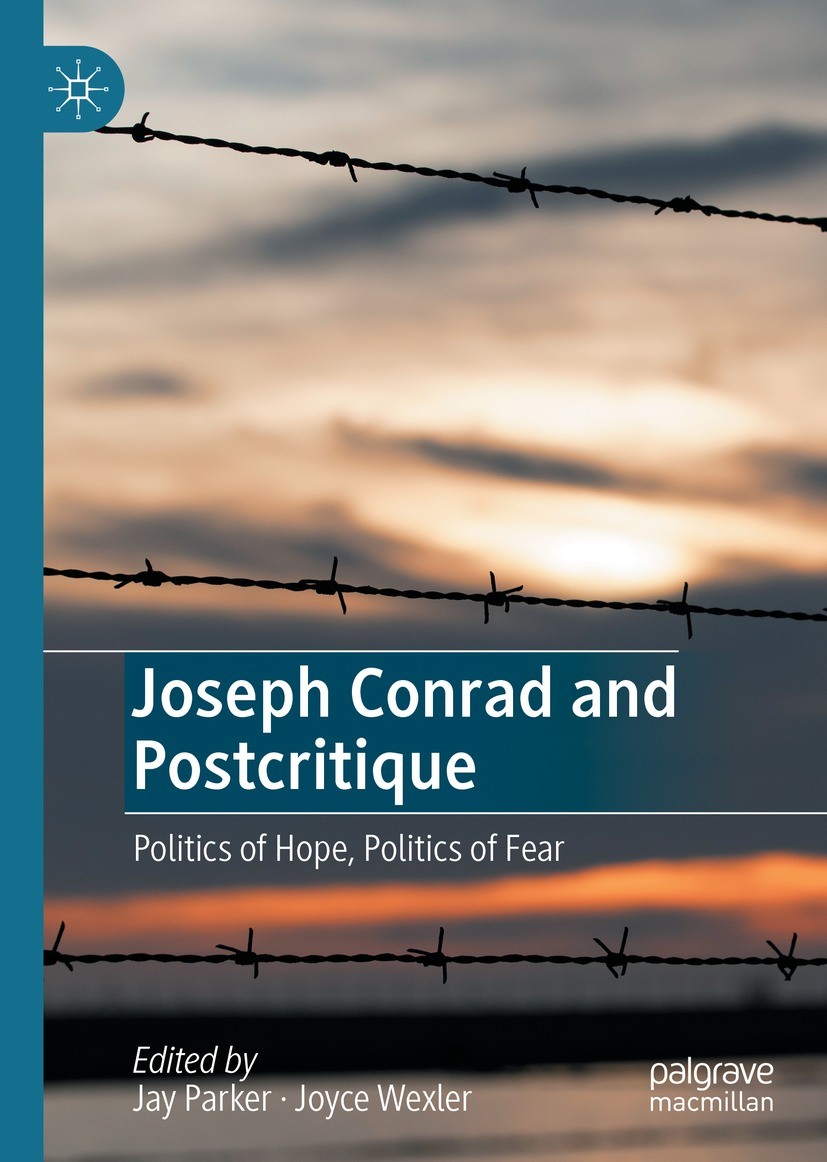
Joseph Conrad and Postcritique [electronic resource] : Politics of Hope, Politics of Fear / edited by Jay Parker, Joyce Wexler.
Erişim Adresi
ISBN
9783030724993
Dil Kodu
İngilizce
Yer Numarası
EK/4113
Basım Bildirimi
1st ed. 2021.
Yayın Bilgisi
Cham : Springer International Publishing : Imprint: Palgrave Macmillan, 2021.
Fiziksel Niteleme
XV, 233 p. 1 illus. online resource.
İçindekiler Notu
Chapter 1: Introduction -- Part I: Finding Hope—Recuperative Reading, Reparative Reading -- Chapter 2: Quixotic Conrad: Betrayal, Conversion, and Flight, Jay Parker -- Chapter 3: "The new sun is rising": Conrad, Women, and Hope, Rachel Hollander -- Part II: Understanding the Politics of Fear -- Chapter 4: Doubling Down on the Politics of Fear, Opening Up the Politics of Hope, Joyce Wexler -- Chapter 5: Joseph Conrad’s “Strange Air of Finality”: Negative Affect and the Politics of Fear in “The Tale, Jarica Linn Watts -- Chapter 6: "Pulsating Wrongfully":Critique, Cliché, and The Secret Agent, James Brophy -- Part III: Ethics and Aesthetics -- Chapter 7: "Heart of Darkness" and the Memory of the Holocaust, Riccardo Capoferro -- Chapter 8: The Beating Heart of Sublime Empire: The Secret Agent as Sequel to “Heart of Darkness”, Jana M. Giles -- Chapter 9: Cross-cultural Accord in the Malay Fiction: The Performative Politics of Conrad’s Eastern World, Mark Deggan -- Chapter 10: "Some Knowledge of Yourself": “Heart of Darkness” in the Twenty-First Century Literature Classroom—An Ethical Approach, Anna Lindhé.
Özet, vb.
‘This collection of essays is a significant contribution to both Conrad studies and the critique / postcritique debate. Through a series of original, insightful and pertinently suggestive critical essays, focussed largely on canonical works by Conrad (Heart of Darkness, Lord Jim and The Secret Agent), it constitutes a paradigm shift in Conrad studies, while, at the same time, using Conrad as a case study, to demonstrate and explore a variety of postcritical approaches.’ —Professor Robert Hampson, FEA, FRSA, Research Fellow, The Institute of English Studies, University of London, UK This book takes a postcritical perspective on Joseph Conrad’s central texts, including Heart of Darkness, The Secret Agent, Under Western Eyes, and Lord Jim. Whereas critique is a form of reading that prioritizes suspicion, unmasking, and demystifying, postcritique ascribes positive value to the knowledge, affect, ethics, and politics that emerge from literature. The essays in this collection recognize the dark elements in Conrad’s fiction—deceit, vanity, avarice, lust, cynicism, and cruelty—yet they perceive hopefulness as well. Conrad’s skepticism unveils the dark heart of politics, and his critical heritage can feed our fear that humanity is incapable of improving. This Conrad is a well-known figure, but there is another, neglected Conrad that this book aims to bring to light, one who delves into the politics of hope as well as the politics of fear. Jay Parker is Assistant Professor in the English Department of the Hang SengUniversity of Hong Kong, Hong Kong. He has published articles on Conrad in relation to liberalism and to justice in Textual Practice, Law and Literature and The Conradian. He was awarded the Juliet McLauchlan Prize in 2012 and the Bruce Harkness Young Scholar Award in 2015 for his research on Conrad, and is fiction editor of the Hong Kong Review of Books, as well as Advisory Editor for The Conradian. He is currently completing a book on Conrad and Liberalism. Joyce Wexler is Professor Emerita of English at Loyola University Chicago, USA. She is the author of Violence without God: The Rhetorical Dilemma of Twentieth-Century Writers (2016), Who Paid for Modernism? Art, Money, and the Fiction of Conrad, Joyce, and Lawrence (1997), Laura Riding: A Bibliography (1981), and Laura Riding’s Pursuit ofTruth (1979). She currently serves as President of the Joseph Conrad Society of America. Chapters 1 and 2 are available open access under a Creative Commons Attribution 4.0 International License via link.springer.com.
Konu
Literature __ Philosophy.
Literature __ History and criticism.
Fiction.
Literature, Modern __ 20th century.
Literature, Modern __ 19th century.
Literary Theory.
Literary Criticism.
Fiction Literature.
Twentieth-Century Literature.
Nineteenth-Century Literature.
Literature __ History and criticism.
Fiction.
Literature, Modern __ 20th century.
Literature, Modern __ 19th century.
Literary Theory.
Literary Criticism.
Fiction Literature.
Twentieth-Century Literature.
Nineteenth-Century Literature.
Diğer Yazarlar
Kurum Adı
Eseri Alıntıla
Referansları kullanmadan önce gözden geçirmeniz ve varsa gerekli düzeltmeleri yapmanız önerilir.
Dijital Kaynak
MARC Görünümü
LEADER 05741nam a22005535i 4500
001 840771
003 TR_AnAIT
005 20260715035131
007 cr nn 008mamaa
008 210917s2021 sz | s |||| 0|eng d
020 |a9783030724993|9978-3-030-72499-3
024 7 |a10.1007/978-3-030-72499-3|2doi
041 |aeng
049 |aTürk Dil Kurumu Kütüphanesi
050 4|aPN45-57
072 7|aDSA|2bicssc
072 7|aLIT006000|2bisacsh
072 7|aDSA|2thema
082 04|a801|223
090 |aEK/4113
245 10|aJoseph Conrad and Postcritique|h[electronic resource] :|bPolitics of Hope, Politics of Fear /|cedited by Jay Parker, Joyce Wexler.
250 |a1st ed. 2021.
264 1|aCham :|bSpringer International Publishing :|bImprint: Palgrave Macmillan,|c2021.
300 |aXV, 233 p. 1 illus.|bonline resource.
336 |atext|btxt|2rdacontent
337 |acomputer|bc|2rdamedia
338 |aonline resource|bcr|2rdacarrier
347 |atext file|bPDF|2rda
505 0 |aChapter 1: Introduction -- Part I: Finding Hope—Recuperative Reading, Reparative Reading -- Chapter 2: Quixotic Conrad: Betrayal, Conversion, and Flight, Jay Parker -- Chapter 3: "The new sun is rising": Conrad, Women, and Hope, Rachel Hollander -- Part II: Understanding the Politics of Fear -- Chapter 4: Doubling Down on the Politics of Fear, Opening Up the Politics of Hope, Joyce Wexler -- Chapter 5: Joseph Conrad’s “Strange Air of Finality”: Negative Affect and the Politics of Fear in “The Tale, Jarica Linn Watts -- Chapter 6: "Pulsating Wrongfully":Critique, Cliché, and The Secret Agent, James Brophy -- Part III: Ethics and Aesthetics -- Chapter 7: "Heart of Darkness" and the Memory of the Holocaust, Riccardo Capoferro -- Chapter 8: The Beating Heart of Sublime Empire: The Secret Agent as Sequel to “Heart of Darkness”, Jana M. Giles -- Chapter 9: Cross-cultural Accord in the Malay Fiction: The Performative Politics of Conrad’s Eastern World, Mark Deggan -- Chapter 10: "Some Knowledge of Yourself": “Heart of Darkness” in the Twenty-First Century Literature Classroom—An Ethical Approach, Anna Lindhé.
520 |a‘This collection of essays is a significant contribution to both Conrad studies and the critique / postcritique debate. Through a series of original, insightful and pertinently suggestive critical essays, focussed largely on canonical works by Conrad (Heart of Darkness, Lord Jim and The Secret Agent), it constitutes a paradigm shift in Conrad studies, while, at the same time, using Conrad as a case study, to demonstrate and explore a variety of postcritical approaches.’ —Professor Robert Hampson, FEA, FRSA, Research Fellow, The Institute of English Studies, University of London, UK This book takes a postcritical perspective on Joseph Conrad’s central texts, including Heart of Darkness, The Secret Agent, Under Western Eyes, and Lord Jim. Whereas critique is a form of reading that prioritizes suspicion, unmasking, and demystifying, postcritique ascribes positive value to the knowledge, affect, ethics, and politics that emerge from literature. The essays in this collection recognize the dark elements in Conrad’s fiction—deceit, vanity, avarice, lust, cynicism, and cruelty—yet they perceive hopefulness as well. Conrad’s skepticism unveils the dark heart of politics, and his critical heritage can feed our fear that humanity is incapable of improving. This Conrad is a well-known figure, but there is another, neglected Conrad that this book aims to bring to light, one who delves into the politics of hope as well as the politics of fear. Jay Parker is Assistant Professor in the English Department of the Hang SengUniversity of Hong Kong, Hong Kong. He has published articles on Conrad in relation to liberalism and to justice in Textual Practice, Law and Literature and The Conradian. He was awarded the Juliet McLauchlan Prize in 2012 and the Bruce Harkness Young Scholar Award in 2015 for his research on Conrad, and is fiction editor of the Hong Kong Review of Books, as well as Advisory Editor for The Conradian. He is currently completing a book on Conrad and Liberalism. Joyce Wexler is Professor Emerita of English at Loyola University Chicago, USA. She is the author of Violence without God: The Rhetorical Dilemma of Twentieth-Century Writers (2016), Who Paid for Modernism? Art, Money, and the Fiction of Conrad, Joyce, and Lawrence (1997), Laura Riding: A Bibliography (1981), and Laura Riding’s Pursuit ofTruth (1979). She currently serves as President of the Joseph Conrad Society of America. Chapters 1 and 2 are available open access under a Creative Commons Attribution 4.0 International License via link.springer.com.
650 0|aLiterature|xPhilosophy.
650 0|aLiterature|xHistory and criticism.
650 0|aFiction.
650 0|aLiterature, Modern|x20th century.
650 0|aLiterature, Modern|x19th century.
650 14|aLiterary Theory.
650 24|aLiterary Criticism.
650 24|aFiction Literature.
650 24|aTwentieth-Century Literature.
650 24|aNineteenth-Century Literature.
700 1 |aParker, Jay.|eeditor.|4edt|4http://id.loc.gov/vocabulary/relators/edt
700 1 |aWexler, Joyce.|eeditor.|4edt|4http://id.loc.gov/vocabulary/relators/edt
710 2 |aSpringerLink (Online service)
773 0 |tSpringer Nature eBook
776 08|iPrinted edition:|z9783030724986
776 08|iPrinted edition:|z9783030725006
776 08|iPrinted edition:|z9783030725013
856 40|uhttps://doi.org/10.1007/978-3-030-72499-3
912 |aZDB-2-LCM
912 |aZDB-2-SXL
950 |aLiterature, Cultural and Media Studies (SpringerNature-41173)
950 |aLiterature, Cultural and Media Studies (R0) (SpringerNature-43723)
001 840771
003 TR_AnAIT
005 20260715035131
007 cr nn 008mamaa
008 210917s2021 sz | s |||| 0|eng d
020 |a9783030724993|9978-3-030-72499-3
024 7 |a10.1007/978-3-030-72499-3|2doi
041 |aeng
049 |aTürk Dil Kurumu Kütüphanesi
050 4|aPN45-57
072 7|aDSA|2bicssc
072 7|aLIT006000|2bisacsh
072 7|aDSA|2thema
082 04|a801|223
090 |aEK/4113
245 10|aJoseph Conrad and Postcritique|h[electronic resource] :|bPolitics of Hope, Politics of Fear /|cedited by Jay Parker, Joyce Wexler.
250 |a1st ed. 2021.
264 1|aCham :|bSpringer International Publishing :|bImprint: Palgrave Macmillan,|c2021.
300 |aXV, 233 p. 1 illus.|bonline resource.
336 |atext|btxt|2rdacontent
337 |acomputer|bc|2rdamedia
338 |aonline resource|bcr|2rdacarrier
347 |atext file|bPDF|2rda
505 0 |aChapter 1: Introduction -- Part I: Finding Hope—Recuperative Reading, Reparative Reading -- Chapter 2: Quixotic Conrad: Betrayal, Conversion, and Flight, Jay Parker -- Chapter 3: "The new sun is rising": Conrad, Women, and Hope, Rachel Hollander -- Part II: Understanding the Politics of Fear -- Chapter 4: Doubling Down on the Politics of Fear, Opening Up the Politics of Hope, Joyce Wexler -- Chapter 5: Joseph Conrad’s “Strange Air of Finality”: Negative Affect and the Politics of Fear in “The Tale, Jarica Linn Watts -- Chapter 6: "Pulsating Wrongfully":Critique, Cliché, and The Secret Agent, James Brophy -- Part III: Ethics and Aesthetics -- Chapter 7: "Heart of Darkness" and the Memory of the Holocaust, Riccardo Capoferro -- Chapter 8: The Beating Heart of Sublime Empire: The Secret Agent as Sequel to “Heart of Darkness”, Jana M. Giles -- Chapter 9: Cross-cultural Accord in the Malay Fiction: The Performative Politics of Conrad’s Eastern World, Mark Deggan -- Chapter 10: "Some Knowledge of Yourself": “Heart of Darkness” in the Twenty-First Century Literature Classroom—An Ethical Approach, Anna Lindhé.
520 |a‘This collection of essays is a significant contribution to both Conrad studies and the critique / postcritique debate. Through a series of original, insightful and pertinently suggestive critical essays, focussed largely on canonical works by Conrad (Heart of Darkness, Lord Jim and The Secret Agent), it constitutes a paradigm shift in Conrad studies, while, at the same time, using Conrad as a case study, to demonstrate and explore a variety of postcritical approaches.’ —Professor Robert Hampson, FEA, FRSA, Research Fellow, The Institute of English Studies, University of London, UK This book takes a postcritical perspective on Joseph Conrad’s central texts, including Heart of Darkness, The Secret Agent, Under Western Eyes, and Lord Jim. Whereas critique is a form of reading that prioritizes suspicion, unmasking, and demystifying, postcritique ascribes positive value to the knowledge, affect, ethics, and politics that emerge from literature. The essays in this collection recognize the dark elements in Conrad’s fiction—deceit, vanity, avarice, lust, cynicism, and cruelty—yet they perceive hopefulness as well. Conrad’s skepticism unveils the dark heart of politics, and his critical heritage can feed our fear that humanity is incapable of improving. This Conrad is a well-known figure, but there is another, neglected Conrad that this book aims to bring to light, one who delves into the politics of hope as well as the politics of fear. Jay Parker is Assistant Professor in the English Department of the Hang SengUniversity of Hong Kong, Hong Kong. He has published articles on Conrad in relation to liberalism and to justice in Textual Practice, Law and Literature and The Conradian. He was awarded the Juliet McLauchlan Prize in 2012 and the Bruce Harkness Young Scholar Award in 2015 for his research on Conrad, and is fiction editor of the Hong Kong Review of Books, as well as Advisory Editor for The Conradian. He is currently completing a book on Conrad and Liberalism. Joyce Wexler is Professor Emerita of English at Loyola University Chicago, USA. She is the author of Violence without God: The Rhetorical Dilemma of Twentieth-Century Writers (2016), Who Paid for Modernism? Art, Money, and the Fiction of Conrad, Joyce, and Lawrence (1997), Laura Riding: A Bibliography (1981), and Laura Riding’s Pursuit ofTruth (1979). She currently serves as President of the Joseph Conrad Society of America. Chapters 1 and 2 are available open access under a Creative Commons Attribution 4.0 International License via link.springer.com.
650 0|aLiterature|xPhilosophy.
650 0|aLiterature|xHistory and criticism.
650 0|aFiction.
650 0|aLiterature, Modern|x20th century.
650 0|aLiterature, Modern|x19th century.
650 14|aLiterary Theory.
650 24|aLiterary Criticism.
650 24|aFiction Literature.
650 24|aTwentieth-Century Literature.
650 24|aNineteenth-Century Literature.
700 1 |aParker, Jay.|eeditor.|4edt|4http://id.loc.gov/vocabulary/relators/edt
700 1 |aWexler, Joyce.|eeditor.|4edt|4http://id.loc.gov/vocabulary/relators/edt
710 2 |aSpringerLink (Online service)
773 0 |tSpringer Nature eBook
776 08|iPrinted edition:|z9783030724986
776 08|iPrinted edition:|z9783030725006
776 08|iPrinted edition:|z9783030725013
856 40|uhttps://doi.org/10.1007/978-3-030-72499-3
912 |aZDB-2-LCM
912 |aZDB-2-SXL
950 |aLiterature, Cultural and Media Studies (SpringerNature-41173)
950 |aLiterature, Cultural and Media Studies (R0) (SpringerNature-43723)
Materyaller
Depodan talep edilen materyal sadece kütüphane içerisinde kullanılmaktadır.
Materyal dışarıya ödünç verilmemektedir.
Materyal dışarıya ödünç verilmemektedir.
