

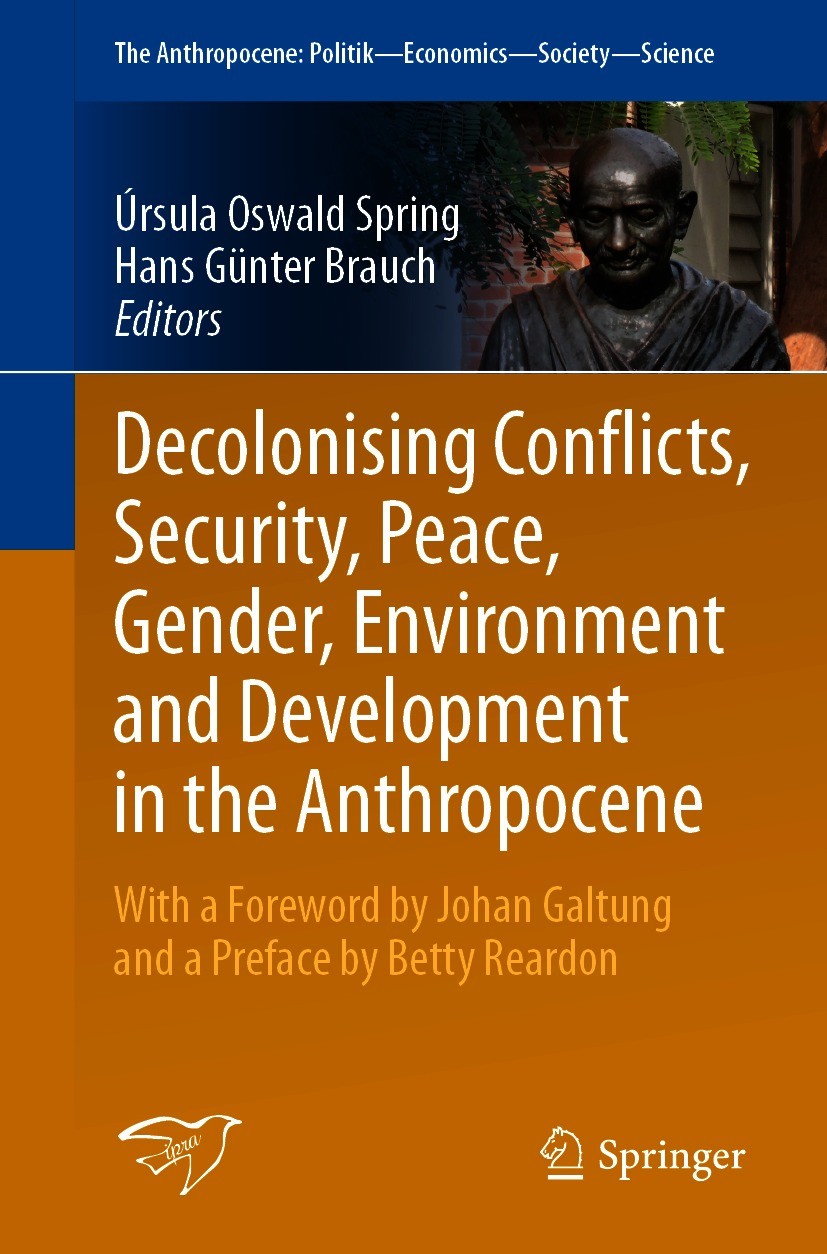
Decolonising Conflicts, Security, Peace, Gender, Environment and Development in the Anthropocene [electronic resource] / edited by Úrsula Oswald Spring, Hans Günter Brauch.
Erişim Adresi
ISBN
9783030623166
Dil Kodu
İngilizce
Yer Numarası
EK/4430
Basım Bildirimi
1st ed. 2021.
Yayın Bilgisi
Cham : Springer International Publishing : Imprint: Springer, 2021.
Fiziksel Niteleme
XXX, 749 p. 47 illus., 33 illus. in color. online resource.
Dizi
The Anthropocene: Politik—Economics—Society—Science, 2367-4032 ; 30
İçindekiler Notu
1. Decolonising Peace in the Anthropocene: Introduction towards an Alternative Understanding of Peace and Security -- 2. Peace Ecology in the Anthropocene -- 3. Transformative and Participative Peace:A Theoretical and Methodological Proposal of Epistemology for Peace and Conflict studies -- 4. Peaceful Societies through Social Cohesion? The Power of Paradigms for Normative and Interdisciplinary Research -- 5. The National and Universal Importance of the Non-Violent Policy of Mohandas K. Gandhi -- 6. Disobedient Peace: Non-Cooperation With Inhuman Orders -- 7. Risks, Mitigation and Adaptation to Urban Climate Change Impacts in the Global South from a Gender Perspective -- 8. Conflicts in Kenya: Drivers of Conflicts and Assessing Mitigation Measures -- 9. Human Rights and Sexual Abuse of the Girl-Child in Nigeria: Implications for Development -- 10. The Farmer-Herder Conflicts in Nigeria’s Open Space: Taming the Tide -- 11. Climate Rituals: Cultural Response for Climate Change Adaptations in Africa -- 12. Ethnically-Charged Wartime Sexual Violence: The Agony of the South Sudanese Refugees in Uganda -- 13. Traditional Conflict and Peacemaking Process Through the Case of Kurdish Tribes in Mardin, Turkey -- 14. Family Shame and Eloping Couples: A Hindustani Warp in Time. Steps in Progress toward Nonviolence -- 15. We Are Not Victims:The Roma, an Outdoor Art Gallery and the Same Old Story – Critical Thinking in Communication for Development -- 16. Governance by Violent Non-State Actors as a Challenge to Sustainable Peace in Brazil -- 17 -- Governance by Violent Non-State Actors as a Challenge to Sustainable Peace in Brazil -- 18. Art of Peace: Cultural Practices and Peacebuilding in Mexico -- 19. Grass-Roots Post-Conflict Peacebuilding: A Case Study of Mosintuwu Women School in Poso District, Central Sulawesi, Indonesia -- 20. Hydro-diplomacy Towards Peace Ecology: The Case of the Indus Water Treaty between India and Pakistan -- 21 -- The Rohingya Refugee Crisis: Implications for Regional Security -- 22. An Unsustainable Price: The Opportunity Costs of Transitional Justice -- 23. Simultaneous Intervention Strategies at Local Ecosystems for Sustainable Development Goals and Peace: Design and Systems Perspectives -- 24. Citizen-Led Assessment and the Participatory Approach to Peace Education in Nepal -- 25. Can Infrastructure-Based Development Bring Peace to West Papua?. .
Özet, vb.
In this book 25 authors from the Global South (19) and the Global North (6) address conflicts, security, peace, gender, environment and development. Four parts cover I) peace research epistemology; II) conflicts, families and vulnerable people; III) peacekeeping, peacebuilding and transitional justice; and IV) peace and education. Part I deals with peace ecology, transformative peace, peaceful societies, Gandhi’s non-violent policy and disobedient peace. Part II discusses urban climate change, climate rituals, conflicts in Kenya, the sexual abuse of girls, farmer-herder conflicts in Nigeria, wartime sexual violence facing refugees, the traditional conflict and peacemakingprocess of Kurdish tribes, Hindustani family shame, and communication with Roma. Part III analyses norms of peacekeeping, violent non-state actors in Brazil, the art of peace in Mexico, grass-roots post-conflict peacebuilding in Sulawesi, hydrodiplomacyin the Indus River Basin, the Rohingya refugee crisis, and transitional justice. Part IV assesses SDGs and peace in India, peace education in Nepal, and infrastructure-based development and peace in West Papua. • Peer-reviewed texts prepared for the 27th Conference of the International Peace Research Association (IPRA) in 2018 in Ahmedabad in India. • Contributions from two pioneers of global peace research:a foreword by Johan Galtung from Norway and a preface by Betty Reardon from the United States. • Innovative case studies by peace researchers on decolonising conflicts, security, peace, gender, environment and development in the Anthropocene, the new epoch of earth and human history. • New theoretical perspectives by senior and junior scholars from Europe and Latin America on peace ecology, transformative peace, peaceful societies, and Gandhi’s non-violence policy. • Case studies on climate change, SDGs and peace in India; conflicts in Kenya, Nigeria, South Sudan, Turkey, Braziland Mexico; Roma in Hungary;the refugee crisis in Bangladesh; peace action in Indonesia and India/Pakistan; and peace education in Nepal.
Konu
Sex.
Economic development.
Human ecology __ Study and teaching.
Gender Studies.
Development Studies.
Environmental Studies.
Economic development.
Human ecology __ Study and teaching.
Gender Studies.
Development Studies.
Environmental Studies.
Diğer Yazarlar
Kurum Adı
Eseri Alıntıla
Referansları kullanmadan önce gözden geçirmeniz ve varsa gerekli düzeltmeleri yapmanız önerilir.
Dijital Kaynak
MARC Görünümü
LEADER 06590nam a22005295i 4500
001 841248
003 TR_AnAIT
005 20260715031038
007 cr nn 008mamaa
008 210125s2021 sz | s |||| 0|eng d
020 |a9783030623166|9978-3-030-62316-6
024 7 |a10.1007/978-3-030-62316-6|2doi
041 |aeng
049 |aTürk Dil Kurumu Kütüphanesi
050 4|aHQ12-449
072 7|aJFSJ|2bicssc
072 7|aSOC032000|2bisacsh
072 7|aJBSF|2thema
082 04|a305.3|223
090 |aEK/4430
245 10|aDecolonising Conflicts, Security, Peace, Gender, Environment and Development in the Anthropocene|h[electronic resource] /|cedited by Úrsula Oswald Spring, Hans Günter Brauch.
250 |a1st ed. 2021.
264 1|aCham :|bSpringer International Publishing :|bImprint: Springer,|c2021.
300 |aXXX, 749 p. 47 illus., 33 illus. in color.|bonline resource.
336 |atext|btxt|2rdacontent
337 |acomputer|bc|2rdamedia
338 |aonline resource|bcr|2rdacarrier
347 |atext file|bPDF|2rda
490 1 |aThe Anthropocene: Politik—Economics—Society—Science,|x2367-4032 ;|v30
505 0 |a1. Decolonising Peace in the Anthropocene: Introduction towards an Alternative Understanding of Peace and Security -- 2. Peace Ecology in the Anthropocene -- 3. Transformative and Participative Peace:A Theoretical and Methodological Proposal of Epistemology for Peace and Conflict studies -- 4. Peaceful Societies through Social Cohesion? The Power of Paradigms for Normative and Interdisciplinary Research -- 5. The National and Universal Importance of the Non-Violent Policy of Mohandas K. Gandhi -- 6. Disobedient Peace: Non-Cooperation With Inhuman Orders -- 7. Risks, Mitigation and Adaptation to Urban Climate Change Impacts in the Global South from a Gender Perspective -- 8. Conflicts in Kenya: Drivers of Conflicts and Assessing Mitigation Measures -- 9. Human Rights and Sexual Abuse of the Girl-Child in Nigeria: Implications for Development -- 10. The Farmer-Herder Conflicts in Nigeria’s Open Space: Taming the Tide -- 11. Climate Rituals: Cultural Response for Climate Change Adaptations in Africa -- 12. Ethnically-Charged Wartime Sexual Violence: The Agony of the South Sudanese Refugees in Uganda -- 13. Traditional Conflict and Peacemaking Process Through the Case of Kurdish Tribes in Mardin, Turkey -- 14. Family Shame and Eloping Couples: A Hindustani Warp in Time. Steps in Progress toward Nonviolence -- 15. We Are Not Victims:The Roma, an Outdoor Art Gallery and the Same Old Story – Critical Thinking in Communication for Development -- 16. Governance by Violent Non-State Actors as a Challenge to Sustainable Peace in Brazil -- 17 -- Governance by Violent Non-State Actors as a Challenge to Sustainable Peace in Brazil -- 18. Art of Peace: Cultural Practices and Peacebuilding in Mexico -- 19. Grass-Roots Post-Conflict Peacebuilding: A Case Study of Mosintuwu Women School in Poso District, Central Sulawesi, Indonesia -- 20. Hydro-diplomacy Towards Peace Ecology: The Case of the Indus Water Treaty between India and Pakistan -- 21 -- The Rohingya Refugee Crisis: Implications for Regional Security -- 22. An Unsustainable Price: The Opportunity Costs of Transitional Justice -- 23. Simultaneous Intervention Strategies at Local Ecosystems for Sustainable Development Goals and Peace: Design and Systems Perspectives -- 24. Citizen-Led Assessment and the Participatory Approach to Peace Education in Nepal -- 25. Can Infrastructure-Based Development Bring Peace to West Papua?. .
520 |aIn this book 25 authors from the Global South (19) and the Global North (6) address conflicts, security, peace, gender, environment and development. Four parts cover I) peace research epistemology; II) conflicts, families and vulnerable people; III) peacekeeping, peacebuilding and transitional justice; and IV) peace and education. Part I deals with peace ecology, transformative peace, peaceful societies, Gandhi’s non-violent policy and disobedient peace. Part II discusses urban climate change, climate rituals, conflicts in Kenya, the sexual abuse of girls, farmer-herder conflicts in Nigeria, wartime sexual violence facing refugees, the traditional conflict and peacemakingprocess of Kurdish tribes, Hindustani family shame, and communication with Roma. Part III analyses norms of peacekeeping, violent non-state actors in Brazil, the art of peace in Mexico, grass-roots post-conflict peacebuilding in Sulawesi, hydrodiplomacyin the Indus River Basin, the Rohingya refugee crisis, and transitional justice. Part IV assesses SDGs and peace in India, peace education in Nepal, and infrastructure-based development and peace in West Papua. • Peer-reviewed texts prepared for the 27th Conference of the International Peace Research Association (IPRA) in 2018 in Ahmedabad in India. • Contributions from two pioneers of global peace research:a foreword by Johan Galtung from Norway and a preface by Betty Reardon from the United States. • Innovative case studies by peace researchers on decolonising conflicts, security, peace, gender, environment and development in the Anthropocene, the new epoch of earth and human history. • New theoretical perspectives by senior and junior scholars from Europe and Latin America on peace ecology, transformative peace, peaceful societies, and Gandhi’s non-violence policy. • Case studies on climate change, SDGs and peace in India; conflicts in Kenya, Nigeria, South Sudan, Turkey, Braziland Mexico; Roma in Hungary;the refugee crisis in Bangladesh; peace action in Indonesia and India/Pakistan; and peace education in Nepal.
650 0|aSex.
650 0|aEconomic development.
650 0|aHuman ecology|xStudy and teaching.
650 14|aGender Studies.
650 24|aDevelopment Studies.
650 24|aEnvironmental Studies.
700 1 |aOswald Spring, Úrsula.|eeditor.|4edt|4http://id.loc.gov/vocabulary/relators/edt
700 1 |aBrauch, Hans Günter.|eeditor.|4edt|4http://id.loc.gov/vocabulary/relators/edt
710 2 |aSpringerLink (Online service)
773 0 |tSpringer Nature eBook
776 08|iPrinted edition:|z9783030623159
776 08|iPrinted edition:|z9783030623173
776 08|iPrinted edition:|z9783030623180
830 0|aThe Anthropocene: Politik—Economics—Society—Science,|x2367-4032 ;|v30
856 40|uhttps://doi.org/10.1007/978-3-030-62316-6
912 |aZDB-2-LCM
912 |aZDB-2-SXL
950 |aLiterature, Cultural and Media Studies (SpringerNature-41173)
950 |aLiterature, Cultural and Media Studies (R0) (SpringerNature-43723)
001 841248
003 TR_AnAIT
005 20260715031038
007 cr nn 008mamaa
008 210125s2021 sz | s |||| 0|eng d
020 |a9783030623166|9978-3-030-62316-6
024 7 |a10.1007/978-3-030-62316-6|2doi
041 |aeng
049 |aTürk Dil Kurumu Kütüphanesi
050 4|aHQ12-449
072 7|aJFSJ|2bicssc
072 7|aSOC032000|2bisacsh
072 7|aJBSF|2thema
082 04|a305.3|223
090 |aEK/4430
245 10|aDecolonising Conflicts, Security, Peace, Gender, Environment and Development in the Anthropocene|h[electronic resource] /|cedited by Úrsula Oswald Spring, Hans Günter Brauch.
250 |a1st ed. 2021.
264 1|aCham :|bSpringer International Publishing :|bImprint: Springer,|c2021.
300 |aXXX, 749 p. 47 illus., 33 illus. in color.|bonline resource.
336 |atext|btxt|2rdacontent
337 |acomputer|bc|2rdamedia
338 |aonline resource|bcr|2rdacarrier
347 |atext file|bPDF|2rda
490 1 |aThe Anthropocene: Politik—Economics—Society—Science,|x2367-4032 ;|v30
505 0 |a1. Decolonising Peace in the Anthropocene: Introduction towards an Alternative Understanding of Peace and Security -- 2. Peace Ecology in the Anthropocene -- 3. Transformative and Participative Peace:A Theoretical and Methodological Proposal of Epistemology for Peace and Conflict studies -- 4. Peaceful Societies through Social Cohesion? The Power of Paradigms for Normative and Interdisciplinary Research -- 5. The National and Universal Importance of the Non-Violent Policy of Mohandas K. Gandhi -- 6. Disobedient Peace: Non-Cooperation With Inhuman Orders -- 7. Risks, Mitigation and Adaptation to Urban Climate Change Impacts in the Global South from a Gender Perspective -- 8. Conflicts in Kenya: Drivers of Conflicts and Assessing Mitigation Measures -- 9. Human Rights and Sexual Abuse of the Girl-Child in Nigeria: Implications for Development -- 10. The Farmer-Herder Conflicts in Nigeria’s Open Space: Taming the Tide -- 11. Climate Rituals: Cultural Response for Climate Change Adaptations in Africa -- 12. Ethnically-Charged Wartime Sexual Violence: The Agony of the South Sudanese Refugees in Uganda -- 13. Traditional Conflict and Peacemaking Process Through the Case of Kurdish Tribes in Mardin, Turkey -- 14. Family Shame and Eloping Couples: A Hindustani Warp in Time. Steps in Progress toward Nonviolence -- 15. We Are Not Victims:The Roma, an Outdoor Art Gallery and the Same Old Story – Critical Thinking in Communication for Development -- 16. Governance by Violent Non-State Actors as a Challenge to Sustainable Peace in Brazil -- 17 -- Governance by Violent Non-State Actors as a Challenge to Sustainable Peace in Brazil -- 18. Art of Peace: Cultural Practices and Peacebuilding in Mexico -- 19. Grass-Roots Post-Conflict Peacebuilding: A Case Study of Mosintuwu Women School in Poso District, Central Sulawesi, Indonesia -- 20. Hydro-diplomacy Towards Peace Ecology: The Case of the Indus Water Treaty between India and Pakistan -- 21 -- The Rohingya Refugee Crisis: Implications for Regional Security -- 22. An Unsustainable Price: The Opportunity Costs of Transitional Justice -- 23. Simultaneous Intervention Strategies at Local Ecosystems for Sustainable Development Goals and Peace: Design and Systems Perspectives -- 24. Citizen-Led Assessment and the Participatory Approach to Peace Education in Nepal -- 25. Can Infrastructure-Based Development Bring Peace to West Papua?. .
520 |aIn this book 25 authors from the Global South (19) and the Global North (6) address conflicts, security, peace, gender, environment and development. Four parts cover I) peace research epistemology; II) conflicts, families and vulnerable people; III) peacekeeping, peacebuilding and transitional justice; and IV) peace and education. Part I deals with peace ecology, transformative peace, peaceful societies, Gandhi’s non-violent policy and disobedient peace. Part II discusses urban climate change, climate rituals, conflicts in Kenya, the sexual abuse of girls, farmer-herder conflicts in Nigeria, wartime sexual violence facing refugees, the traditional conflict and peacemakingprocess of Kurdish tribes, Hindustani family shame, and communication with Roma. Part III analyses norms of peacekeeping, violent non-state actors in Brazil, the art of peace in Mexico, grass-roots post-conflict peacebuilding in Sulawesi, hydrodiplomacyin the Indus River Basin, the Rohingya refugee crisis, and transitional justice. Part IV assesses SDGs and peace in India, peace education in Nepal, and infrastructure-based development and peace in West Papua. • Peer-reviewed texts prepared for the 27th Conference of the International Peace Research Association (IPRA) in 2018 in Ahmedabad in India. • Contributions from two pioneers of global peace research:a foreword by Johan Galtung from Norway and a preface by Betty Reardon from the United States. • Innovative case studies by peace researchers on decolonising conflicts, security, peace, gender, environment and development in the Anthropocene, the new epoch of earth and human history. • New theoretical perspectives by senior and junior scholars from Europe and Latin America on peace ecology, transformative peace, peaceful societies, and Gandhi’s non-violence policy. • Case studies on climate change, SDGs and peace in India; conflicts in Kenya, Nigeria, South Sudan, Turkey, Braziland Mexico; Roma in Hungary;the refugee crisis in Bangladesh; peace action in Indonesia and India/Pakistan; and peace education in Nepal.
650 0|aSex.
650 0|aEconomic development.
650 0|aHuman ecology|xStudy and teaching.
650 14|aGender Studies.
650 24|aDevelopment Studies.
650 24|aEnvironmental Studies.
700 1 |aOswald Spring, Úrsula.|eeditor.|4edt|4http://id.loc.gov/vocabulary/relators/edt
700 1 |aBrauch, Hans Günter.|eeditor.|4edt|4http://id.loc.gov/vocabulary/relators/edt
710 2 |aSpringerLink (Online service)
773 0 |tSpringer Nature eBook
776 08|iPrinted edition:|z9783030623159
776 08|iPrinted edition:|z9783030623173
776 08|iPrinted edition:|z9783030623180
830 0|aThe Anthropocene: Politik—Economics—Society—Science,|x2367-4032 ;|v30
856 40|uhttps://doi.org/10.1007/978-3-030-62316-6
912 |aZDB-2-LCM
912 |aZDB-2-SXL
950 |aLiterature, Cultural and Media Studies (SpringerNature-41173)
950 |aLiterature, Cultural and Media Studies (R0) (SpringerNature-43723)
Materyaller
Depodan talep edilen materyal sadece kütüphane içerisinde kullanılmaktadır.
Materyal dışarıya ödünç verilmemektedir.
Materyal dışarıya ödünç verilmemektedir.
