

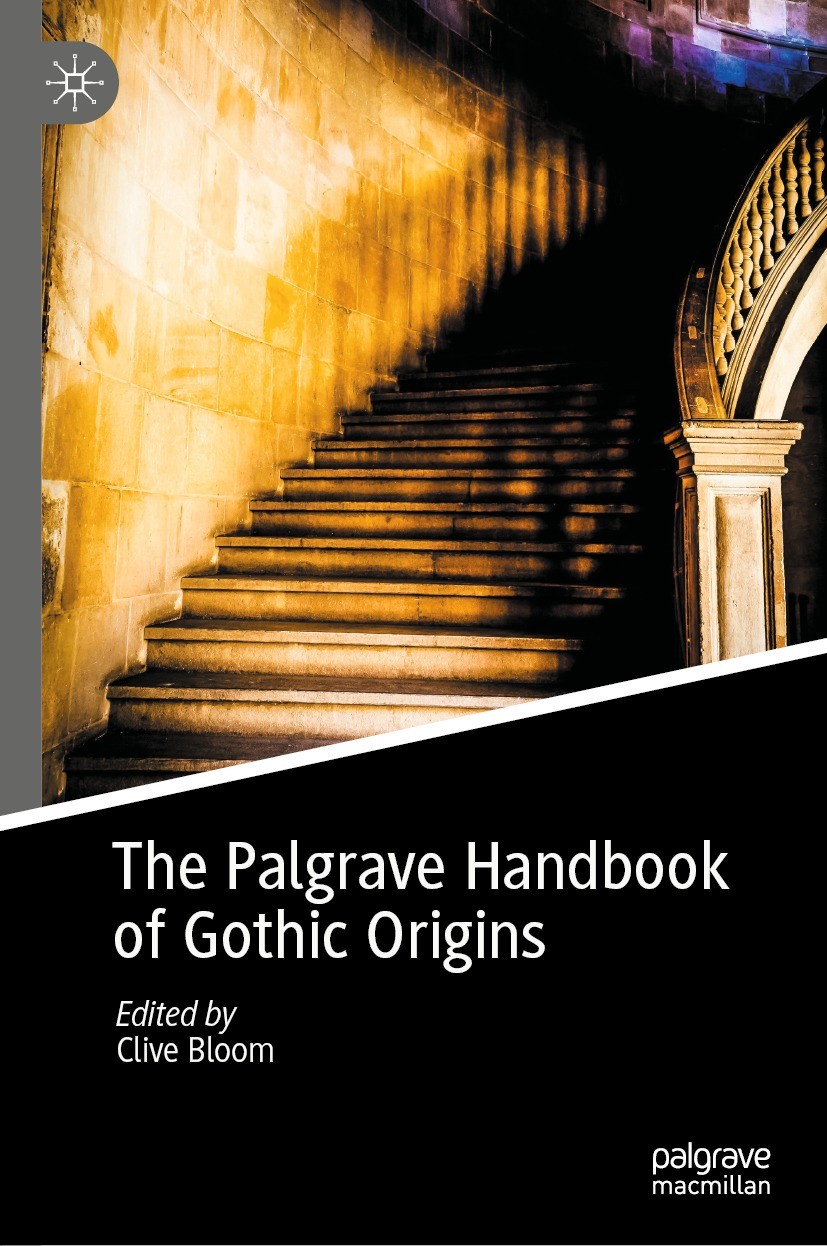
The Palgrave Handbook of Gothic Origins [electronic resource] / edited by Clive Bloom.
Erişim Adresi
ISBN
9783030845629
Dil Kodu
İngilizce
Yer Numarası
EK/4677
Basım Bildirimi
1st ed. 2021.
Yayın Bilgisi
Cham : Springer International Publishing : Imprint: Palgrave Macmillan, 2021.
Fiziksel Niteleme
XVI, 618 p. 24 illus., 18 illus. in color. online resource.
İçindekiler Notu
1. Clive Bloom: Introduction: From Horace Walpole to the Divine Marquis de Sade -- Gothic Ancestors -- 2. Giles Whiteley: Shakespeare, Influence and Appropriation -- 3. Cecilia Lindskog Whiteley: Jacobean Drama and the Macabre -- Gothic Style -- 4. Beatriz Sánchez Santos and Manuel Aguirre: The Grammar of a Genre -- 5. Manuel Aguirre: Formulaic Language -- Sentimental Gothic -- 6. Joan Passey: Ann Radcliffe's Influences and Legacies -- 7. Fanny Lacôte: Ann Radcliffe and the French Revolution -- 8. Kaley Kramer: Forms and Feelings in the Genre -- 9. J.S. Mackley: The re-discovery of Eleanor Sleath -- Gothic Science -- 10. Robert K. Shepherd: Victor Frankenstein Sullies The Book of Splendour -- 11. Marta Vega: The Myth of Frankenstein -- Graveyard Gothic -- 12. Eric Parisot: Graveyard Poetry and the Aesthetics of Horror -- 13. Roger Luckhurst: The Necropolitan Imagination -- 14. Nicola Bowring: Writing the City and Loss in the Work of Thomas De Quincey -- Gothic Poetry -- 15. Maria Giakaniki: The Dark Poetry of Charlotte Dacre -- 16. Kirstin A. Mills: The Poetics of Space, the Mind and the Supernatural in S. T. Coleridge -- Visual Gothic -- 17. James Rattue: Gardens and Designed Landscapes -- 18. Peter N. Lindfield and Dale Townshend: Metaphor and Revivalist Architecture at Strawberry Hill -- 19. David Annwn Jones: The Art of Ghostly Projections -- 20. Simon Bacon: The Nightmare and Proto-vampires -- Gothic Exoticism -- 21. Martina Bartlett: John Polidori’s Mesmerising Vampire -- 22. Naomi Simone Borwein: The Cabinet of Orientalisms -- Gothic Theology and the Mystical -- 23. HollyHirst: Gothic Theologies of the Supernatural -- 24. Miranda Corcoran: Imagining the Occult in the Age of Enlightenment -- 25. Cleo Cameron: Materialism and The Monk -- 26. Charlie Jorge: Between the Nation and the Dark Recesses of the Soul in Charles Maturin -- 27. Joakim Wrethed: Charles Maturin Revisited -- 28. Simon Bacon: The Vrykolokas, the Wandering Jew, and the Flying Dutchman -- 29. Madeline Potter: The Body, Materiality, and Damnation in Charles Maturin. .
Özet, vb.
This handbook provides a comprehensive overview of research on the Gothic Revival. The Gothic Revival was based on emotion rather than reason and when Horace Walpole created Strawberry Hill House, a gleaming white castle on the banks of the Thames, he had to create new words to describe the experience of gothic lifestyle. Nevertheless, Walpole’s house produced nightmares and his book The Castle of Otranto was the first truly gothic novel, with supernatural, sensational and Shakespearean elements challenging the emergent fiction of social relationships. The novel’s themes of violence, tragedy, death, imprisonment, castle battlements, dungeons, fair maidens, secrets, ghosts and prophecies led to a new genre encompassing prose, theatre, poetry and painting, whilst opening up a whole world of imagination for entrepreneurial female writers such as Mary Shelley, Joanna Baillie and Ann Radcliffe, whose immensely popular books led to the intense inner landscapes of the Bronte sisters. Matthew Lewis’s The Monk created a new gothic: atheistic, decadent, perverse, necrophilic and hellish. The social upheaval of the French Revolution and the emergence of the Romantic movement with its more intense (and often) atheistic self-absorption led the gothic into darker corners of human experience with a greater emphasis on the inner life, hallucination, delusion, drug addiction, mental instability, perversion and death and the emerging science of psychology. The intensity of the German experience led to an emphasis on doubles and schizophrenic behaviour, ghosts, spirits, mesmerism, the occult and hell. This volume charts the origins of this major shift in social perceptions and completes a trilogy of Palgrave Handbooks on the Gothic—combined they provide an exhaustive survey of current research in Gothic studies, a go-to for students and researchers alike. Clive Bloom is Emeritus Professor at Middlesex University, UK,and currently, Professor in Residence at the Larkin Centre for Poetry and Creative Writing at Hull University, UK. He has written numerous books on popular literature and Gothic fiction, history and politics. He is a broadcaster and occasional journalist who has been quoted in both the Washington Post and Pravda and has an entry in the Columbia Book of World Quotations.
Konu
Goth culture (Subculture).
Film genres.
Gothic Studies.
Genre Studies.
Film genres.
Gothic Studies.
Genre Studies.
Diğer Yazarlar
Kurum Adı
Eseri Alıntıla
Referansları kullanmadan önce gözden geçirmeniz ve varsa gerekli düzeltmeleri yapmanız önerilir.
Dijital Kaynak
MARC Görünümü
LEADER 06064nam a22004815i 4500
001 841453
003 TR_AnAIT
005 20260715025904
007 cr nn 008mamaa
008 211221s2021 sz | s |||| 0|eng d
020 |a9783030845629|9978-3-030-84562-9
024 7 |a10.1007/978-3-030-84562-9|2doi
041 |aeng
049 |aTürk Dil Kurumu Kütüphanesi
050 4|aHM646
072 7|aJFCA|2bicssc
072 7|aFIC027040|2bisacsh
072 7|aJBCC1|2thema
082 04|a306|223
082 04|a809.38729|223
090 |aEK/4677
245 14|aThe Palgrave Handbook of Gothic Origins|h[electronic resource] /|cedited by Clive Bloom.
250 |a1st ed. 2021.
264 1|aCham :|bSpringer International Publishing :|bImprint: Palgrave Macmillan,|c2021.
300 |aXVI, 618 p. 24 illus., 18 illus. in color.|bonline resource.
336 |atext|btxt|2rdacontent
337 |acomputer|bc|2rdamedia
338 |aonline resource|bcr|2rdacarrier
347 |atext file|bPDF|2rda
505 0 |a1. Clive Bloom: Introduction: From Horace Walpole to the Divine Marquis de Sade -- Gothic Ancestors -- 2. Giles Whiteley: Shakespeare, Influence and Appropriation -- 3. Cecilia Lindskog Whiteley: Jacobean Drama and the Macabre -- Gothic Style -- 4. Beatriz Sánchez Santos and Manuel Aguirre: The Grammar of a Genre -- 5. Manuel Aguirre: Formulaic Language -- Sentimental Gothic -- 6. Joan Passey: Ann Radcliffe's Influences and Legacies -- 7. Fanny Lacôte: Ann Radcliffe and the French Revolution -- 8. Kaley Kramer: Forms and Feelings in the Genre -- 9. J.S. Mackley: The re-discovery of Eleanor Sleath -- Gothic Science -- 10. Robert K. Shepherd: Victor Frankenstein Sullies The Book of Splendour -- 11. Marta Vega: The Myth of Frankenstein -- Graveyard Gothic -- 12. Eric Parisot: Graveyard Poetry and the Aesthetics of Horror -- 13. Roger Luckhurst: The Necropolitan Imagination -- 14. Nicola Bowring: Writing the City and Loss in the Work of Thomas De Quincey -- Gothic Poetry -- 15. Maria Giakaniki: The Dark Poetry of Charlotte Dacre -- 16. Kirstin A. Mills: The Poetics of Space, the Mind and the Supernatural in S. T. Coleridge -- Visual Gothic -- 17. James Rattue: Gardens and Designed Landscapes -- 18. Peter N. Lindfield and Dale Townshend: Metaphor and Revivalist Architecture at Strawberry Hill -- 19. David Annwn Jones: The Art of Ghostly Projections -- 20. Simon Bacon: The Nightmare and Proto-vampires -- Gothic Exoticism -- 21. Martina Bartlett: John Polidori’s Mesmerising Vampire -- 22. Naomi Simone Borwein: The Cabinet of Orientalisms -- Gothic Theology and the Mystical -- 23. HollyHirst: Gothic Theologies of the Supernatural -- 24. Miranda Corcoran: Imagining the Occult in the Age of Enlightenment -- 25. Cleo Cameron: Materialism and The Monk -- 26. Charlie Jorge: Between the Nation and the Dark Recesses of the Soul in Charles Maturin -- 27. Joakim Wrethed: Charles Maturin Revisited -- 28. Simon Bacon: The Vrykolokas, the Wandering Jew, and the Flying Dutchman -- 29. Madeline Potter: The Body, Materiality, and Damnation in Charles Maturin. .
520 |aThis handbook provides a comprehensive overview of research on the Gothic Revival. The Gothic Revival was based on emotion rather than reason and when Horace Walpole created Strawberry Hill House, a gleaming white castle on the banks of the Thames, he had to create new words to describe the experience of gothic lifestyle. Nevertheless, Walpole’s house produced nightmares and his book The Castle of Otranto was the first truly gothic novel, with supernatural, sensational and Shakespearean elements challenging the emergent fiction of social relationships. The novel’s themes of violence, tragedy, death, imprisonment, castle battlements, dungeons, fair maidens, secrets, ghosts and prophecies led to a new genre encompassing prose, theatre, poetry and painting, whilst opening up a whole world of imagination for entrepreneurial female writers such as Mary Shelley, Joanna Baillie and Ann Radcliffe, whose immensely popular books led to the intense inner landscapes of the Bronte sisters. Matthew Lewis’s The Monk created a new gothic: atheistic, decadent, perverse, necrophilic and hellish. The social upheaval of the French Revolution and the emergence of the Romantic movement with its more intense (and often) atheistic self-absorption led the gothic into darker corners of human experience with a greater emphasis on the inner life, hallucination, delusion, drug addiction, mental instability, perversion and death and the emerging science of psychology. The intensity of the German experience led to an emphasis on doubles and schizophrenic behaviour, ghosts, spirits, mesmerism, the occult and hell. This volume charts the origins of this major shift in social perceptions and completes a trilogy of Palgrave Handbooks on the Gothic—combined they provide an exhaustive survey of current research in Gothic studies, a go-to for students and researchers alike. Clive Bloom is Emeritus Professor at Middlesex University, UK,and currently, Professor in Residence at the Larkin Centre for Poetry and Creative Writing at Hull University, UK. He has written numerous books on popular literature and Gothic fiction, history and politics. He is a broadcaster and occasional journalist who has been quoted in both the Washington Post and Pravda and has an entry in the Columbia Book of World Quotations.
650 0|aGoth culture (Subculture).
650 0|aFilm genres.
650 14|aGothic Studies.
650 24|aGenre Studies.
700 1 |aBloom, Clive.|eeditor.|4edt|4http://id.loc.gov/vocabulary/relators/edt
710 2 |aSpringerLink (Online service)
773 0 |tSpringer Nature eBook
776 08|iPrinted edition:|z9783030845612
776 08|iPrinted edition:|z9783030845636
776 08|iPrinted edition:|z9783030845643
856 40|uhttps://doi.org/10.1007/978-3-030-84562-9
912 |aZDB-2-LCM
912 |aZDB-2-SXL
950 |aLiterature, Cultural and Media Studies (SpringerNature-41173)
950 |aLiterature, Cultural and Media Studies (R0) (SpringerNature-43723)
001 841453
003 TR_AnAIT
005 20260715025904
007 cr nn 008mamaa
008 211221s2021 sz | s |||| 0|eng d
020 |a9783030845629|9978-3-030-84562-9
024 7 |a10.1007/978-3-030-84562-9|2doi
041 |aeng
049 |aTürk Dil Kurumu Kütüphanesi
050 4|aHM646
072 7|aJFCA|2bicssc
072 7|aFIC027040|2bisacsh
072 7|aJBCC1|2thema
082 04|a306|223
082 04|a809.38729|223
090 |aEK/4677
245 14|aThe Palgrave Handbook of Gothic Origins|h[electronic resource] /|cedited by Clive Bloom.
250 |a1st ed. 2021.
264 1|aCham :|bSpringer International Publishing :|bImprint: Palgrave Macmillan,|c2021.
300 |aXVI, 618 p. 24 illus., 18 illus. in color.|bonline resource.
336 |atext|btxt|2rdacontent
337 |acomputer|bc|2rdamedia
338 |aonline resource|bcr|2rdacarrier
347 |atext file|bPDF|2rda
505 0 |a1. Clive Bloom: Introduction: From Horace Walpole to the Divine Marquis de Sade -- Gothic Ancestors -- 2. Giles Whiteley: Shakespeare, Influence and Appropriation -- 3. Cecilia Lindskog Whiteley: Jacobean Drama and the Macabre -- Gothic Style -- 4. Beatriz Sánchez Santos and Manuel Aguirre: The Grammar of a Genre -- 5. Manuel Aguirre: Formulaic Language -- Sentimental Gothic -- 6. Joan Passey: Ann Radcliffe's Influences and Legacies -- 7. Fanny Lacôte: Ann Radcliffe and the French Revolution -- 8. Kaley Kramer: Forms and Feelings in the Genre -- 9. J.S. Mackley: The re-discovery of Eleanor Sleath -- Gothic Science -- 10. Robert K. Shepherd: Victor Frankenstein Sullies The Book of Splendour -- 11. Marta Vega: The Myth of Frankenstein -- Graveyard Gothic -- 12. Eric Parisot: Graveyard Poetry and the Aesthetics of Horror -- 13. Roger Luckhurst: The Necropolitan Imagination -- 14. Nicola Bowring: Writing the City and Loss in the Work of Thomas De Quincey -- Gothic Poetry -- 15. Maria Giakaniki: The Dark Poetry of Charlotte Dacre -- 16. Kirstin A. Mills: The Poetics of Space, the Mind and the Supernatural in S. T. Coleridge -- Visual Gothic -- 17. James Rattue: Gardens and Designed Landscapes -- 18. Peter N. Lindfield and Dale Townshend: Metaphor and Revivalist Architecture at Strawberry Hill -- 19. David Annwn Jones: The Art of Ghostly Projections -- 20. Simon Bacon: The Nightmare and Proto-vampires -- Gothic Exoticism -- 21. Martina Bartlett: John Polidori’s Mesmerising Vampire -- 22. Naomi Simone Borwein: The Cabinet of Orientalisms -- Gothic Theology and the Mystical -- 23. HollyHirst: Gothic Theologies of the Supernatural -- 24. Miranda Corcoran: Imagining the Occult in the Age of Enlightenment -- 25. Cleo Cameron: Materialism and The Monk -- 26. Charlie Jorge: Between the Nation and the Dark Recesses of the Soul in Charles Maturin -- 27. Joakim Wrethed: Charles Maturin Revisited -- 28. Simon Bacon: The Vrykolokas, the Wandering Jew, and the Flying Dutchman -- 29. Madeline Potter: The Body, Materiality, and Damnation in Charles Maturin. .
520 |aThis handbook provides a comprehensive overview of research on the Gothic Revival. The Gothic Revival was based on emotion rather than reason and when Horace Walpole created Strawberry Hill House, a gleaming white castle on the banks of the Thames, he had to create new words to describe the experience of gothic lifestyle. Nevertheless, Walpole’s house produced nightmares and his book The Castle of Otranto was the first truly gothic novel, with supernatural, sensational and Shakespearean elements challenging the emergent fiction of social relationships. The novel’s themes of violence, tragedy, death, imprisonment, castle battlements, dungeons, fair maidens, secrets, ghosts and prophecies led to a new genre encompassing prose, theatre, poetry and painting, whilst opening up a whole world of imagination for entrepreneurial female writers such as Mary Shelley, Joanna Baillie and Ann Radcliffe, whose immensely popular books led to the intense inner landscapes of the Bronte sisters. Matthew Lewis’s The Monk created a new gothic: atheistic, decadent, perverse, necrophilic and hellish. The social upheaval of the French Revolution and the emergence of the Romantic movement with its more intense (and often) atheistic self-absorption led the gothic into darker corners of human experience with a greater emphasis on the inner life, hallucination, delusion, drug addiction, mental instability, perversion and death and the emerging science of psychology. The intensity of the German experience led to an emphasis on doubles and schizophrenic behaviour, ghosts, spirits, mesmerism, the occult and hell. This volume charts the origins of this major shift in social perceptions and completes a trilogy of Palgrave Handbooks on the Gothic—combined they provide an exhaustive survey of current research in Gothic studies, a go-to for students and researchers alike. Clive Bloom is Emeritus Professor at Middlesex University, UK,and currently, Professor in Residence at the Larkin Centre for Poetry and Creative Writing at Hull University, UK. He has written numerous books on popular literature and Gothic fiction, history and politics. He is a broadcaster and occasional journalist who has been quoted in both the Washington Post and Pravda and has an entry in the Columbia Book of World Quotations.
650 0|aGoth culture (Subculture).
650 0|aFilm genres.
650 14|aGothic Studies.
650 24|aGenre Studies.
700 1 |aBloom, Clive.|eeditor.|4edt|4http://id.loc.gov/vocabulary/relators/edt
710 2 |aSpringerLink (Online service)
773 0 |tSpringer Nature eBook
776 08|iPrinted edition:|z9783030845612
776 08|iPrinted edition:|z9783030845636
776 08|iPrinted edition:|z9783030845643
856 40|uhttps://doi.org/10.1007/978-3-030-84562-9
912 |aZDB-2-LCM
912 |aZDB-2-SXL
950 |aLiterature, Cultural and Media Studies (SpringerNature-41173)
950 |aLiterature, Cultural and Media Studies (R0) (SpringerNature-43723)
Materyaller
Depodan talep edilen materyal sadece kütüphane içerisinde kullanılmaktadır.
Materyal dışarıya ödünç verilmemektedir.
Materyal dışarıya ödünç verilmemektedir.
