LEADER 03665nam a22005655i 4500
001 841529
003 TR_AnAIT
005 20260715025806
007 cr nn 008mamaa
008 211004s2021 sz | s |||| 0|eng d
020 |a9783030847968|9978-3-030-84796-8
024 7 |a10.1007/978-3-030-84796-8|2doi
041 |aeng
049 |aTürk Dil Kurumu Kütüphanesi
050 4|aHM741-743
072 7|aJFD|2bicssc
072 7|aSOC052000|2bisacsh
072 7|aJBCT1|2thema
082 04|a302.231|223
090 |aEK/4767
100 1 |aCarlson, Bronwyn.|eauthor.|4aut|4http://id.loc.gov/vocabulary/relators/aut
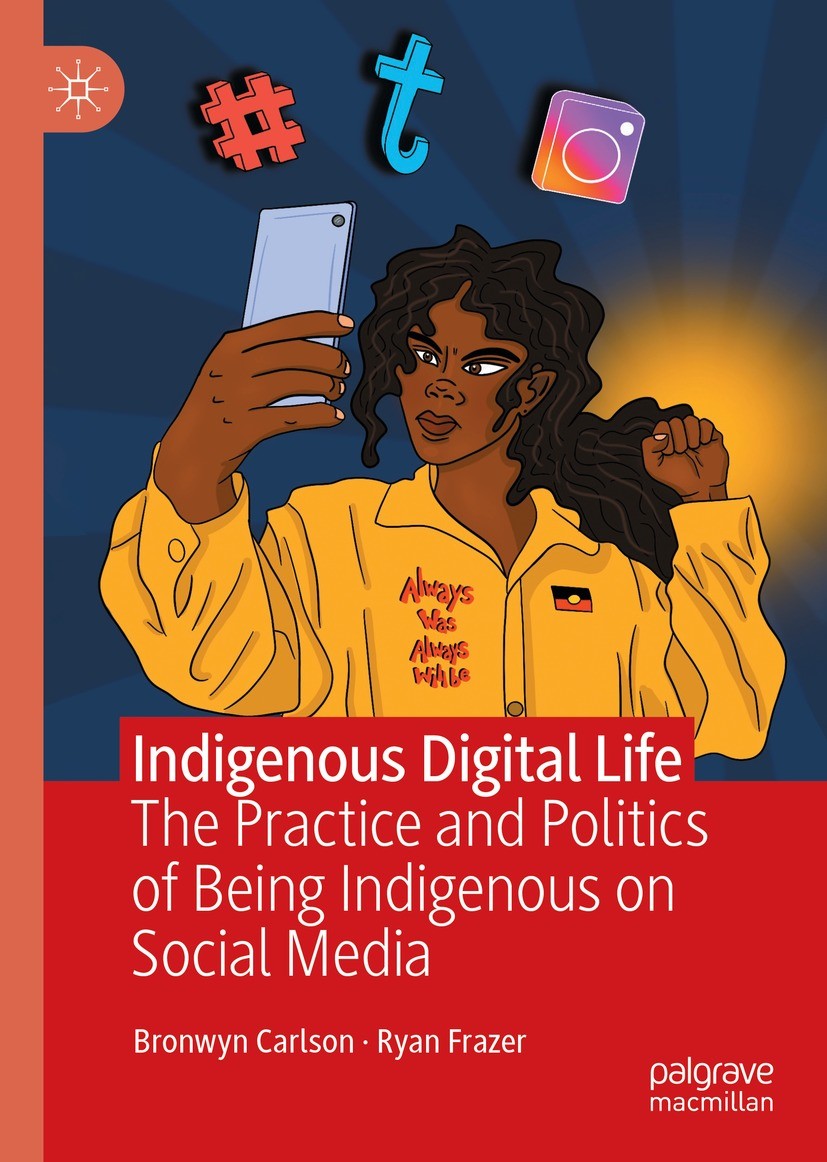
245 10|aIndigenous Digital Life|h[electronic resource] :|bThe Practice and Politics of Being Indigenous on Social Media /|cby Bronwyn Carlson, Ryan Frazer.
250 |a1st ed. 2021.
264 1|aCham :|bSpringer International Publishing :|bImprint: Palgrave Macmillan,|c2021.
300 |aXV, 259 p.|bonline resource.
336 |atext|btxt|2rdacontent
337 |acomputer|bc|2rdamedia
338 |aonline resource|bcr|2rdacarrier
347 |atext file|bPDF|2rda
505 0 |a1. Chapter 1: Openings -- 2. Chapter 2: Identity -- 3. Chapter 3: Community -- 4. Chapter 4: Hate -- 5. Chapter 5: Desire -- 6. Chapter 6: Fun -- 7. Chapter 7: Death -- 8. Chapter 8: Activism -- 9. Chapter 9: Histories -- 10. Chapter 10: Allies -- 11. Chapter 11: Futures.
520 |aSettler societies habitually frame Indigenous people as ‘a people of the past’—their culture somehow ‘frozen’ in time, their identities tied to static notions of ‘authenticity’, and their communities understood as ‘in decline’. But this narrative erases the many ways that Indigenous people are actively engaged in future-orientated practice, including through new technologies. Indigenous Digital Life offers a broad, wide-ranging account of how social media has become embedded in the lives of Indigenous Australians. Centring on ten core themes—including identity, community, hate, desire and death—we seek to understand both the practice and broader politics of being Indigenous on social media. Rather than reproducing settler narratives of Indigenous ‘deficiency’, we approach Indigenous social media as a space of Indigenous action, production, and creativity; we see Indigenous social media users as powerful agents, who interact with and shape their immediate worlds with skill, flair and nous; and instead of being ‘a people of the past’, we show that Indigenous digital life is often future-orientated, working towards building better relations, communities and worlds. This book offers new ideas, insights and provocations for both students and scholars of Indigenous studies, media and communication studies, and cultural studies. .
650 0|aSocial media.
650 0|aCommunication.
650 0|aCulture.
650 0|aAustralasia.
650 0|aDigital media.
650 0|aScience|xSocial aspects.
650 14|aSocial Media.
650 24|aMedia and Communication.
650 24|aAustralasian Culture.
650 24|aDigital and New Media.
650 24|aScience and Technology Studies.
700 1 |aFrazer, Ryan.|eauthor.|4aut|4http://id.loc.gov/vocabulary/relators/aut
710 2 |aSpringerLink (Online service)
773 0 |tSpringer Nature eBook
776 08|iPrinted edition:|z9783030847951
776 08|iPrinted edition:|z9783030847975
776 08|iPrinted edition:|z9783030847982
856 40|uhttps://doi.org/10.1007/978-3-030-84796-8
912 |aZDB-2-LCM
912 |aZDB-2-SXL
950 |aLiterature, Cultural and Media Studies (SpringerNature-41173)
950 |aLiterature, Cultural and Media Studies (R0) (SpringerNature-43723)