

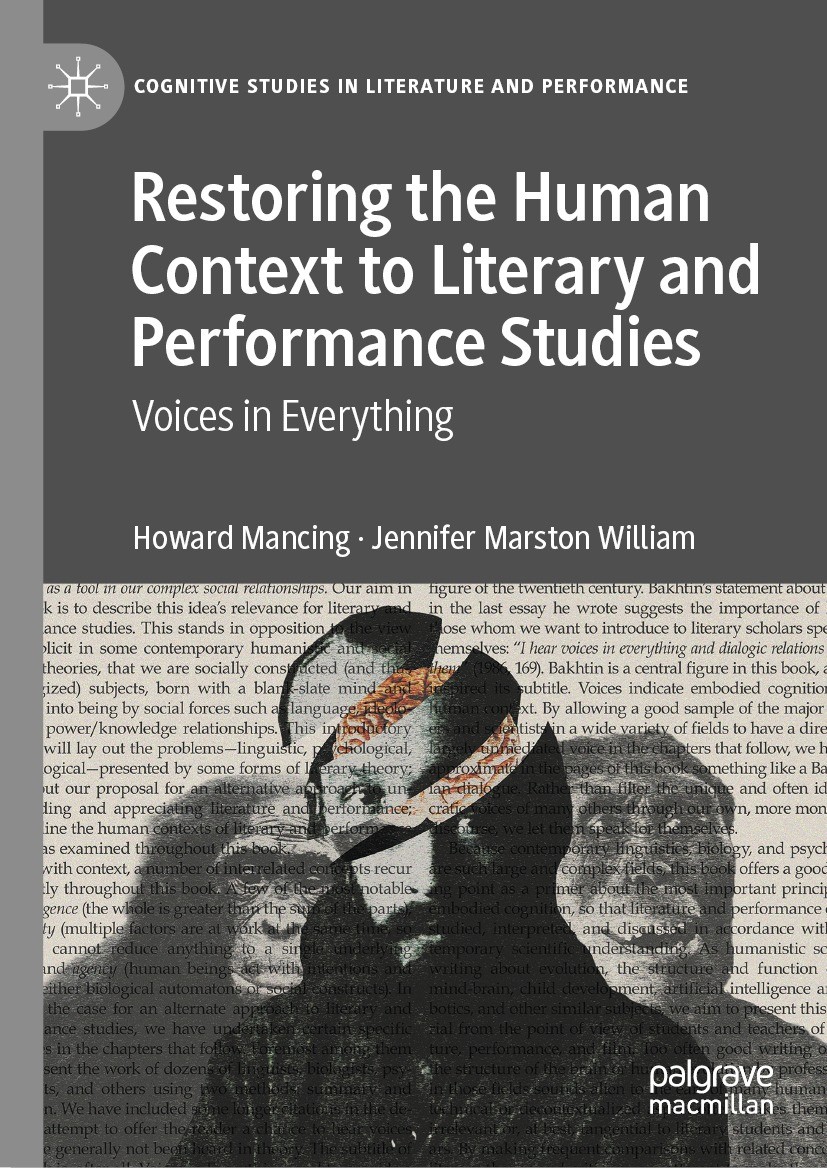
Restoring the Human Context to Literary and Performance Studies [electronic resource] : Voices in Everything / by Howard Mancing, Jennifer Marston William.
Erişim Adresi
ISBN
9783030890780
Dil Kodu
İngilizce
Yer Numarası
EK/4959
Yazar
Basım Bildirimi
1st ed. 2022.
Yayın Bilgisi
Cham : Springer International Publishing : Imprint: Palgrave Macmillan, 2022.
Fiziksel Niteleme
XIV, 400 p. 1 illus. online resource.
Dizi
Cognitive Studies in Literature and Performance, 2945-7300
İçindekiler Notu
Chapter 1. Introduction: The Human Contexts of Literary Studies -- Part I: Linguistics and the Legacy of Bakhtin’s Philosophy of Language -- Chapter 2. Saussurean Linguistics and Bakhtin’s Critique -- Chapter 3. On Theory, Rewriting Saussure, and Chomsky -- Chapter 4. Bakhtin and His Echoes -- Part II: Biology, Language, and the Brain -- Chapter 5. Evolution and Language -- Chapter 6. The Brain -- Chapter 7. Development of the Brain -- Part III: Psychology and the Development of the “Literary Mind” -- Chapter 8. The Mind at Work -- Chapter 9. Development of the Mind -- Chapter 10. Theory of Mind (ToM) -- Part IV: Context in Science and the Humanities -- Chapter 11. Cognitivism -- Chapter 12. Contextualism -- Chapter 13. Evolutionary Psychology -- Part V: Contextualism—Changing the Paradigm in Literary and Performance Studies for the Twenty-First Century -- Chapter 14. Cognitive Literary Studies -- Chapter 15. Cognitive Approaches to Performance Studies -- Chapter 16: Conclusion: The Bridging Function of Contextualism and the Cognitive Paradigm. .
Özet, vb.
Restoring the Human Context to Literary and Performance Studies argues that much of contemporary literary theory is still predicated, at least implicitly, on outdated linguistic and psychological models such as post-structuralism, psychoanalysis, and behaviorism, which significantly contradict current dominant scientific views. By contrast, this monograph promotes an alternative paradigm for literary studies, namely Contextualism, and in so doing highlights the similarities and differences among the sometimes-conflicting contemporary cognitive approaches to literature and performance, arguing not in favor of one over the other but for Contextualism as their common ground. Howard Mancing, who has recently made the transition to Professor Emeritus of Spanish at Purdue University, USA, is a renowned expert on Cervantes and Early Modern Spanish Literature, as well as a pioneer in Cognitive Literary Studies. He has published two monographs: The Chivalric World of Don Quixote: Style, Structure, and Narrative (1982) and Miguel de Cervantes’ ‘Don Quixote’: A Reference Guide (2006), and coedited three volumes of essay collections. In addition, he authored the two-volume Cervantes Encyclopedia in 2004. Howard has also written numerous journal articles and book chapters on Cognitive Studies topics such as embodied cognition, narrative and affect and Theory of Mind representations in literature. Jennifer Marston William is a Professor of German with specializations in twentieth and twenty-first century literature and film. She is currently serving as the Head of the School of Languages and Cultures at Purdue University, USA. Jennifer’s second monograph, Cognitive Approaches to German Historical Film: Seeing is Not Believing, was published with Palgrave in 2017, and she has published scholarly articles and book chapters on conceptual metaphor and on literary analyses from the perspective of Theory of Mind. She is also a co-founder, with Howard Mancing, of the Center for Cognitive Literary Studies at Purdue, which has existed since 2008 and was recently renamed the Center for Neurohumanities.
Konu
Literature __ Philosophy.
Performing arts.
Theater.
Cognitive science.
Cognitive psychology.
Literary Theory.
Theatre and Performance Arts.
Cognitive Science.
Cognitive Psychology.
Performing arts.
Theater.
Cognitive science.
Cognitive psychology.
Literary Theory.
Theatre and Performance Arts.
Cognitive Science.
Cognitive Psychology.
Diğer Yazarlar
Kurum Adı
Eseri Alıntıla
Referansları kullanmadan önce gözden geçirmeniz ve varsa gerekli düzeltmeleri yapmanız önerilir.
Dijital Kaynak
MARC Görünümü
LEADER 05330nam a22005655i 4500
001 841658
003 TR_AnAIT
005 20260715025453
007 cr nn 008mamaa
008 220128s2022 sz | s |||| 0|eng d
020 |a9783030890780|9978-3-030-89078-0
024 7 |a10.1007/978-3-030-89078-0|2doi
041 |aeng
049 |aTürk Dil Kurumu Kütüphanesi
050 4|aPN45-57
072 7|aDSA|2bicssc
072 7|aLIT006000|2bisacsh
072 7|aDSA|2thema
082 04|a801|223
090 |aEK/4959
100 1 |aMancing, Howard.|eauthor.|4aut|4http://id.loc.gov/vocabulary/relators/aut
245 10|aRestoring the Human Context to Literary and Performance Studies|h[electronic resource] :|bVoices in Everything /|cby Howard Mancing, Jennifer Marston William.
250 |a1st ed. 2022.
264 1|aCham :|bSpringer International Publishing :|bImprint: Palgrave Macmillan,|c2022.
300 |aXIV, 400 p. 1 illus.|bonline resource.
336 |atext|btxt|2rdacontent
337 |acomputer|bc|2rdamedia
338 |aonline resource|bcr|2rdacarrier
347 |atext file|bPDF|2rda
490 1 |aCognitive Studies in Literature and Performance,|x2945-7300
505 0 |aChapter 1. Introduction: The Human Contexts of Literary Studies -- Part I: Linguistics and the Legacy of Bakhtin’s Philosophy of Language -- Chapter 2. Saussurean Linguistics and Bakhtin’s Critique -- Chapter 3. On Theory, Rewriting Saussure, and Chomsky -- Chapter 4. Bakhtin and His Echoes -- Part II: Biology, Language, and the Brain -- Chapter 5. Evolution and Language -- Chapter 6. The Brain -- Chapter 7. Development of the Brain -- Part III: Psychology and the Development of the “Literary Mind” -- Chapter 8. The Mind at Work -- Chapter 9. Development of the Mind -- Chapter 10. Theory of Mind (ToM) -- Part IV: Context in Science and the Humanities -- Chapter 11. Cognitivism -- Chapter 12. Contextualism -- Chapter 13. Evolutionary Psychology -- Part V: Contextualism—Changing the Paradigm in Literary and Performance Studies for the Twenty-First Century -- Chapter 14. Cognitive Literary Studies -- Chapter 15. Cognitive Approaches to Performance Studies -- Chapter 16: Conclusion: The Bridging Function of Contextualism and the Cognitive Paradigm. .
520 |aRestoring the Human Context to Literary and Performance Studies argues that much of contemporary literary theory is still predicated, at least implicitly, on outdated linguistic and psychological models such as post-structuralism, psychoanalysis, and behaviorism, which significantly contradict current dominant scientific views. By contrast, this monograph promotes an alternative paradigm for literary studies, namely Contextualism, and in so doing highlights the similarities and differences among the sometimes-conflicting contemporary cognitive approaches to literature and performance, arguing not in favor of one over the other but for Contextualism as their common ground. Howard Mancing, who has recently made the transition to Professor Emeritus of Spanish at Purdue University, USA, is a renowned expert on Cervantes and Early Modern Spanish Literature, as well as a pioneer in Cognitive Literary Studies. He has published two monographs: The Chivalric World of Don Quixote: Style, Structure, and Narrative (1982) and Miguel de Cervantes’ ‘Don Quixote’: A Reference Guide (2006), and coedited three volumes of essay collections. In addition, he authored the two-volume Cervantes Encyclopedia in 2004. Howard has also written numerous journal articles and book chapters on Cognitive Studies topics such as embodied cognition, narrative and affect and Theory of Mind representations in literature. Jennifer Marston William is a Professor of German with specializations in twentieth and twenty-first century literature and film. She is currently serving as the Head of the School of Languages and Cultures at Purdue University, USA. Jennifer’s second monograph, Cognitive Approaches to German Historical Film: Seeing is Not Believing, was published with Palgrave in 2017, and she has published scholarly articles and book chapters on conceptual metaphor and on literary analyses from the perspective of Theory of Mind. She is also a co-founder, with Howard Mancing, of the Center for Cognitive Literary Studies at Purdue, which has existed since 2008 and was recently renamed the Center for Neurohumanities.
650 0|aLiterature|xPhilosophy.
650 0|aPerforming arts.
650 0|aTheater.
650 0|aCognitive science.
650 0|aCognitive psychology.
650 14|aLiterary Theory.
650 24|aTheatre and Performance Arts.
650 24|aCognitive Science.
650 24|aCognitive Psychology.
700 1 |aMarston William, Jennifer.|eauthor.|4aut|4http://id.loc.gov/vocabulary/relators/aut
710 2 |aSpringerLink (Online service)
773 0 |tSpringer Nature eBook
776 08|iPrinted edition:|z9783030890773
776 08|iPrinted edition:|z9783030890797
776 08|iPrinted edition:|z9783030890803
830 0|aCognitive Studies in Literature and Performance,|x2945-7300
856 40|uhttps://doi.org/10.1007/978-3-030-89078-0
912 |aZDB-2-LCM
912 |aZDB-2-SXL
950 |aLiterature, Cultural and Media Studies (SpringerNature-41173)
950 |aLiterature, Cultural and Media Studies (R0) (SpringerNature-43723)
001 841658
003 TR_AnAIT
005 20260715025453
007 cr nn 008mamaa
008 220128s2022 sz | s |||| 0|eng d
020 |a9783030890780|9978-3-030-89078-0
024 7 |a10.1007/978-3-030-89078-0|2doi
041 |aeng
049 |aTürk Dil Kurumu Kütüphanesi
050 4|aPN45-57
072 7|aDSA|2bicssc
072 7|aLIT006000|2bisacsh
072 7|aDSA|2thema
082 04|a801|223
090 |aEK/4959
100 1 |aMancing, Howard.|eauthor.|4aut|4http://id.loc.gov/vocabulary/relators/aut
245 10|aRestoring the Human Context to Literary and Performance Studies|h[electronic resource] :|bVoices in Everything /|cby Howard Mancing, Jennifer Marston William.
250 |a1st ed. 2022.
264 1|aCham :|bSpringer International Publishing :|bImprint: Palgrave Macmillan,|c2022.
300 |aXIV, 400 p. 1 illus.|bonline resource.
336 |atext|btxt|2rdacontent
337 |acomputer|bc|2rdamedia
338 |aonline resource|bcr|2rdacarrier
347 |atext file|bPDF|2rda
490 1 |aCognitive Studies in Literature and Performance,|x2945-7300
505 0 |aChapter 1. Introduction: The Human Contexts of Literary Studies -- Part I: Linguistics and the Legacy of Bakhtin’s Philosophy of Language -- Chapter 2. Saussurean Linguistics and Bakhtin’s Critique -- Chapter 3. On Theory, Rewriting Saussure, and Chomsky -- Chapter 4. Bakhtin and His Echoes -- Part II: Biology, Language, and the Brain -- Chapter 5. Evolution and Language -- Chapter 6. The Brain -- Chapter 7. Development of the Brain -- Part III: Psychology and the Development of the “Literary Mind” -- Chapter 8. The Mind at Work -- Chapter 9. Development of the Mind -- Chapter 10. Theory of Mind (ToM) -- Part IV: Context in Science and the Humanities -- Chapter 11. Cognitivism -- Chapter 12. Contextualism -- Chapter 13. Evolutionary Psychology -- Part V: Contextualism—Changing the Paradigm in Literary and Performance Studies for the Twenty-First Century -- Chapter 14. Cognitive Literary Studies -- Chapter 15. Cognitive Approaches to Performance Studies -- Chapter 16: Conclusion: The Bridging Function of Contextualism and the Cognitive Paradigm. .
520 |aRestoring the Human Context to Literary and Performance Studies argues that much of contemporary literary theory is still predicated, at least implicitly, on outdated linguistic and psychological models such as post-structuralism, psychoanalysis, and behaviorism, which significantly contradict current dominant scientific views. By contrast, this monograph promotes an alternative paradigm for literary studies, namely Contextualism, and in so doing highlights the similarities and differences among the sometimes-conflicting contemporary cognitive approaches to literature and performance, arguing not in favor of one over the other but for Contextualism as their common ground. Howard Mancing, who has recently made the transition to Professor Emeritus of Spanish at Purdue University, USA, is a renowned expert on Cervantes and Early Modern Spanish Literature, as well as a pioneer in Cognitive Literary Studies. He has published two monographs: The Chivalric World of Don Quixote: Style, Structure, and Narrative (1982) and Miguel de Cervantes’ ‘Don Quixote’: A Reference Guide (2006), and coedited three volumes of essay collections. In addition, he authored the two-volume Cervantes Encyclopedia in 2004. Howard has also written numerous journal articles and book chapters on Cognitive Studies topics such as embodied cognition, narrative and affect and Theory of Mind representations in literature. Jennifer Marston William is a Professor of German with specializations in twentieth and twenty-first century literature and film. She is currently serving as the Head of the School of Languages and Cultures at Purdue University, USA. Jennifer’s second monograph, Cognitive Approaches to German Historical Film: Seeing is Not Believing, was published with Palgrave in 2017, and she has published scholarly articles and book chapters on conceptual metaphor and on literary analyses from the perspective of Theory of Mind. She is also a co-founder, with Howard Mancing, of the Center for Cognitive Literary Studies at Purdue, which has existed since 2008 and was recently renamed the Center for Neurohumanities.
650 0|aLiterature|xPhilosophy.
650 0|aPerforming arts.
650 0|aTheater.
650 0|aCognitive science.
650 0|aCognitive psychology.
650 14|aLiterary Theory.
650 24|aTheatre and Performance Arts.
650 24|aCognitive Science.
650 24|aCognitive Psychology.
700 1 |aMarston William, Jennifer.|eauthor.|4aut|4http://id.loc.gov/vocabulary/relators/aut
710 2 |aSpringerLink (Online service)
773 0 |tSpringer Nature eBook
776 08|iPrinted edition:|z9783030890773
776 08|iPrinted edition:|z9783030890797
776 08|iPrinted edition:|z9783030890803
830 0|aCognitive Studies in Literature and Performance,|x2945-7300
856 40|uhttps://doi.org/10.1007/978-3-030-89078-0
912 |aZDB-2-LCM
912 |aZDB-2-SXL
950 |aLiterature, Cultural and Media Studies (SpringerNature-41173)
950 |aLiterature, Cultural and Media Studies (R0) (SpringerNature-43723)
Materyaller
Depodan talep edilen materyal sadece kütüphane içerisinde kullanılmaktadır.
Materyal dışarıya ödünç verilmemektedir.
Materyal dışarıya ödünç verilmemektedir.
