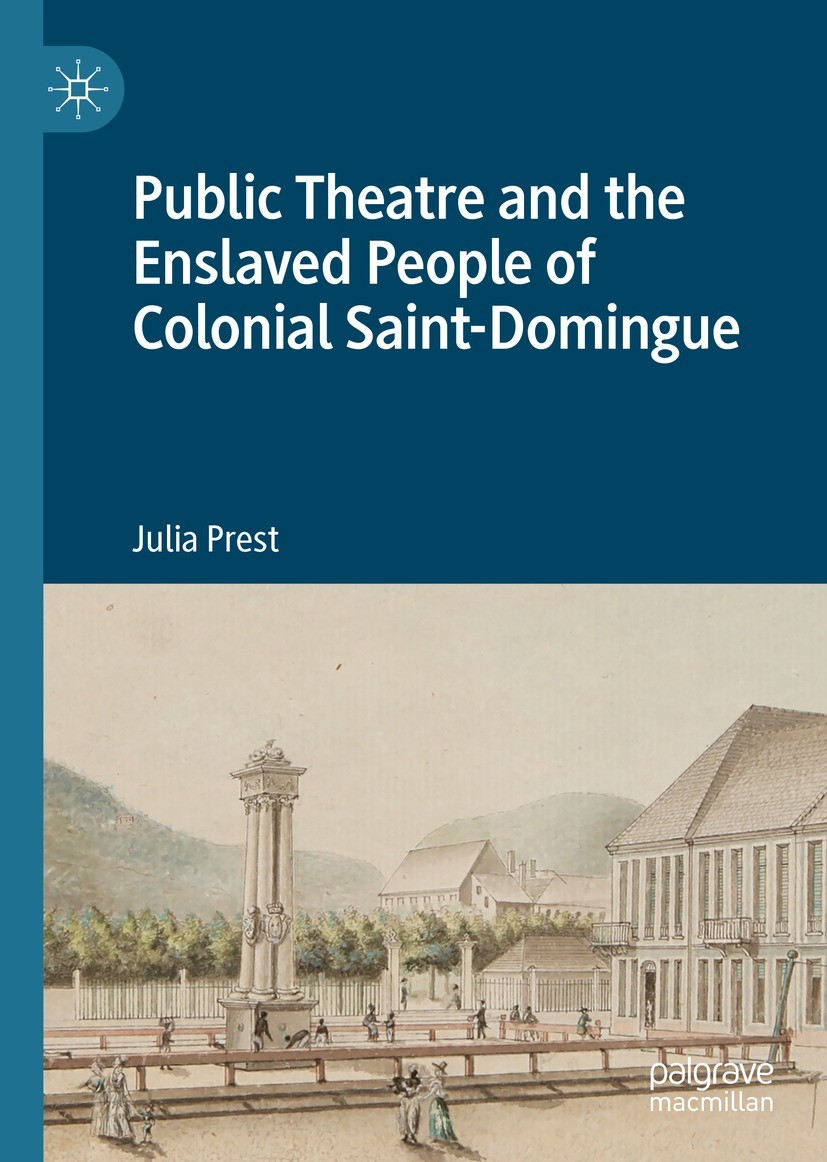
Public Theatre and the Enslaved People of Colonial Saint-Domingue [electronic resource] / by Julia Prest.
Erişim Adresi
ISBN
9783031226915
Dil Kodu
İngilizce
Yer Numarası
EK/4976
Basım Bildirimi
1st ed. 2023.
Yayın Bilgisi
Cham : Springer International Publishing : Imprint: Palgrave Macmillan, 2023.
Fiziksel Niteleme
XVI, 278 p. online resource.
İçindekiler Notu
1 Introduction -- 2 Mitigated Spectators: Enslaved People in the Playhouse -- 3 Unsustainable Tensions: ‘Slave Ownership’ among Theatre-Makers -- 4 Mitigated Portrayals: Enslaved Figures in Creole Repertoire -- 5 Concealed Contributors: Enslaved Participation in Theatre-Making -- 6 New Citizens: Shifting Roles in Revolutionary-Era Theatre -- 7 Conclusion.
Özet, vb.
“[This] is an exciting and impressive project that presents the first study of public theatre and slavery in the French colony of Saint-Domingue. Prof. Prest brings to bear a remarkable corpus of sources, from notarial records and eyewitness accounts to newspaper adverts, published treatises, and the texts of plays, to advance a series of significant, groundbreaking findings.” —Christy Pichichero, George Mason University, Fairfax, USA “‘Un-silencing’ the enslaved Haitians who built the theaters, changed the scenery, and played the accompaniments, Julia Prest discovers new worlds backstage in the theaters of eighteenth-century Saint-Domingue—an exemplary study in the method and imagination required of voicing muted histories.” —Joseph Roach, Yale University, Connecticut, USA The French colony of Saint-Domingue (now Haiti) was home to one of the richest public theatre traditions of the colonial-era Caribbean. This book examines the relationship between public theatre and the enslaved people of Saint-Domingue—something that is generally given short shrift owing to a perceived lack of documentation. Here, a range of materials and methodologies are used to explore pressing questions including the ‘mitigated spectatorship’ of the enslaved, portrayals of enslaved people in French and Creole repertoire, the contributions of enslaved people to theatre-making, and shifting attitudes during the revolutionary era. The book demonstrates that slavery was no mere backdrop to this portion of theatre history but an integral part of its story. It also helps recover the hidden experiences of some of the enslaved individuals who became entangled in that story. Julia Prest is Professor of French and Caribbean Studies at the University of St Andrews, Scotland, UK. She has published widely on early-modern French and Caribbean theatre, opera and dance, and is the creator of the trilingual (English-French-Kreyòl) Theatre in Saint-Domingue, 1764-1791 performance database: 'theatreinsaintdomingue.org'. She has collaborated with theatre-makers to create new works that bring colonial-era theatre to today’s audiences, and her edited collection, Colonial-Era Caribbean Theatre: Issues in Research, Writing and Methodology is forthcoming in 2023.
Konu
Theater __ History.
Theater.
Imperialism.
America __ History.
Theatre History.
Global and International Theatre and Performance.
Imperialism and Colonialism.
History of the Americas.
Theater.
Imperialism.
America __ History.
Theatre History.
Global and International Theatre and Performance.
Imperialism and Colonialism.
History of the Americas.
Kurum Adı

Eseri Alıntıla
Referansları kullanmadan önce gözden geçirmeniz ve varsa gerekli düzeltmeleri yapmanız önerilir.
Dijital Kaynak
MARC Görünümü
LEADER 05805nam a22006615i 4500
001 841789
003 TR_AnAIT
005 20260715025121
007 cr nn 008mamaa
008 230413s2023 sz | s |||| 0|eng d
020 |a9783031226915|9978-3-031-22691-5
024 7 |a10.1007/978-3-031-22691-5|2doi
041 |aeng
049 |aTürk Dil Kurumu Kütüphanesi
050 4|aPN2100-2193
072 7|aAN|2bicssc
072 7|aHBT|2bicssc
072 7|aPER011020|2bisacsh
072 7|aATD|2thema
072 7|aATY|2thema
082 04|a792.09|223
090 |aEK/4976
100 1 |aPrest, Julia.|eauthor.|0(orcid)0000-0002-3266-7390|1https://orcid.org/0000-0002-3266-7390|4aut|4http://id.loc.gov/vocabulary/relators/aut
245 10|aPublic Theatre and the Enslaved People of Colonial Saint-Domingue|h[electronic resource] /|cby Julia Prest.
250 |a1st ed. 2023.
264 1|aCham :|bSpringer International Publishing :|bImprint: Palgrave Macmillan,|c2023.
300 |aXVI, 278 p.|bonline resource.
336 |atext|btxt|2rdacontent
337 |acomputer|bc|2rdamedia
338 |aonline resource|bcr|2rdacarrier
341 0 |bTable of contents navigation|2onix
341 0 |bSingle logical reading order|2onix
341 0 |bShort alternative textual descriptions|2onix
341 0 |bUse of color is not sole means of conveying information|2onix
341 0 |bUse of high contrast between text and background color|2onix
341 0 |bNext / Previous structural navigation|2onix
341 0 |bAll non-decorative content supports reading without sight|2onix
347 |atext file|bPDF|2rda
505 0 |a1 Introduction -- 2 Mitigated Spectators: Enslaved People in the Playhouse -- 3 Unsustainable Tensions: ‘Slave Ownership’ among Theatre-Makers -- 4 Mitigated Portrayals: Enslaved Figures in Creole Repertoire -- 5 Concealed Contributors: Enslaved Participation in Theatre-Making -- 6 New Citizens: Shifting Roles in Revolutionary-Era Theatre -- 7 Conclusion.
520 |a“[This] is an exciting and impressive project that presents the first study of public theatre and slavery in the French colony of Saint-Domingue. Prof. Prest brings to bear a remarkable corpus of sources, from notarial records and eyewitness accounts to newspaper adverts, published treatises, and the texts of plays, to advance a series of significant, groundbreaking findings.” —Christy Pichichero, George Mason University, Fairfax, USA “‘Un-silencing’ the enslaved Haitians who built the theaters, changed the scenery, and played the accompaniments, Julia Prest discovers new worlds backstage in the theaters of eighteenth-century Saint-Domingue—an exemplary study in the method and imagination required of voicing muted histories.” —Joseph Roach, Yale University, Connecticut, USA The French colony of Saint-Domingue (now Haiti) was home to one of the richest public theatre traditions of the colonial-era Caribbean. This book examines the relationship between public theatre and the enslaved people of Saint-Domingue—something that is generally given short shrift owing to a perceived lack of documentation. Here, a range of materials and methodologies are used to explore pressing questions including the ‘mitigated spectatorship’ of the enslaved, portrayals of enslaved people in French and Creole repertoire, the contributions of enslaved people to theatre-making, and shifting attitudes during the revolutionary era. The book demonstrates that slavery was no mere backdrop to this portion of theatre history but an integral part of its story. It also helps recover the hidden experiences of some of the enslaved individuals who became entangled in that story. Julia Prest is Professor of French and Caribbean Studies at the University of St Andrews, Scotland, UK. She has published widely on early-modern French and Caribbean theatre, opera and dance, and is the creator of the trilingual (English-French-Kreyòl) Theatre in Saint-Domingue, 1764-1791 performance database: 'theatreinsaintdomingue.org'. She has collaborated with theatre-makers to create new works that bring colonial-era theatre to today’s audiences, and her edited collection, Colonial-Era Caribbean Theatre: Issues in Research, Writing and Methodology is forthcoming in 2023.
532 8 |aAccessibility summary: This PDF does not fully comply with PDF/UA standards, but does feature limited screen reader support, described non-text content (images, graphs), bookmarks for easy navigation and searchable, selectable text. Users of assistive technologies may experience difficulty navigating or interpreting content in this document. We recognize the importance of accessibility, and we welcome queries about accessibility for any of our products. If you have a question or an access need, please get in touch with us at accessibilitysupport@springernature.com.
532 8 |aNo reading system accessibility options actively disabled
532 8 |aPublisher contact for further accessibility information: accessibilitysupport@springernature.com
650 0|aTheater|xHistory.
650 0|aTheater.
650 0|aImperialism.
650 0|aAmerica|xHistory.
650 14|aTheatre History.
650 24|aGlobal and International Theatre and Performance.
650 24|aImperialism and Colonialism.
650 24|aHistory of the Americas.
710 2 |aSpringerLink (Online service)
773 0 |tSpringer Nature eBook
776 08|iPrinted edition:|z9783031226908
776 08|iPrinted edition:|z9783031226922
776 08|iPrinted edition:|z9783031226939
856 40|uhttps://doi.org/10.1007/978-3-031-22691-5
912 |aZDB-2-LCM
912 |aZDB-2-SXL
950 |aLiterature, Cultural and Media Studies (SpringerNature-41173)
950 |aLiterature, Cultural and Media Studies (R0) (SpringerNature-43723)
001 841789
003 TR_AnAIT
005 20260715025121
007 cr nn 008mamaa
008 230413s2023 sz | s |||| 0|eng d
020 |a9783031226915|9978-3-031-22691-5
024 7 |a10.1007/978-3-031-22691-5|2doi
041 |aeng
049 |aTürk Dil Kurumu Kütüphanesi
050 4|aPN2100-2193
072 7|aAN|2bicssc
072 7|aHBT|2bicssc
072 7|aPER011020|2bisacsh
072 7|aATD|2thema
072 7|aATY|2thema
082 04|a792.09|223
090 |aEK/4976
100 1 |aPrest, Julia.|eauthor.|0(orcid)0000-0002-3266-7390|1https://orcid.org/0000-0002-3266-7390|4aut|4http://id.loc.gov/vocabulary/relators/aut
245 10|aPublic Theatre and the Enslaved People of Colonial Saint-Domingue|h[electronic resource] /|cby Julia Prest.
250 |a1st ed. 2023.
264 1|aCham :|bSpringer International Publishing :|bImprint: Palgrave Macmillan,|c2023.
300 |aXVI, 278 p.|bonline resource.
336 |atext|btxt|2rdacontent
337 |acomputer|bc|2rdamedia
338 |aonline resource|bcr|2rdacarrier
341 0 |bTable of contents navigation|2onix
341 0 |bSingle logical reading order|2onix
341 0 |bShort alternative textual descriptions|2onix
341 0 |bUse of color is not sole means of conveying information|2onix
341 0 |bUse of high contrast between text and background color|2onix
341 0 |bNext / Previous structural navigation|2onix
341 0 |bAll non-decorative content supports reading without sight|2onix
347 |atext file|bPDF|2rda
505 0 |a1 Introduction -- 2 Mitigated Spectators: Enslaved People in the Playhouse -- 3 Unsustainable Tensions: ‘Slave Ownership’ among Theatre-Makers -- 4 Mitigated Portrayals: Enslaved Figures in Creole Repertoire -- 5 Concealed Contributors: Enslaved Participation in Theatre-Making -- 6 New Citizens: Shifting Roles in Revolutionary-Era Theatre -- 7 Conclusion.
520 |a“[This] is an exciting and impressive project that presents the first study of public theatre and slavery in the French colony of Saint-Domingue. Prof. Prest brings to bear a remarkable corpus of sources, from notarial records and eyewitness accounts to newspaper adverts, published treatises, and the texts of plays, to advance a series of significant, groundbreaking findings.” —Christy Pichichero, George Mason University, Fairfax, USA “‘Un-silencing’ the enslaved Haitians who built the theaters, changed the scenery, and played the accompaniments, Julia Prest discovers new worlds backstage in the theaters of eighteenth-century Saint-Domingue—an exemplary study in the method and imagination required of voicing muted histories.” —Joseph Roach, Yale University, Connecticut, USA The French colony of Saint-Domingue (now Haiti) was home to one of the richest public theatre traditions of the colonial-era Caribbean. This book examines the relationship between public theatre and the enslaved people of Saint-Domingue—something that is generally given short shrift owing to a perceived lack of documentation. Here, a range of materials and methodologies are used to explore pressing questions including the ‘mitigated spectatorship’ of the enslaved, portrayals of enslaved people in French and Creole repertoire, the contributions of enslaved people to theatre-making, and shifting attitudes during the revolutionary era. The book demonstrates that slavery was no mere backdrop to this portion of theatre history but an integral part of its story. It also helps recover the hidden experiences of some of the enslaved individuals who became entangled in that story. Julia Prest is Professor of French and Caribbean Studies at the University of St Andrews, Scotland, UK. She has published widely on early-modern French and Caribbean theatre, opera and dance, and is the creator of the trilingual (English-French-Kreyòl) Theatre in Saint-Domingue, 1764-1791 performance database: 'theatreinsaintdomingue.org'. She has collaborated with theatre-makers to create new works that bring colonial-era theatre to today’s audiences, and her edited collection, Colonial-Era Caribbean Theatre: Issues in Research, Writing and Methodology is forthcoming in 2023.
532 8 |aAccessibility summary: This PDF does not fully comply with PDF/UA standards, but does feature limited screen reader support, described non-text content (images, graphs), bookmarks for easy navigation and searchable, selectable text. Users of assistive technologies may experience difficulty navigating or interpreting content in this document. We recognize the importance of accessibility, and we welcome queries about accessibility for any of our products. If you have a question or an access need, please get in touch with us at accessibilitysupport@springernature.com.
532 8 |aNo reading system accessibility options actively disabled
532 8 |aPublisher contact for further accessibility information: accessibilitysupport@springernature.com
650 0|aTheater|xHistory.
650 0|aTheater.
650 0|aImperialism.
650 0|aAmerica|xHistory.
650 14|aTheatre History.
650 24|aGlobal and International Theatre and Performance.
650 24|aImperialism and Colonialism.
650 24|aHistory of the Americas.
710 2 |aSpringerLink (Online service)
773 0 |tSpringer Nature eBook
776 08|iPrinted edition:|z9783031226908
776 08|iPrinted edition:|z9783031226922
776 08|iPrinted edition:|z9783031226939
856 40|uhttps://doi.org/10.1007/978-3-031-22691-5
912 |aZDB-2-LCM
912 |aZDB-2-SXL
950 |aLiterature, Cultural and Media Studies (SpringerNature-41173)
950 |aLiterature, Cultural and Media Studies (R0) (SpringerNature-43723)
Materyaller
Depodan talep edilen materyal sadece kütüphane içerisinde kullanılmaktadır.
Materyal dışarıya ödünç verilmemektedir.
