

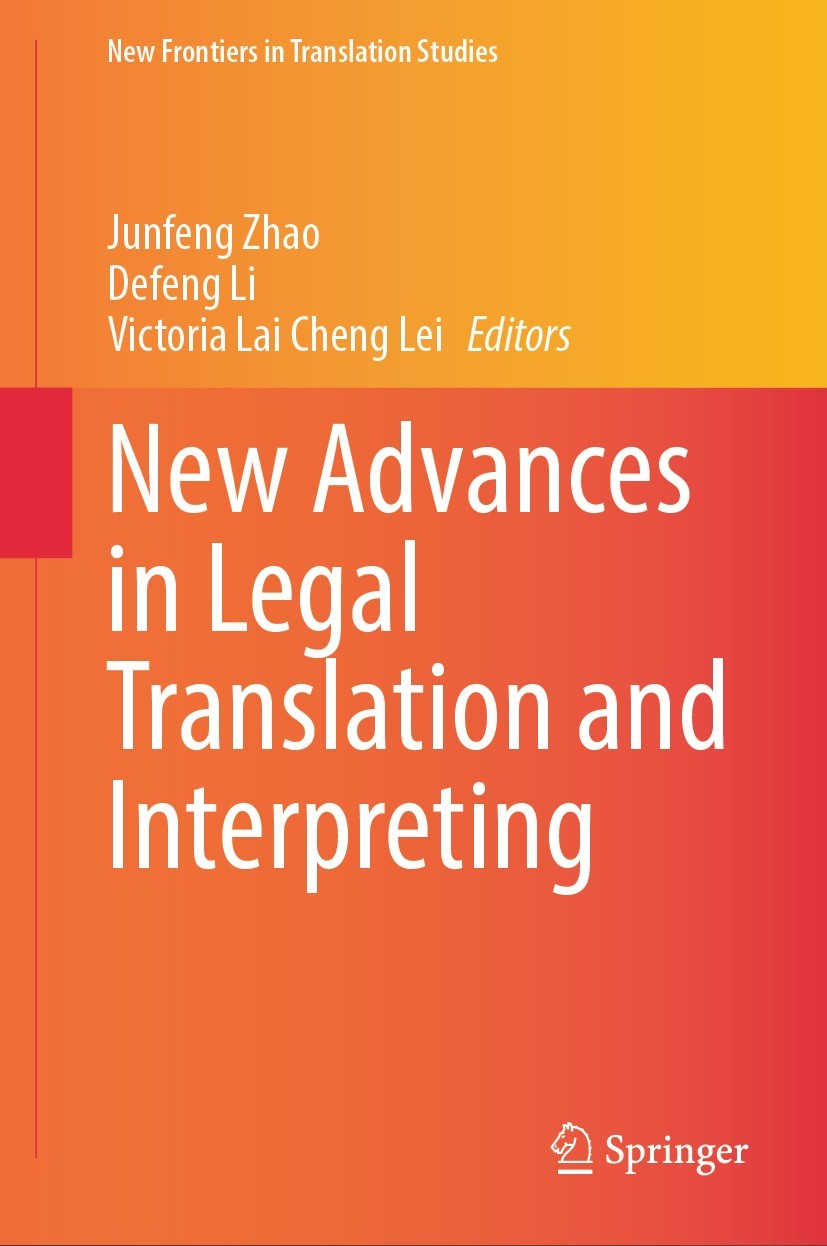
New Advances in Legal Translation and Interpreting [electronic resource] / edited by Junfeng Zhao, Defeng Li, Victoria Lai Cheng Lei.
Erişim Adresi
ISBN
9789811994227
Dil Kodu
İngilizce
Yer Numarası
EK/5322
Basım Bildirimi
1st ed. 2023.
Yayın Bilgisi
Singapore : Springer Nature Singapore : Imprint: Springer, 2023.
Fiziksel Niteleme
IX, 264 p. 55 illus., 4 illus. in color. online resource.
Dizi
New Frontiers in Translation Studies, 2197-8697
İçindekiler Notu
Part I Theoretical Issues -- Chapter 1. Legal Translation: Current Issues and Challenges in Research -- Chapter 2. Multilingual Lawmaking and Legal (Un)Certainty -- Chapter 3. Interpreting in Legal Settings. Chapter 5. Legal Linguistics and legal translation -- Chapter 6. Ethics in legal translation and interpreting -- Chapter 7. Legal translation in intercultural communications -- Chapter 8. Legal translation and soft power -- Chapter 9. Popular Participation in the Japanese Legal Process -- Chapter 10. Law, State, and Society in Early Imperial China -- Chapter 11Equivalence in Legal Translation: From a sociosemiotic perspective -- Chapter 12. Evolutionary and revolutionary changes in legal terminology.-Chapter 13. Translating synonymous legal terms: A mixed-genre parallel corpus study -- Part II Methods and Practices of Legal Translation -- Chapter 14. Legal Translation and Bilingual Law Drafting in Hong Kong -- Chapter 15. Translating legal terminology and phraseology -- Chapter 16. Translating Key Terms in Company Law of Hong Kong, Mainland China -- Chapter 18. The Translation of Witness Statements -- Chapter 19. Translation of Legal Papers from Urdu to English -- Chapter 20. Translating lexical legal terms between English and Arabic -- Chapter 21. Legal Translation outsourced -- Chapter 22. Advance Preparation in court interpreting -- Chapter 23. Translation in the Shadows of Interpreting in US Court Systems: standards, guidelines and practice -- Chapter 24. US Court Interpreters Act and Its 1988 Amendment: Implications for China’s Court Interpreting Legislation -- Chapter 25. Stress in Polish sworn translators and interpreters -- Chapter 26. Discourse markers in interpreter-mediated police interviews -- Part III Training Legal Translators and Interpreters -- Chapter 27. Buiding resources for court interpreters: an illustrative study on translation-oriented terminological records about Spanish criminal proceedings. -- Chapter 28. Usung audiovisual clips to allow students to practise interpreting authentic court questions -- Chapter 29. Training legal translators in the United States -- Chapter 30. Court interpreter’s perceived impartiality and its pedagogical implications -- Chapter 31. Interpreter Training in Hungary: from consecutive to conference and legal interpreting -- Chapter 32 -- Curricular design and implementation of a training course for interpreters in an asylum context. .
Özet, vb.
This book describes interdisciplinary exploration of matters related to the translation and interpreting of legal texts. Translation of legal texts has grown exponentially since the beginning of new millennium in response to the fast-increasing volume of international trade and business as well as all sorts of other transnational activities in a myriad of spheres. International trade demands translation of trade laws and business contracts, immigration leads to rise in court interpreting services, and countries may seek to enhance their international influence through translating and making known to the world their laws and/or other legal documents. These legal translation activities occurred mostly between languages officially used in international or regional organizations, such as the United Nations and the European Union, and between the languages of major countries who exert or seek influence on international economy and law. On the other hand, rapid advances in computer technology and artificial intelligence in recent years have also brought about changes in the practices of legal translation. With changes also come problems in both theory and practice that merit our immediate attention. This edited volume highlights the newest developments in the theory, practice, and training of legal translation, with contributions from international leading researchers in this area. It will be a standard reference for anyone who is to embark on research and practice of legal translation in the twenty-first century. It is also adaptable as teaching materials for translation and interpreting training. Chapter “Translating Legal Terms at International Organisations: Do Institutional Term Banks Meet Translators’ Needs?” is available open access under a Creative Commons Attribution 4.0 International License via link.springer.com.
Konu
Translating and interpreting.
Computational linguistics.
Sociolinguistics.
Law and the social sciences.
Language Translation.
Computational Linguistics.
Sociolinguistics.
Socio-Legal Studies.
Computational linguistics.
Sociolinguistics.
Law and the social sciences.
Language Translation.
Computational Linguistics.
Sociolinguistics.
Socio-Legal Studies.
Diğer Yazarlar
Kurum Adı
Eseri Alıntıla
Referansları kullanmadan önce gözden geçirmeniz ve varsa gerekli düzeltmeleri yapmanız önerilir.
Dijital Kaynak
MARC Görünümü
LEADER 07704nam a22006855i 4500
001 841995
003 TR_AnAIT
005 20260715024621
007 cr nn 008mamaa
008 230302s2023 si | s |||| 0|eng d
020 |a9789811994227|9978-981-19-9422-7
024 7 |a10.1007/978-981-19-9422-7|2doi
041 |aeng
049 |aTürk Dil Kurumu Kütüphanesi
050 4|aP306-310
072 7|aCFP|2bicssc
072 7|aLAN023000|2bisacsh
072 7|aCFP|2thema
082 04|a418.02|223
090 |aEK/5322
245 10|aNew Advances in Legal Translation and Interpreting|h[electronic resource] /|cedited by Junfeng Zhao, Defeng Li, Victoria Lai Cheng Lei.
250 |a1st ed. 2023.
264 1|aSingapore :|bSpringer Nature Singapore :|bImprint: Springer,|c2023.
300 |aIX, 264 p. 55 illus., 4 illus. in color.|bonline resource.
336 |atext|btxt|2rdacontent
337 |acomputer|bc|2rdamedia
338 |aonline resource|bcr|2rdacarrier
341 0 |bTable of contents navigation|2onix
341 0 |bSingle logical reading order|2onix
341 0 |bShort alternative textual descriptions|2onix
341 0 |bUse of color is not sole means of conveying information|2onix
341 0 |bUse of high contrast between text and background color|2onix
341 0 |bNext / Previous structural navigation|2onix
341 0 |bAll non-decorative content supports reading without sight|2onix
347 |atext file|bPDF|2rda
490 1 |aNew Frontiers in Translation Studies,|x2197-8697
505 0 |aPart I Theoretical Issues -- Chapter 1. Legal Translation: Current Issues and Challenges in Research -- Chapter 2. Multilingual Lawmaking and Legal (Un)Certainty -- Chapter 3. Interpreting in Legal Settings. Chapter 5. Legal Linguistics and legal translation -- Chapter 6. Ethics in legal translation and interpreting -- Chapter 7. Legal translation in intercultural communications -- Chapter 8. Legal translation and soft power -- Chapter 9. Popular Participation in the Japanese Legal Process -- Chapter 10. Law, State, and Society in Early Imperial China -- Chapter 11Equivalence in Legal Translation: From a sociosemiotic perspective -- Chapter 12. Evolutionary and revolutionary changes in legal terminology.-Chapter 13. Translating synonymous legal terms: A mixed-genre parallel corpus study -- Part II Methods and Practices of Legal Translation -- Chapter 14. Legal Translation and Bilingual Law Drafting in Hong Kong -- Chapter 15. Translating legal terminology and phraseology -- Chapter 16. Translating Key Terms in Company Law of Hong Kong, Mainland China -- Chapter 18. The Translation of Witness Statements -- Chapter 19. Translation of Legal Papers from Urdu to English -- Chapter 20. Translating lexical legal terms between English and Arabic -- Chapter 21. Legal Translation outsourced -- Chapter 22. Advance Preparation in court interpreting -- Chapter 23. Translation in the Shadows of Interpreting in US Court Systems: standards, guidelines and practice -- Chapter 24. US Court Interpreters Act and Its 1988 Amendment: Implications for China’s Court Interpreting Legislation -- Chapter 25. Stress in Polish sworn translators and interpreters -- Chapter 26. Discourse markers in interpreter-mediated police interviews -- Part III Training Legal Translators and Interpreters -- Chapter 27. Buiding resources for court interpreters: an illustrative study on translation-oriented terminological records about Spanish criminal proceedings. -- Chapter 28. Usung audiovisual clips to allow students to practise interpreting authentic court questions -- Chapter 29. Training legal translators in the United States -- Chapter 30. Court interpreter’s perceived impartiality and its pedagogical implications -- Chapter 31. Interpreter Training in Hungary: from consecutive to conference and legal interpreting -- Chapter 32 -- Curricular design and implementation of a training course for interpreters in an asylum context. .
520 |aThis book describes interdisciplinary exploration of matters related to the translation and interpreting of legal texts. Translation of legal texts has grown exponentially since the beginning of new millennium in response to the fast-increasing volume of international trade and business as well as all sorts of other transnational activities in a myriad of spheres. International trade demands translation of trade laws and business contracts, immigration leads to rise in court interpreting services, and countries may seek to enhance their international influence through translating and making known to the world their laws and/or other legal documents. These legal translation activities occurred mostly between languages officially used in international or regional organizations, such as the United Nations and the European Union, and between the languages of major countries who exert or seek influence on international economy and law. On the other hand, rapid advances in computer technology and artificial intelligence in recent years have also brought about changes in the practices of legal translation. With changes also come problems in both theory and practice that merit our immediate attention. This edited volume highlights the newest developments in the theory, practice, and training of legal translation, with contributions from international leading researchers in this area. It will be a standard reference for anyone who is to embark on research and practice of legal translation in the twenty-first century. It is also adaptable as teaching materials for translation and interpreting training. Chapter “Translating Legal Terms at International Organisations: Do Institutional Term Banks Meet Translators’ Needs?” is available open access under a Creative Commons Attribution 4.0 International License via link.springer.com.
532 8 |aAccessibility summary: This PDF does not fully comply with PDF/UA standards, but does feature limited screen reader support, described non-text content (images, graphs), bookmarks for easy navigation and searchable, selectable text. Users of assistive technologies may experience difficulty navigating or interpreting content in this document. We recognize the importance of accessibility, and we welcome queries about accessibility for any of our products. If you have a question or an access need, please get in touch with us at accessibilitysupport@springernature.com.
532 8 |aNo reading system accessibility options actively disabled
532 8 |aPublisher contact for further accessibility information: accessibilitysupport@springernature.com
650 0|aTranslating and interpreting.
650 0|aComputational linguistics.
650 0|aSociolinguistics.
650 0|aLaw and the social sciences.
650 14|aLanguage Translation.
650 24|aComputational Linguistics.
650 24|aSociolinguistics.
650 24|aSocio-Legal Studies.
700 1 |aZhao, Junfeng.|eeditor.|4edt|4http://id.loc.gov/vocabulary/relators/edt
700 1 |aLi, Defeng.|eeditor.|4edt|4http://id.loc.gov/vocabulary/relators/edt
700 1 |aLei, Victoria Lai Cheng.|eeditor.|4edt|4http://id.loc.gov/vocabulary/relators/edt
710 2 |aSpringerLink (Online service)
773 0 |tSpringer Nature eBook
776 08|iPrinted edition:|z9789811994210
776 08|iPrinted edition:|z9789811994234
776 08|iPrinted edition:|z9789811994241
830 0|aNew Frontiers in Translation Studies,|x2197-8697
856 40|uhttps://doi.org/10.1007/978-981-19-9422-7
912 |aZDB-2-LCM
912 |aZDB-2-SXL
950 |aLiterature, Cultural and Media Studies (SpringerNature-41173)
950 |aLiterature, Cultural and Media Studies (R0) (SpringerNature-43723)
001 841995
003 TR_AnAIT
005 20260715024621
007 cr nn 008mamaa
008 230302s2023 si | s |||| 0|eng d
020 |a9789811994227|9978-981-19-9422-7
024 7 |a10.1007/978-981-19-9422-7|2doi
041 |aeng
049 |aTürk Dil Kurumu Kütüphanesi
050 4|aP306-310
072 7|aCFP|2bicssc
072 7|aLAN023000|2bisacsh
072 7|aCFP|2thema
082 04|a418.02|223
090 |aEK/5322
245 10|aNew Advances in Legal Translation and Interpreting|h[electronic resource] /|cedited by Junfeng Zhao, Defeng Li, Victoria Lai Cheng Lei.
250 |a1st ed. 2023.
264 1|aSingapore :|bSpringer Nature Singapore :|bImprint: Springer,|c2023.
300 |aIX, 264 p. 55 illus., 4 illus. in color.|bonline resource.
336 |atext|btxt|2rdacontent
337 |acomputer|bc|2rdamedia
338 |aonline resource|bcr|2rdacarrier
341 0 |bTable of contents navigation|2onix
341 0 |bSingle logical reading order|2onix
341 0 |bShort alternative textual descriptions|2onix
341 0 |bUse of color is not sole means of conveying information|2onix
341 0 |bUse of high contrast between text and background color|2onix
341 0 |bNext / Previous structural navigation|2onix
341 0 |bAll non-decorative content supports reading without sight|2onix
347 |atext file|bPDF|2rda
490 1 |aNew Frontiers in Translation Studies,|x2197-8697
505 0 |aPart I Theoretical Issues -- Chapter 1. Legal Translation: Current Issues and Challenges in Research -- Chapter 2. Multilingual Lawmaking and Legal (Un)Certainty -- Chapter 3. Interpreting in Legal Settings. Chapter 5. Legal Linguistics and legal translation -- Chapter 6. Ethics in legal translation and interpreting -- Chapter 7. Legal translation in intercultural communications -- Chapter 8. Legal translation and soft power -- Chapter 9. Popular Participation in the Japanese Legal Process -- Chapter 10. Law, State, and Society in Early Imperial China -- Chapter 11Equivalence in Legal Translation: From a sociosemiotic perspective -- Chapter 12. Evolutionary and revolutionary changes in legal terminology.-Chapter 13. Translating synonymous legal terms: A mixed-genre parallel corpus study -- Part II Methods and Practices of Legal Translation -- Chapter 14. Legal Translation and Bilingual Law Drafting in Hong Kong -- Chapter 15. Translating legal terminology and phraseology -- Chapter 16. Translating Key Terms in Company Law of Hong Kong, Mainland China -- Chapter 18. The Translation of Witness Statements -- Chapter 19. Translation of Legal Papers from Urdu to English -- Chapter 20. Translating lexical legal terms between English and Arabic -- Chapter 21. Legal Translation outsourced -- Chapter 22. Advance Preparation in court interpreting -- Chapter 23. Translation in the Shadows of Interpreting in US Court Systems: standards, guidelines and practice -- Chapter 24. US Court Interpreters Act and Its 1988 Amendment: Implications for China’s Court Interpreting Legislation -- Chapter 25. Stress in Polish sworn translators and interpreters -- Chapter 26. Discourse markers in interpreter-mediated police interviews -- Part III Training Legal Translators and Interpreters -- Chapter 27. Buiding resources for court interpreters: an illustrative study on translation-oriented terminological records about Spanish criminal proceedings. -- Chapter 28. Usung audiovisual clips to allow students to practise interpreting authentic court questions -- Chapter 29. Training legal translators in the United States -- Chapter 30. Court interpreter’s perceived impartiality and its pedagogical implications -- Chapter 31. Interpreter Training in Hungary: from consecutive to conference and legal interpreting -- Chapter 32 -- Curricular design and implementation of a training course for interpreters in an asylum context. .
520 |aThis book describes interdisciplinary exploration of matters related to the translation and interpreting of legal texts. Translation of legal texts has grown exponentially since the beginning of new millennium in response to the fast-increasing volume of international trade and business as well as all sorts of other transnational activities in a myriad of spheres. International trade demands translation of trade laws and business contracts, immigration leads to rise in court interpreting services, and countries may seek to enhance their international influence through translating and making known to the world their laws and/or other legal documents. These legal translation activities occurred mostly between languages officially used in international or regional organizations, such as the United Nations and the European Union, and between the languages of major countries who exert or seek influence on international economy and law. On the other hand, rapid advances in computer technology and artificial intelligence in recent years have also brought about changes in the practices of legal translation. With changes also come problems in both theory and practice that merit our immediate attention. This edited volume highlights the newest developments in the theory, practice, and training of legal translation, with contributions from international leading researchers in this area. It will be a standard reference for anyone who is to embark on research and practice of legal translation in the twenty-first century. It is also adaptable as teaching materials for translation and interpreting training. Chapter “Translating Legal Terms at International Organisations: Do Institutional Term Banks Meet Translators’ Needs?” is available open access under a Creative Commons Attribution 4.0 International License via link.springer.com.
532 8 |aAccessibility summary: This PDF does not fully comply with PDF/UA standards, but does feature limited screen reader support, described non-text content (images, graphs), bookmarks for easy navigation and searchable, selectable text. Users of assistive technologies may experience difficulty navigating or interpreting content in this document. We recognize the importance of accessibility, and we welcome queries about accessibility for any of our products. If you have a question or an access need, please get in touch with us at accessibilitysupport@springernature.com.
532 8 |aNo reading system accessibility options actively disabled
532 8 |aPublisher contact for further accessibility information: accessibilitysupport@springernature.com
650 0|aTranslating and interpreting.
650 0|aComputational linguistics.
650 0|aSociolinguistics.
650 0|aLaw and the social sciences.
650 14|aLanguage Translation.
650 24|aComputational Linguistics.
650 24|aSociolinguistics.
650 24|aSocio-Legal Studies.
700 1 |aZhao, Junfeng.|eeditor.|4edt|4http://id.loc.gov/vocabulary/relators/edt
700 1 |aLi, Defeng.|eeditor.|4edt|4http://id.loc.gov/vocabulary/relators/edt
700 1 |aLei, Victoria Lai Cheng.|eeditor.|4edt|4http://id.loc.gov/vocabulary/relators/edt
710 2 |aSpringerLink (Online service)
773 0 |tSpringer Nature eBook
776 08|iPrinted edition:|z9789811994210
776 08|iPrinted edition:|z9789811994234
776 08|iPrinted edition:|z9789811994241
830 0|aNew Frontiers in Translation Studies,|x2197-8697
856 40|uhttps://doi.org/10.1007/978-981-19-9422-7
912 |aZDB-2-LCM
912 |aZDB-2-SXL
950 |aLiterature, Cultural and Media Studies (SpringerNature-41173)
950 |aLiterature, Cultural and Media Studies (R0) (SpringerNature-43723)
Materyaller
Depodan talep edilen materyal sadece kütüphane içerisinde kullanılmaktadır.
Materyal dışarıya ödünç verilmemektedir.
Materyal dışarıya ödünç verilmemektedir.
