

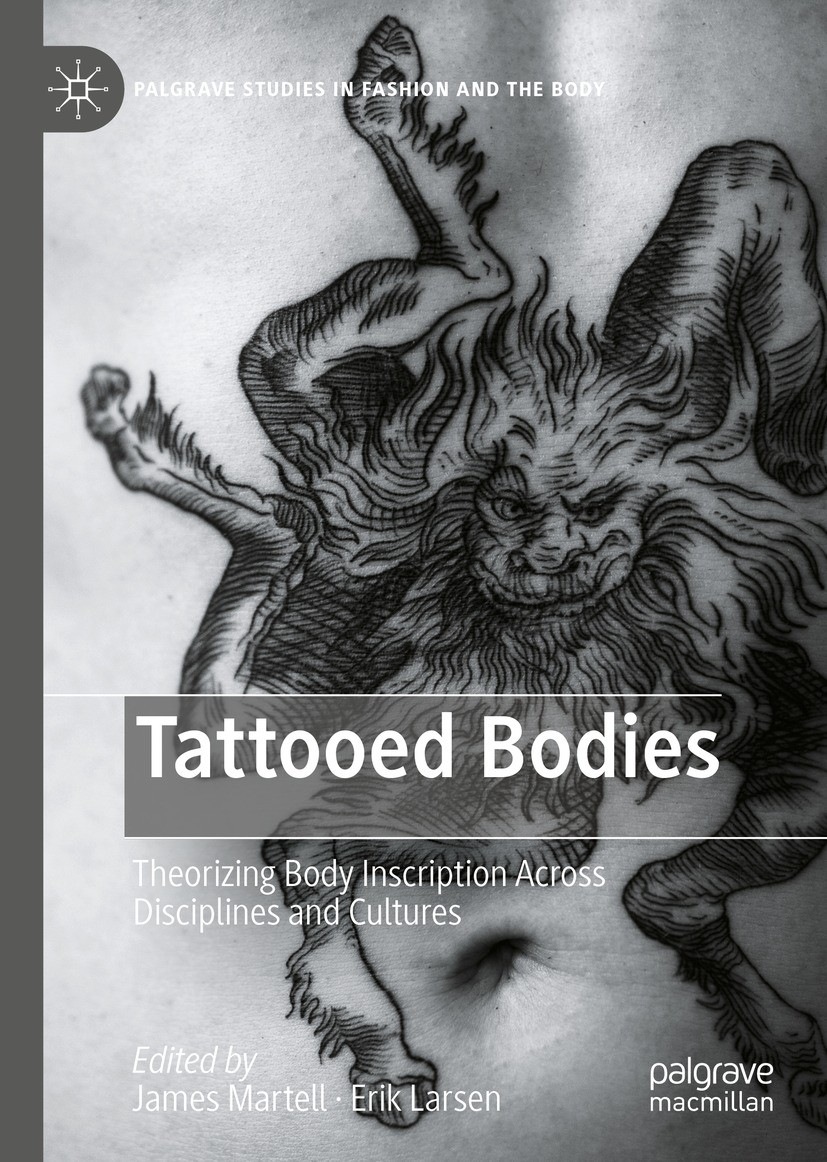
Tattooed Bodies [electronic resource] : Theorizing Body Inscription Across Disciplines and Cultures / edited by James Martell, Erik Larsen.
Erişim Adresi
ISBN
9783030865665
Dil Kodu
İngilizce
Yer Numarası
EK/5553
Basım Bildirimi
1st ed. 2022.
Yayın Bilgisi
Cham : Springer International Publishing : Imprint: Palgrave Macmillan, 2022.
Fiziksel Niteleme
XVIII, 358 p. 23 illus., 22 illus. in color. online resource.
Dizi
Palgrave Studies in Fashion and the Body
İçindekiler Notu
Chapter 1: Introduction: “Totem and Tattoo” -- Part I: TATTOOING (AS) ART -- Chapter 2: “A Medium, Not a Phenomenon: An Argument for An Art Historical Approach to Western Tattooing” -- Chapter 3: “Contemporary Western Tattooing as an Inherently Collaborative Practice: The Contingent Authorial Input and Operational Mode of the Tattooist” -- Chapter 4: “Branch out, Perform, Interlink: Reading Tattoos as Soma-Hypertexts in Shelley Jackson's SKIN and Skin Motion's Soundwave Tattoos” -- Part II: TRANSCULTURAL TATTOOING -- Chapter 5: “Hüh tu pu/ To Mark with Tattoo: Chen Naga Tiger-Spirit Tattoos and Indigenous Ontologies in Northeast India” -- Chapter 6: “The last generation of tattooed Bedouin women in southern Jordan: When tradition and climate change collided in Wadi Rum” -- Chapter 7: “Tattoos, ‘Tattoos,’ Vikings, ‘Vikings,’ and Vikings” -- Part III: TATTOOING THE POLITICAL BODY -- Chapter 8: “Herman Melville’s (Un)Readables: Tattoos” -- Chapter 9: “The Life of the Tattoo: Subcutaneous Surveillances and the Economy of the Stigmatization” -- Chapter 10: “Democratic Hieroglyphs: On the People’s Indecipherable Flesh in Moby-Dick” -- Part IV: TATTOOING LITERATURES -- Chapter 11: “Jeff VanderMeer’s Southern Reach Trilogy: Writing Out the Body Between Grammatology and Exscription” -- Chapter 12: “Tattooing Terminable Interminable: Psychoanalysis, Corporeal Marking and Literature” -- Chapter 13: “Effluvial Exhalations: Genet’s ontological quandary” -- Chapter 14: “Limited Ink: Of Repressence, Inkorporation, and Marineation” -- Chapter 15: “Derrida & Deleuze as Tattooed Savages”.
Özet, vb.
“Tattooed Bodies—apart from often being an exemplary model of Continental philosophy—is a groundbreaking contribution to tattoo studies that shows us how tattooing, when taken seriously, can open up the meanings of works of art, literature, film, and theory itself in unexpected ways. For those who have already been thinking about the meaning of “the tattoo,” this collection of essays will greatly expand possibilities of inquiry. For those who are new to the field, several essays act simply as excellent primers on how to undertake deconstructive, anthropological, aesthetic analysis in general offering up scholarly, nuanced investigations of texts without indulging in exclusionary jargon.” -Danielle Meijer, DePaul University "What is a tattoo? Associated in the past with criminals and degenerates, tattoos have become high fashion in the 21st century. In this collection, leading scholars speculate about the nature and implications ofthese bodily inscriptions. Are they social or antisocial? Conformist or rebellious? Decorative or disfiguring? Atavistic or futuristic? How do they relate to other scars, such as the navel as the mark of our maternal origin? By opening up these questions and many more, the essays in this volume show how the tattoo challenges the distinction between word and flesh, self and society, life and death.” -Maud Ellmann, University of Chicago The essays collected in Tattooed Bodies draw on a range of theoretical paradigms and empirical knowledge to investigate tattoos, tattooing, and our complex relations with marks on skin. Engaging with perspectives in art history, continental philosophy, media studies, psychoanalysis, critical theory, literary studies, biopolitics, and cultural anthropology, the volume reflects the diversity of meanings attributed to tattoos across cultures. Essays explore tattoos and tattooing in Derrida, Deleuze and Guattari, Lacan, Agamben, and Jean-Luc Nancy, while interpreting tattoos in literary works by Melville, Beckett, Kafka, Genet, and Jeff VanderMeer, among others. James Martell is Associate Professor of French at Lyon College, USA. Erik Larsen is Assistant Professor of Medical Humanities at the University of Rochester, USA.
Konu
Clothing and dress __ Social aspects.
Human body in popular culture.
Culture __ Study and teaching.
Arts.
Fashion and the Body.
Cultural Studies.
Visual Culture.
Arts.
Human body in popular culture.
Culture __ Study and teaching.
Arts.
Fashion and the Body.
Cultural Studies.
Visual Culture.
Arts.
Diğer Yazarlar
Kurum Adı
Eseri Alıntıla
Referansları kullanmadan önce gözden geçirmeniz ve varsa gerekli düzeltmeleri yapmanız önerilir.
Dijital Kaynak
MARC Görünümü
LEADER 05959nam a22005535i 4500
001 842256
003 TR_AnAIT
005 20260715024709
007 cr nn 008mamaa
008 220120s2022 sz | s |||| 0|eng d
020 |a9783030865665|9978-3-030-86566-5
024 7 |a10.1007/978-3-030-86566-5|2doi
041 |aeng
049 |aTürk Dil Kurumu Kütüphanesi
050 4|aGT525
072 7|aJFC|2bicssc
072 7|aSOC032000|2bisacsh
072 7|aJBCC|2thema
082 04|a391|223
090 |aEK/5553
245 10|aTattooed Bodies|h[electronic resource] :|bTheorizing Body Inscription Across Disciplines and Cultures /|cedited by James Martell, Erik Larsen.
250 |a1st ed. 2022.
264 1|aCham :|bSpringer International Publishing :|bImprint: Palgrave Macmillan,|c2022.
300 |aXVIII, 358 p. 23 illus., 22 illus. in color.|bonline resource.
336 |atext|btxt|2rdacontent
337 |acomputer|bc|2rdamedia
338 |aonline resource|bcr|2rdacarrier
347 |atext file|bPDF|2rda
490 1 |aPalgrave Studies in Fashion and the Body
505 0 |aChapter 1: Introduction: “Totem and Tattoo” -- Part I: TATTOOING (AS) ART -- Chapter 2: “A Medium, Not a Phenomenon: An Argument for An Art Historical Approach to Western Tattooing” -- Chapter 3: “Contemporary Western Tattooing as an Inherently Collaborative Practice: The Contingent Authorial Input and Operational Mode of the Tattooist” -- Chapter 4: “Branch out, Perform, Interlink: Reading Tattoos as Soma-Hypertexts in Shelley Jackson's SKIN and Skin Motion's Soundwave Tattoos” -- Part II: TRANSCULTURAL TATTOOING -- Chapter 5: “Hüh tu pu/ To Mark with Tattoo: Chen Naga Tiger-Spirit Tattoos and Indigenous Ontologies in Northeast India” -- Chapter 6: “The last generation of tattooed Bedouin women in southern Jordan: When tradition and climate change collided in Wadi Rum” -- Chapter 7: “Tattoos, ‘Tattoos,’ Vikings, ‘Vikings,’ and Vikings” -- Part III: TATTOOING THE POLITICAL BODY -- Chapter 8: “Herman Melville’s (Un)Readables: Tattoos” -- Chapter 9: “The Life of the Tattoo: Subcutaneous Surveillances and the Economy of the Stigmatization” -- Chapter 10: “Democratic Hieroglyphs: On the People’s Indecipherable Flesh in Moby-Dick” -- Part IV: TATTOOING LITERATURES -- Chapter 11: “Jeff VanderMeer’s Southern Reach Trilogy: Writing Out the Body Between Grammatology and Exscription” -- Chapter 12: “Tattooing Terminable Interminable: Psychoanalysis, Corporeal Marking and Literature” -- Chapter 13: “Effluvial Exhalations: Genet’s ontological quandary” -- Chapter 14: “Limited Ink: Of Repressence, Inkorporation, and Marineation” -- Chapter 15: “Derrida & Deleuze as Tattooed Savages”.
520 |a“Tattooed Bodies—apart from often being an exemplary model of Continental philosophy—is a groundbreaking contribution to tattoo studies that shows us how tattooing, when taken seriously, can open up the meanings of works of art, literature, film, and theory itself in unexpected ways. For those who have already been thinking about the meaning of “the tattoo,” this collection of essays will greatly expand possibilities of inquiry. For those who are new to the field, several essays act simply as excellent primers on how to undertake deconstructive, anthropological, aesthetic analysis in general offering up scholarly, nuanced investigations of texts without indulging in exclusionary jargon.” -Danielle Meijer, DePaul University "What is a tattoo? Associated in the past with criminals and degenerates, tattoos have become high fashion in the 21st century. In this collection, leading scholars speculate about the nature and implications ofthese bodily inscriptions. Are they social or antisocial? Conformist or rebellious? Decorative or disfiguring? Atavistic or futuristic? How do they relate to other scars, such as the navel as the mark of our maternal origin? By opening up these questions and many more, the essays in this volume show how the tattoo challenges the distinction between word and flesh, self and society, life and death.” -Maud Ellmann, University of Chicago The essays collected in Tattooed Bodies draw on a range of theoretical paradigms and empirical knowledge to investigate tattoos, tattooing, and our complex relations with marks on skin. Engaging with perspectives in art history, continental philosophy, media studies, psychoanalysis, critical theory, literary studies, biopolitics, and cultural anthropology, the volume reflects the diversity of meanings attributed to tattoos across cultures. Essays explore tattoos and tattooing in Derrida, Deleuze and Guattari, Lacan, Agamben, and Jean-Luc Nancy, while interpreting tattoos in literary works by Melville, Beckett, Kafka, Genet, and Jeff VanderMeer, among others. James Martell is Associate Professor of French at Lyon College, USA. Erik Larsen is Assistant Professor of Medical Humanities at the University of Rochester, USA.
650 0|aClothing and dress|xSocial aspects.
650 0|aHuman body in popular culture.
650 0|aCulture|xStudy and teaching.
650 0|aArts.
650 14|aFashion and the Body.
650 24|aCultural Studies.
650 24|aVisual Culture.
650 24|aArts.
700 1 |aMartell, James.|eeditor.|4edt|4http://id.loc.gov/vocabulary/relators/edt
700 1 |aLarsen, Erik.|eeditor.|4edt|4http://id.loc.gov/vocabulary/relators/edt
710 2 |aSpringerLink (Online service)
773 0 |tSpringer Nature eBook
776 08|iPrinted edition:|z9783030865658
776 08|iPrinted edition:|z9783030865672
776 08|iPrinted edition:|z9783030865689
830 0|aPalgrave Studies in Fashion and the Body
856 40|uhttps://doi.org/10.1007/978-3-030-86566-5
912 |aZDB-2-LCM
912 |aZDB-2-SXL
950 |aLiterature, Cultural and Media Studies (SpringerNature-41173)
950 |aLiterature, Cultural and Media Studies (R0) (SpringerNature-43723)
001 842256
003 TR_AnAIT
005 20260715024709
007 cr nn 008mamaa
008 220120s2022 sz | s |||| 0|eng d
020 |a9783030865665|9978-3-030-86566-5
024 7 |a10.1007/978-3-030-86566-5|2doi
041 |aeng
049 |aTürk Dil Kurumu Kütüphanesi
050 4|aGT525
072 7|aJFC|2bicssc
072 7|aSOC032000|2bisacsh
072 7|aJBCC|2thema
082 04|a391|223
090 |aEK/5553
245 10|aTattooed Bodies|h[electronic resource] :|bTheorizing Body Inscription Across Disciplines and Cultures /|cedited by James Martell, Erik Larsen.
250 |a1st ed. 2022.
264 1|aCham :|bSpringer International Publishing :|bImprint: Palgrave Macmillan,|c2022.
300 |aXVIII, 358 p. 23 illus., 22 illus. in color.|bonline resource.
336 |atext|btxt|2rdacontent
337 |acomputer|bc|2rdamedia
338 |aonline resource|bcr|2rdacarrier
347 |atext file|bPDF|2rda
490 1 |aPalgrave Studies in Fashion and the Body
505 0 |aChapter 1: Introduction: “Totem and Tattoo” -- Part I: TATTOOING (AS) ART -- Chapter 2: “A Medium, Not a Phenomenon: An Argument for An Art Historical Approach to Western Tattooing” -- Chapter 3: “Contemporary Western Tattooing as an Inherently Collaborative Practice: The Contingent Authorial Input and Operational Mode of the Tattooist” -- Chapter 4: “Branch out, Perform, Interlink: Reading Tattoos as Soma-Hypertexts in Shelley Jackson's SKIN and Skin Motion's Soundwave Tattoos” -- Part II: TRANSCULTURAL TATTOOING -- Chapter 5: “Hüh tu pu/ To Mark with Tattoo: Chen Naga Tiger-Spirit Tattoos and Indigenous Ontologies in Northeast India” -- Chapter 6: “The last generation of tattooed Bedouin women in southern Jordan: When tradition and climate change collided in Wadi Rum” -- Chapter 7: “Tattoos, ‘Tattoos,’ Vikings, ‘Vikings,’ and Vikings” -- Part III: TATTOOING THE POLITICAL BODY -- Chapter 8: “Herman Melville’s (Un)Readables: Tattoos” -- Chapter 9: “The Life of the Tattoo: Subcutaneous Surveillances and the Economy of the Stigmatization” -- Chapter 10: “Democratic Hieroglyphs: On the People’s Indecipherable Flesh in Moby-Dick” -- Part IV: TATTOOING LITERATURES -- Chapter 11: “Jeff VanderMeer’s Southern Reach Trilogy: Writing Out the Body Between Grammatology and Exscription” -- Chapter 12: “Tattooing Terminable Interminable: Psychoanalysis, Corporeal Marking and Literature” -- Chapter 13: “Effluvial Exhalations: Genet’s ontological quandary” -- Chapter 14: “Limited Ink: Of Repressence, Inkorporation, and Marineation” -- Chapter 15: “Derrida & Deleuze as Tattooed Savages”.
520 |a“Tattooed Bodies—apart from often being an exemplary model of Continental philosophy—is a groundbreaking contribution to tattoo studies that shows us how tattooing, when taken seriously, can open up the meanings of works of art, literature, film, and theory itself in unexpected ways. For those who have already been thinking about the meaning of “the tattoo,” this collection of essays will greatly expand possibilities of inquiry. For those who are new to the field, several essays act simply as excellent primers on how to undertake deconstructive, anthropological, aesthetic analysis in general offering up scholarly, nuanced investigations of texts without indulging in exclusionary jargon.” -Danielle Meijer, DePaul University "What is a tattoo? Associated in the past with criminals and degenerates, tattoos have become high fashion in the 21st century. In this collection, leading scholars speculate about the nature and implications ofthese bodily inscriptions. Are they social or antisocial? Conformist or rebellious? Decorative or disfiguring? Atavistic or futuristic? How do they relate to other scars, such as the navel as the mark of our maternal origin? By opening up these questions and many more, the essays in this volume show how the tattoo challenges the distinction between word and flesh, self and society, life and death.” -Maud Ellmann, University of Chicago The essays collected in Tattooed Bodies draw on a range of theoretical paradigms and empirical knowledge to investigate tattoos, tattooing, and our complex relations with marks on skin. Engaging with perspectives in art history, continental philosophy, media studies, psychoanalysis, critical theory, literary studies, biopolitics, and cultural anthropology, the volume reflects the diversity of meanings attributed to tattoos across cultures. Essays explore tattoos and tattooing in Derrida, Deleuze and Guattari, Lacan, Agamben, and Jean-Luc Nancy, while interpreting tattoos in literary works by Melville, Beckett, Kafka, Genet, and Jeff VanderMeer, among others. James Martell is Associate Professor of French at Lyon College, USA. Erik Larsen is Assistant Professor of Medical Humanities at the University of Rochester, USA.
650 0|aClothing and dress|xSocial aspects.
650 0|aHuman body in popular culture.
650 0|aCulture|xStudy and teaching.
650 0|aArts.
650 14|aFashion and the Body.
650 24|aCultural Studies.
650 24|aVisual Culture.
650 24|aArts.
700 1 |aMartell, James.|eeditor.|4edt|4http://id.loc.gov/vocabulary/relators/edt
700 1 |aLarsen, Erik.|eeditor.|4edt|4http://id.loc.gov/vocabulary/relators/edt
710 2 |aSpringerLink (Online service)
773 0 |tSpringer Nature eBook
776 08|iPrinted edition:|z9783030865658
776 08|iPrinted edition:|z9783030865672
776 08|iPrinted edition:|z9783030865689
830 0|aPalgrave Studies in Fashion and the Body
856 40|uhttps://doi.org/10.1007/978-3-030-86566-5
912 |aZDB-2-LCM
912 |aZDB-2-SXL
950 |aLiterature, Cultural and Media Studies (SpringerNature-41173)
950 |aLiterature, Cultural and Media Studies (R0) (SpringerNature-43723)
Materyaller
Depodan talep edilen materyal sadece kütüphane içerisinde kullanılmaktadır.
Materyal dışarıya ödünç verilmemektedir.
Materyal dışarıya ödünç verilmemektedir.
