

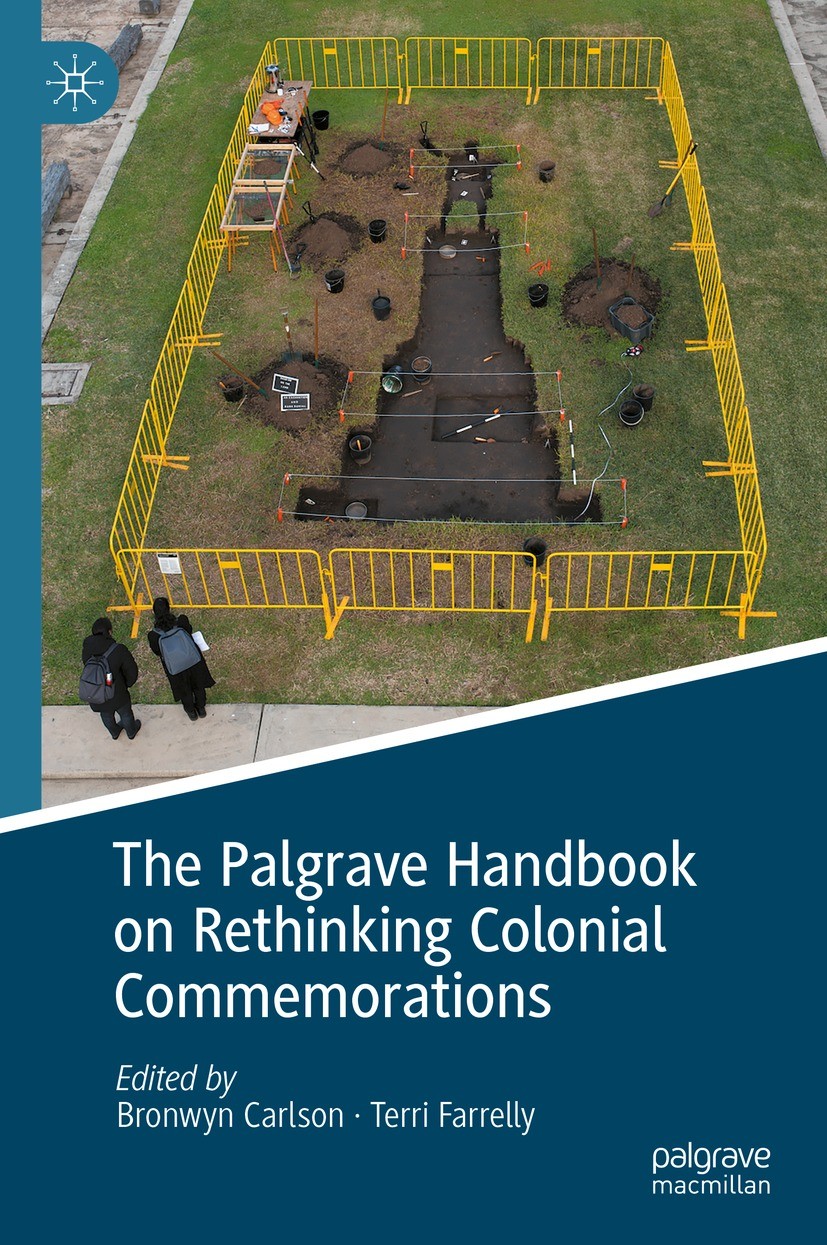
The Palgrave Handbook on Rethinking Colonial Commemorations [electronic resource] / edited by Bronwyn Carlson, Terri Farrelly.
Erişim Adresi
ISBN
9783031286094
Dil Kodu
İngilizce
Yer Numarası
EK/4559
Basım Bildirimi
1st ed. 2023.
Yayın Bilgisi
Cham : Springer International Publishing : Imprint: Palgrave Macmillan, 2023.
Fiziksel Niteleme
XLII, 609 p. 38 illus. online resource.
İçindekiler Notu
Chapter 1. Introduction -- Part I: RECOGNITION & REMEMBERING -- Chapter 2. Memorials to settler colonialism in Australia: racism, colonialism and white power -- Chapter 3. Koro and the statue: disrupting colonial amnesia and white settler sovereignty in Aotearoa New Zealand -- Chapter 4. Space and place: cultural heritage and colonial commemoration at Australian tertiary institutions -- Chapter 5. Toppling the racist Anglo-Saxon politics of Cecil Rhodes -- Chapter 6. The dark side of Canadian history: a two-eyed seeing approach -- Chapter 7. “It’s not a day for you”: Indigenous Australians and the ‘disruption’ of Anzac Day -- Chapter 8. Reflections on Representation, Remembrance and the Memorial.-Chapter 9. Lest we forget: the Tunnerminnerwait and Maulboyheenner saga -- Chapter 10. Unwanted Endeavours and the reconstruction of Cook’s world -- Chapter 11. How churches are framed and presented in the contemporary Sámi homeland of Finland to maintain colonial discourses -- Chapter 12. Colonial histories and artefacts: which way gender? -- Chapter 13. Monumental copper and coal: the case for including extractivism in the rethinking of colonial commemorations -- Part II: RESISTANCE & REIMAGINING -- Chapter 14. Holding dissonance, while disrupting narratives -- Chapter 15. Reason and reckoning: provocation and conversations about re-imaging Samuel Griffith’s University -- Chapter 16. Comedic interventions: toppling monuments and dismantling myths in Rutherford Falls -- Chapter 17. Confederates and colonial commemoration in the United States: collective memory and counter-histories -- Chapter 18. The art of Daniel Boyd: decolonising Banks and Cook, challenging colonial commemoration -- Chapter 19. Asserting Indigenous agencies: constructions and deconstructions of James Cook in Northern Queensland -- Chapter 20. Futuring ruins: the grassroots design activism of the Department of Homo Affairs -- Chapter 21. ‘It’s just always been there’: Rutherford Falls, monuments and settler colonial hegemony -- Part III: REMOVAL & RECTIFICATION -- Chapter 22. The need for context: archaeology’s contribution to the ‘statue wars’ -- Chapter 23. Dis-placing white supremacy: intersections of Black and Indigenous struggles in the removal of the Roosevelt statue at the American Museum of Natural History -- Chapter 24. Edifying: the Deathscapes Project and the landscape of settler-colonial monumentality in Australia -- Chapter 25. The problem and potential of anti-Black monuments in museums -- Chapter 26. Local Empire: George Frampton’s Leeds Queen Victoria Memorial -- Chapter 27. The struggle continues down south: dismantling of colonial monuments and symbols of colonialism and white supremacy -- Chapter 28. Standing strong: the renaming of Toronto Metropolitan University.-Chapter 29. The ‘Crowther Reinterpreted’ project -- Chapter 30. You can handle the truth: Aboriginal peoples, colonial commemorations and the unfinished business of truth-telling.
Özet, vb.
The Palgrave Handbook on Rethinking Colonial Commemorations explores global efforts, particularly from Indigenous and Bla(c)k communities, to dismantle colonial commemorations, monuments, and memorials. Across the world, many Indigenous and Bla(c)k communities have taken action to remove, rectify and/or re-imagine colonial commemorations. These efforts have had the support of some non-Indigenous and white community members, but very often they have faced fierce opposition. In spite of this, many have succeeded, and this work aims to acknowledge and honour these efforts. As a current and much-debated issue, this book will present fresh findings and analyses of recent and historical events, including #RhodesMustFall, Anzac Day protests, and the transferral of confederate monuments to museums. Comprising of chapters written by Indigenous, Bla(c)k and non-Indigenous authors, from a wide variety of locations, backgrounds and purposes, this topical volume is a timely andimportant contribution to the fields of memory studies, Indigenous Studies, and cultural heritage. Professor Bronwyn Carlson is an award-winning Aboriginal author, researcher and academic who lives on Dharawal Country in New South Wales. Bronwyn is the author of The politics of identity: who counts as Aboriginal today? (2016) and a well-known commentator on the place of colonial monuments. She is a co-author of Monumental Disruptions: Aboriginal People and Colonial Commemorations in So-Called Australia (2023). She is the founder and editor of The Journal of Global Indigeneity and the Director of the Centre for Global Indigenous Futures, Head of the Department of Indigenous Studies at Macquarie University and a Fellow of the Australian Academy of the Humanities. Dr Terri Farrelly is an Adjunct Fellow and Postdoctoral Research Associate with the Department of Indigenous Studies at Macquarie University. She is a settler researcher and author whose work has been dedicated to Aboriginal suicidologies and addressing racism and discrimination through truth-telling. She is a co-author of Monumental Disruptions: Aboriginal People and Colonial Commemorations in So-Called Australia (2023).
Konu
Cultural property.
Collective memory.
Culture __ Study and teaching.
Ethnology.
Culture.
Cultural Heritage.
Memory Studies.
Cultural Studies.
Visual Culture.
Regional Cultural Studies.
Collective memory.
Culture __ Study and teaching.
Ethnology.
Culture.
Cultural Heritage.
Memory Studies.
Cultural Studies.
Visual Culture.
Regional Cultural Studies.
Diğer Yazarlar
Kurum Adı
Eseri Alıntıla
Referansları kullanmadan önce gözden geçirmeniz ve varsa gerekli düzeltmeleri yapmanız önerilir.
Dijital Kaynak
MARC Görünümü
LEADER 08508nam a22006975i 4500
001 842294
003 TR_AnAIT
005 20260715024827
007 cr nn 008mamaa
008 230630s2023 sz | s |||| 0|eng d
020 |a9783031286094|9978-3-031-28609-4
024 7 |a10.1007/978-3-031-28609-4|2doi
041 |aeng
049 |aTürk Dil Kurumu Kütüphanesi
050 4|aD1-2027
072 7|aJFC|2bicssc
072 7|aGM|2bicssc
072 7|aSOC002010|2bisacsh
072 7|aJBCC|2thema
072 7|aGLZ|2thema
082 04|a363.69|223
090 |aEK/4559
245 14|aThe Palgrave Handbook on Rethinking Colonial Commemorations|h[electronic resource] /|cedited by Bronwyn Carlson, Terri Farrelly.
250 |a1st ed. 2023.
264 1|aCham :|bSpringer International Publishing :|bImprint: Palgrave Macmillan,|c2023.
300 |aXLII, 609 p. 38 illus.|bonline resource.
336 |atext|btxt|2rdacontent
337 |acomputer|bc|2rdamedia
338 |aonline resource|bcr|2rdacarrier
341 0 |bTable of contents navigation|2onix
341 0 |bSingle logical reading order|2onix
341 0 |bShort alternative textual descriptions|2onix
341 0 |bUse of color is not sole means of conveying information|2onix
341 0 |bUse of high contrast between text and background color|2onix
341 0 |bNext / Previous structural navigation|2onix
341 0 |bAll non-decorative content supports reading without sight|2onix
347 |atext file|bPDF|2rda
505 0 |aChapter 1. Introduction -- Part I: RECOGNITION & REMEMBERING -- Chapter 2. Memorials to settler colonialism in Australia: racism, colonialism and white power -- Chapter 3. Koro and the statue: disrupting colonial amnesia and white settler sovereignty in Aotearoa New Zealand -- Chapter 4. Space and place: cultural heritage and colonial commemoration at Australian tertiary institutions -- Chapter 5. Toppling the racist Anglo-Saxon politics of Cecil Rhodes -- Chapter 6. The dark side of Canadian history: a two-eyed seeing approach -- Chapter 7. “It’s not a day for you”: Indigenous Australians and the ‘disruption’ of Anzac Day -- Chapter 8. Reflections on Representation, Remembrance and the Memorial.-Chapter 9. Lest we forget: the Tunnerminnerwait and Maulboyheenner saga -- Chapter 10. Unwanted Endeavours and the reconstruction of Cook’s world -- Chapter 11. How churches are framed and presented in the contemporary Sámi homeland of Finland to maintain colonial discourses -- Chapter 12. Colonial histories and artefacts: which way gender? -- Chapter 13. Monumental copper and coal: the case for including extractivism in the rethinking of colonial commemorations -- Part II: RESISTANCE & REIMAGINING -- Chapter 14. Holding dissonance, while disrupting narratives -- Chapter 15. Reason and reckoning: provocation and conversations about re-imaging Samuel Griffith’s University -- Chapter 16. Comedic interventions: toppling monuments and dismantling myths in Rutherford Falls -- Chapter 17. Confederates and colonial commemoration in the United States: collective memory and counter-histories -- Chapter 18. The art of Daniel Boyd: decolonising Banks and Cook, challenging colonial commemoration -- Chapter 19. Asserting Indigenous agencies: constructions and deconstructions of James Cook in Northern Queensland -- Chapter 20. Futuring ruins: the grassroots design activism of the Department of Homo Affairs -- Chapter 21. ‘It’s just always been there’: Rutherford Falls, monuments and settler colonial hegemony -- Part III: REMOVAL & RECTIFICATION -- Chapter 22. The need for context: archaeology’s contribution to the ‘statue wars’ -- Chapter 23. Dis-placing white supremacy: intersections of Black and Indigenous struggles in the removal of the Roosevelt statue at the American Museum of Natural History -- Chapter 24. Edifying: the Deathscapes Project and the landscape of settler-colonial monumentality in Australia -- Chapter 25. The problem and potential of anti-Black monuments in museums -- Chapter 26. Local Empire: George Frampton’s Leeds Queen Victoria Memorial -- Chapter 27. The struggle continues down south: dismantling of colonial monuments and symbols of colonialism and white supremacy -- Chapter 28. Standing strong: the renaming of Toronto Metropolitan University.-Chapter 29. The ‘Crowther Reinterpreted’ project -- Chapter 30. You can handle the truth: Aboriginal peoples, colonial commemorations and the unfinished business of truth-telling.
520 |aThe Palgrave Handbook on Rethinking Colonial Commemorations explores global efforts, particularly from Indigenous and Bla(c)k communities, to dismantle colonial commemorations, monuments, and memorials. Across the world, many Indigenous and Bla(c)k communities have taken action to remove, rectify and/or re-imagine colonial commemorations. These efforts have had the support of some non-Indigenous and white community members, but very often they have faced fierce opposition. In spite of this, many have succeeded, and this work aims to acknowledge and honour these efforts. As a current and much-debated issue, this book will present fresh findings and analyses of recent and historical events, including #RhodesMustFall, Anzac Day protests, and the transferral of confederate monuments to museums. Comprising of chapters written by Indigenous, Bla(c)k and non-Indigenous authors, from a wide variety of locations, backgrounds and purposes, this topical volume is a timely andimportant contribution to the fields of memory studies, Indigenous Studies, and cultural heritage. Professor Bronwyn Carlson is an award-winning Aboriginal author, researcher and academic who lives on Dharawal Country in New South Wales. Bronwyn is the author of The politics of identity: who counts as Aboriginal today? (2016) and a well-known commentator on the place of colonial monuments. She is a co-author of Monumental Disruptions: Aboriginal People and Colonial Commemorations in So-Called Australia (2023). She is the founder and editor of The Journal of Global Indigeneity and the Director of the Centre for Global Indigenous Futures, Head of the Department of Indigenous Studies at Macquarie University and a Fellow of the Australian Academy of the Humanities. Dr Terri Farrelly is an Adjunct Fellow and Postdoctoral Research Associate with the Department of Indigenous Studies at Macquarie University. She is a settler researcher and author whose work has been dedicated to Aboriginal suicidologies and addressing racism and discrimination through truth-telling. She is a co-author of Monumental Disruptions: Aboriginal People and Colonial Commemorations in So-Called Australia (2023).
532 8 |aAccessibility summary: This PDF does not fully comply with PDF/UA standards, but does feature limited screen reader support, described non-text content (images, graphs), bookmarks for easy navigation and searchable, selectable text. Users of assistive technologies may experience difficulty navigating or interpreting content in this document. We recognize the importance of accessibility, and we welcome queries about accessibility for any of our products. If you have a question or an access need, please get in touch with us at accessibilitysupport@springernature.com.
532 8 |aNo reading system accessibility options actively disabled
532 8 |aPublisher contact for further accessibility information: accessibilitysupport@springernature.com
650 0|aCultural property.
650 0|aCollective memory.
650 0|aCulture|xStudy and teaching.
650 0|aEthnology.
650 0|aCulture.
650 14|aCultural Heritage.
650 24|aMemory Studies.
650 24|aCultural Studies.
650 24|aVisual Culture.
650 24|aRegional Cultural Studies.
700 1 |aCarlson, Bronwyn.|eeditor.|4edt|4http://id.loc.gov/vocabulary/relators/edt
700 1 |aFarrelly, Terri.|eeditor.|0(orcid)0000-0002-3360-114X|1https://orcid.org/0000-0002-3360-114X|4edt|4http://id.loc.gov/vocabulary/relators/edt
710 2 |aSpringerLink (Online service)
773 0 |tSpringer Nature eBook
776 08|iPrinted edition:|z9783031286087
776 08|iPrinted edition:|z9783031286100
776 08|iPrinted edition:|z9783031286117
856 40|uhttps://doi.org/10.1007/978-3-031-28609-4
912 |aZDB-2-LCM
912 |aZDB-2-SXL
950 |aLiterature, Cultural and Media Studies (SpringerNature-41173)
950 |aLiterature, Cultural and Media Studies (R0) (SpringerNature-43723)
001 842294
003 TR_AnAIT
005 20260715024827
007 cr nn 008mamaa
008 230630s2023 sz | s |||| 0|eng d
020 |a9783031286094|9978-3-031-28609-4
024 7 |a10.1007/978-3-031-28609-4|2doi
041 |aeng
049 |aTürk Dil Kurumu Kütüphanesi
050 4|aD1-2027
072 7|aJFC|2bicssc
072 7|aGM|2bicssc
072 7|aSOC002010|2bisacsh
072 7|aJBCC|2thema
072 7|aGLZ|2thema
082 04|a363.69|223
090 |aEK/4559
245 14|aThe Palgrave Handbook on Rethinking Colonial Commemorations|h[electronic resource] /|cedited by Bronwyn Carlson, Terri Farrelly.
250 |a1st ed. 2023.
264 1|aCham :|bSpringer International Publishing :|bImprint: Palgrave Macmillan,|c2023.
300 |aXLII, 609 p. 38 illus.|bonline resource.
336 |atext|btxt|2rdacontent
337 |acomputer|bc|2rdamedia
338 |aonline resource|bcr|2rdacarrier
341 0 |bTable of contents navigation|2onix
341 0 |bSingle logical reading order|2onix
341 0 |bShort alternative textual descriptions|2onix
341 0 |bUse of color is not sole means of conveying information|2onix
341 0 |bUse of high contrast between text and background color|2onix
341 0 |bNext / Previous structural navigation|2onix
341 0 |bAll non-decorative content supports reading without sight|2onix
347 |atext file|bPDF|2rda
505 0 |aChapter 1. Introduction -- Part I: RECOGNITION & REMEMBERING -- Chapter 2. Memorials to settler colonialism in Australia: racism, colonialism and white power -- Chapter 3. Koro and the statue: disrupting colonial amnesia and white settler sovereignty in Aotearoa New Zealand -- Chapter 4. Space and place: cultural heritage and colonial commemoration at Australian tertiary institutions -- Chapter 5. Toppling the racist Anglo-Saxon politics of Cecil Rhodes -- Chapter 6. The dark side of Canadian history: a two-eyed seeing approach -- Chapter 7. “It’s not a day for you”: Indigenous Australians and the ‘disruption’ of Anzac Day -- Chapter 8. Reflections on Representation, Remembrance and the Memorial.-Chapter 9. Lest we forget: the Tunnerminnerwait and Maulboyheenner saga -- Chapter 10. Unwanted Endeavours and the reconstruction of Cook’s world -- Chapter 11. How churches are framed and presented in the contemporary Sámi homeland of Finland to maintain colonial discourses -- Chapter 12. Colonial histories and artefacts: which way gender? -- Chapter 13. Monumental copper and coal: the case for including extractivism in the rethinking of colonial commemorations -- Part II: RESISTANCE & REIMAGINING -- Chapter 14. Holding dissonance, while disrupting narratives -- Chapter 15. Reason and reckoning: provocation and conversations about re-imaging Samuel Griffith’s University -- Chapter 16. Comedic interventions: toppling monuments and dismantling myths in Rutherford Falls -- Chapter 17. Confederates and colonial commemoration in the United States: collective memory and counter-histories -- Chapter 18. The art of Daniel Boyd: decolonising Banks and Cook, challenging colonial commemoration -- Chapter 19. Asserting Indigenous agencies: constructions and deconstructions of James Cook in Northern Queensland -- Chapter 20. Futuring ruins: the grassroots design activism of the Department of Homo Affairs -- Chapter 21. ‘It’s just always been there’: Rutherford Falls, monuments and settler colonial hegemony -- Part III: REMOVAL & RECTIFICATION -- Chapter 22. The need for context: archaeology’s contribution to the ‘statue wars’ -- Chapter 23. Dis-placing white supremacy: intersections of Black and Indigenous struggles in the removal of the Roosevelt statue at the American Museum of Natural History -- Chapter 24. Edifying: the Deathscapes Project and the landscape of settler-colonial monumentality in Australia -- Chapter 25. The problem and potential of anti-Black monuments in museums -- Chapter 26. Local Empire: George Frampton’s Leeds Queen Victoria Memorial -- Chapter 27. The struggle continues down south: dismantling of colonial monuments and symbols of colonialism and white supremacy -- Chapter 28. Standing strong: the renaming of Toronto Metropolitan University.-Chapter 29. The ‘Crowther Reinterpreted’ project -- Chapter 30. You can handle the truth: Aboriginal peoples, colonial commemorations and the unfinished business of truth-telling.
520 |aThe Palgrave Handbook on Rethinking Colonial Commemorations explores global efforts, particularly from Indigenous and Bla(c)k communities, to dismantle colonial commemorations, monuments, and memorials. Across the world, many Indigenous and Bla(c)k communities have taken action to remove, rectify and/or re-imagine colonial commemorations. These efforts have had the support of some non-Indigenous and white community members, but very often they have faced fierce opposition. In spite of this, many have succeeded, and this work aims to acknowledge and honour these efforts. As a current and much-debated issue, this book will present fresh findings and analyses of recent and historical events, including #RhodesMustFall, Anzac Day protests, and the transferral of confederate monuments to museums. Comprising of chapters written by Indigenous, Bla(c)k and non-Indigenous authors, from a wide variety of locations, backgrounds and purposes, this topical volume is a timely andimportant contribution to the fields of memory studies, Indigenous Studies, and cultural heritage. Professor Bronwyn Carlson is an award-winning Aboriginal author, researcher and academic who lives on Dharawal Country in New South Wales. Bronwyn is the author of The politics of identity: who counts as Aboriginal today? (2016) and a well-known commentator on the place of colonial monuments. She is a co-author of Monumental Disruptions: Aboriginal People and Colonial Commemorations in So-Called Australia (2023). She is the founder and editor of The Journal of Global Indigeneity and the Director of the Centre for Global Indigenous Futures, Head of the Department of Indigenous Studies at Macquarie University and a Fellow of the Australian Academy of the Humanities. Dr Terri Farrelly is an Adjunct Fellow and Postdoctoral Research Associate with the Department of Indigenous Studies at Macquarie University. She is a settler researcher and author whose work has been dedicated to Aboriginal suicidologies and addressing racism and discrimination through truth-telling. She is a co-author of Monumental Disruptions: Aboriginal People and Colonial Commemorations in So-Called Australia (2023).
532 8 |aAccessibility summary: This PDF does not fully comply with PDF/UA standards, but does feature limited screen reader support, described non-text content (images, graphs), bookmarks for easy navigation and searchable, selectable text. Users of assistive technologies may experience difficulty navigating or interpreting content in this document. We recognize the importance of accessibility, and we welcome queries about accessibility for any of our products. If you have a question or an access need, please get in touch with us at accessibilitysupport@springernature.com.
532 8 |aNo reading system accessibility options actively disabled
532 8 |aPublisher contact for further accessibility information: accessibilitysupport@springernature.com
650 0|aCultural property.
650 0|aCollective memory.
650 0|aCulture|xStudy and teaching.
650 0|aEthnology.
650 0|aCulture.
650 14|aCultural Heritage.
650 24|aMemory Studies.
650 24|aCultural Studies.
650 24|aVisual Culture.
650 24|aRegional Cultural Studies.
700 1 |aCarlson, Bronwyn.|eeditor.|4edt|4http://id.loc.gov/vocabulary/relators/edt
700 1 |aFarrelly, Terri.|eeditor.|0(orcid)0000-0002-3360-114X|1https://orcid.org/0000-0002-3360-114X|4edt|4http://id.loc.gov/vocabulary/relators/edt
710 2 |aSpringerLink (Online service)
773 0 |tSpringer Nature eBook
776 08|iPrinted edition:|z9783031286087
776 08|iPrinted edition:|z9783031286100
776 08|iPrinted edition:|z9783031286117
856 40|uhttps://doi.org/10.1007/978-3-031-28609-4
912 |aZDB-2-LCM
912 |aZDB-2-SXL
950 |aLiterature, Cultural and Media Studies (SpringerNature-41173)
950 |aLiterature, Cultural and Media Studies (R0) (SpringerNature-43723)
Materyaller
Depodan talep edilen materyal sadece kütüphane içerisinde kullanılmaktadır.
Materyal dışarıya ödünç verilmemektedir.
Materyal dışarıya ödünç verilmemektedir.
