

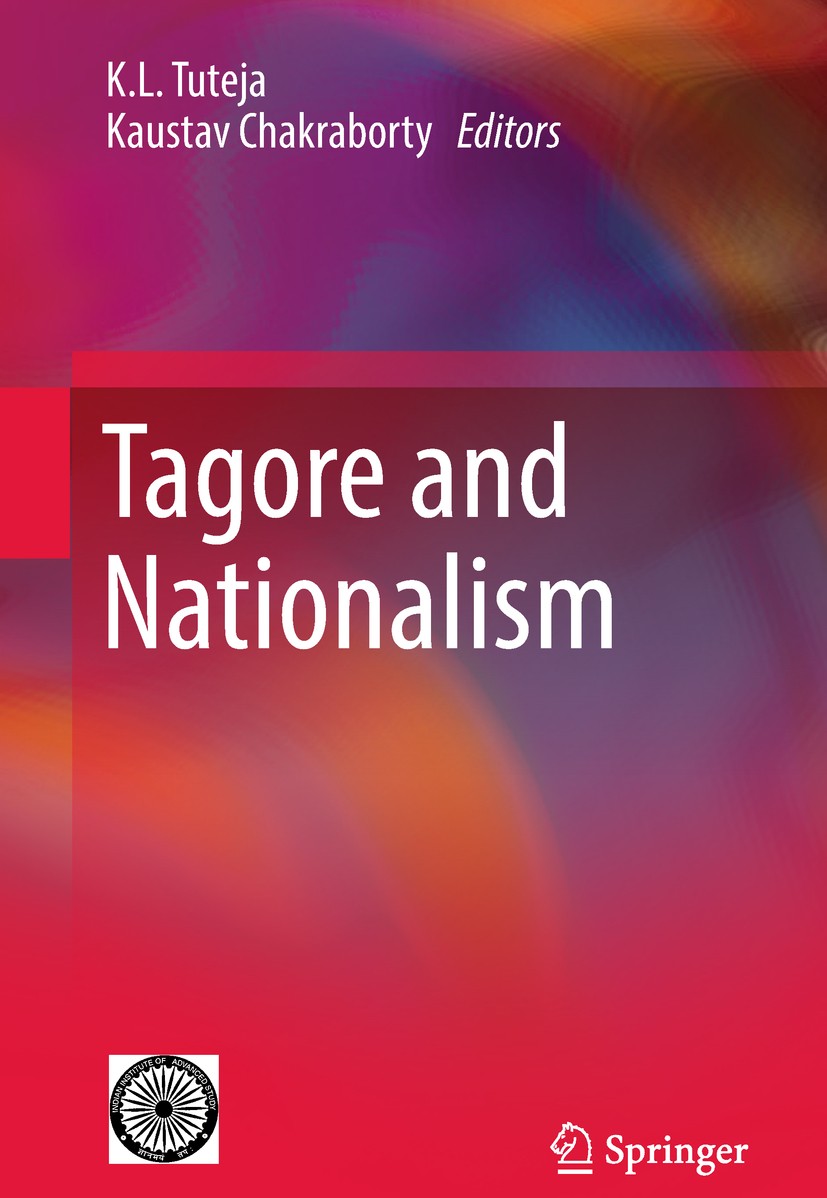
Tagore and Nationalism [electronic resource] / edited by K. L. Tuteja, Kaustav Chakraborty.
Erişim Adresi
ISBN
9788132236962
Dil Kodu
İngilizce
Yer Numarası
EK/3915
Basım Bildirimi
1st ed. 2017.
Yayın Bilgisi
New Delhi : Springer India : Imprint: Springer, 2017.
Fiziksel Niteleme
XIV, 379 p. online resource.
İçindekiler Notu
Foreword: CHETAN SINGH -- 1. Introduction: K L TUTEJA and KAUSTAV CHAKRABORTY -- PART I: Nationalism, Ambivalence and Tagore -- 2. Rethinking Tagore on the Antinomies of Nationalism: SABYASACHI BHATTACHARYA -- 3. 1910 and the Evolution of Rabindranath Tagore’s Vernacular Nationalism: KRISHNA SEN -- 4. Language, Nationalism and Tagore: TILOTTOMA MISRA -- 5. Tagore, Nationalism and Imperialism: SUKANTA CHAUDHURI -- 6. Tagore’s Nation: Swadeshi Samaj and the Political Novel: MAKARAND R. PARANJAPE -- 7. Santiniketan, the Making of a Community: R. SIVA KUMAR -- 8. The Pathography of Nationalism: Tagore’s Critique of the Idea of the Nation: K. SATCHIDANANDAN -- 9. Rabindranath Tagore at the Intersection of Nationalism and Modernity: FAKRUL ALAM -- PART II: Nation and Textual Representations 10.History, Identity and Nation in Tagore's Fiction: SUPRIYA CHAUDHURI -- 11. The Self, the Nation and the World Beyond It: Reading Tagore’s Travel Writings: BHASKAR CHAKRABARTY -- 12.'Pollution complex', Tagore and the Tabooed Nation: Revisiting the Select Short Stories: KAUSTAV CHAKRABORTY -- 13. Tagore’s Ghaire Baire (Home and the World) and Char Adhyaya (Four Chapters): Rethinking Nationalism, Cosmopolitanism and Gender: BIRAJ MEHTA RATHI -- PART III: National Discourse under the Comparative Lens 14. Tagore's Nationalism and Premchand's: HARISH TRIVEDI -- 15. Language, Nation, Freedom: Rabindranath Tagore and Ludwig Wittgenstein on the Epistemology of Education: RUKMINI BHAYA NAIR -- 16. The Spirit of India: An Exploration of Rabindranath Tagore and Mahatma Gandhi’s ideas on Nationalism: BASHABI FRASER -- 17. Rabindranath Tagore’s Use of Guru Gobind Singh as a Nationalist Icon: CHHANDA CHATTERJEE -- 18. Nation and Civil Society as Spheres of “Enlightenment”: The Dialogue of Gandhi and Tagore, and Ambedkarite Inflection: SUKUMAR MURALIDHARAN -- 19. Ideas on Nationalism in Tagore and Unamuno: A Comparative Study: SWAGATA KUMAR BASU -- 20. Tagore and Nationalism: A Perspective on Italy Imagining the Indian Unity: STEFANO BEGGIORA -- PART IV: Interrogating Nationalism in Art and Culture 21. From Rabindranath Tagore to Rituporno Ghosh: Domestic space, Gender and the Nation in Chokher Bali: PATHIK ROY -- 22. Nation and Partition: Tagore Reinvented by Ritwik Ghatak: MANAS GHOSH -- 23. The Useless and the ‘Wonderful’: Work, Leisure and Being ‘at Home in Modernity’ in the Music of Rabindranath Tagore: SAURAV DASTHAKUR -- 24. Dancing against the Nation? Politics versus Performance in Tagore’s Politics of Performance: AISHIKA CHAKRABORTY.
Özet, vb.
This volume brings together eminent Tagore scholars and younger writers to revisit the concepts of nation, nationalism, identity and selfhood, civilization, culture and homeland in Tagore’s writings. As these ideas take up the centre-stage of politics in the subcontinent as also elsewhere in the world in the 21st century, it becomes extremely relevant to revisit his works in this context. Tagore’s ambivalence towards nationalism as an ideology was apparent in the responses in his discussions with Indians and non-Indians alike. Tagore developed the concept of ‘syncretic’ civilization as a basis of nationalist civilizational unity, where society was central, unlike the European model of state-centric civilization. However, as the subterranean tensions of communalism became clear in the early 20th century, Tagore reflexively critiqued his own political position in society. He thus emerged as the critic of the nation/nation-state and in this he shared his deep unease with other thinkers like Romain Rolland and Albert Einstein. This volume for the first time covers the socio-political, historical, literary and cultural concerns relating to Tagore’s efforts towards the 'de-colonization' of the Self. The volume begins with various perspectives on Tagore’s ‘ambivalence’ about nationalism. It encompasses critical examinations of Tagore’s literary works and other art forms as well as adaptations of his works on film. It also reads Tagore’s nationalism in a comparative mode with contemporary thinkers in India and abroad who were engaged in similar debates.
Konu
Ethnology __ Asia.
Culture.
Literature.
Asia __ History.
Asian Culture.
World Literature.
History of South Asia.
Culture.
Literature.
Asia __ History.
Asian Culture.
World Literature.
History of South Asia.
Diğer Yazarlar
Kurum Adı
Eseri Alıntıla
Referansları kullanmadan önce gözden geçirmeniz ve varsa gerekli düzeltmeleri yapmanız önerilir.
Dijital Kaynak
MARC Görünümü
LEADER 05989nam a22005295i 4500
001 842348
003 TR_AnAIT
005 20260715025040
007 cr nn 008mamaa
008 170315s2017 ii | s |||| 0|eng d
020 |a9788132236962|9978-81-322-3696-2
024 7 |a10.1007/978-81-322-3696-2|2doi
041 |aeng
049 |aTürk Dil Kurumu Kütüphanesi
050 4|aGN625-635
072 7|aJFC|2bicssc
072 7|a1F|2bicssc
072 7|aSOC008020|2bisacsh
072 7|aJBCC|x1F|2thema
082 04|a306.095|223
090 |aEK/3915
245 10|aTagore and Nationalism|h[electronic resource] /|cedited by K. L. Tuteja, Kaustav Chakraborty.
250 |a1st ed. 2017.
264 1|aNew Delhi :|bSpringer India :|bImprint: Springer,|c2017.
300 |aXIV, 379 p.|bonline resource.
336 |atext|btxt|2rdacontent
337 |acomputer|bc|2rdamedia
338 |aonline resource|bcr|2rdacarrier
347 |atext file|bPDF|2rda
505 0 |aForeword: CHETAN SINGH -- 1. Introduction: K L TUTEJA and KAUSTAV CHAKRABORTY -- PART I: Nationalism, Ambivalence and Tagore -- 2. Rethinking Tagore on the Antinomies of Nationalism: SABYASACHI BHATTACHARYA -- 3. 1910 and the Evolution of Rabindranath Tagore’s Vernacular Nationalism: KRISHNA SEN -- 4. Language, Nationalism and Tagore: TILOTTOMA MISRA -- 5. Tagore, Nationalism and Imperialism: SUKANTA CHAUDHURI -- 6. Tagore’s Nation: Swadeshi Samaj and the Political Novel: MAKARAND R. PARANJAPE -- 7. Santiniketan, the Making of a Community: R. SIVA KUMAR -- 8. The Pathography of Nationalism: Tagore’s Critique of the Idea of the Nation: K. SATCHIDANANDAN -- 9. Rabindranath Tagore at the Intersection of Nationalism and Modernity: FAKRUL ALAM -- PART II: Nation and Textual Representations 10.History, Identity and Nation in Tagore's Fiction: SUPRIYA CHAUDHURI -- 11. The Self, the Nation and the World Beyond It: Reading Tagore’s Travel Writings: BHASKAR CHAKRABARTY -- 12.'Pollution complex', Tagore and the Tabooed Nation: Revisiting the Select Short Stories: KAUSTAV CHAKRABORTY -- 13. Tagore’s Ghaire Baire (Home and the World) and Char Adhyaya (Four Chapters): Rethinking Nationalism, Cosmopolitanism and Gender: BIRAJ MEHTA RATHI -- PART III: National Discourse under the Comparative Lens 14. Tagore's Nationalism and Premchand's: HARISH TRIVEDI -- 15. Language, Nation, Freedom: Rabindranath Tagore and Ludwig Wittgenstein on the Epistemology of Education: RUKMINI BHAYA NAIR -- 16. The Spirit of India: An Exploration of Rabindranath Tagore and Mahatma Gandhi’s ideas on Nationalism: BASHABI FRASER -- 17. Rabindranath Tagore’s Use of Guru Gobind Singh as a Nationalist Icon: CHHANDA CHATTERJEE -- 18. Nation and Civil Society as Spheres of “Enlightenment”: The Dialogue of Gandhi and Tagore, and Ambedkarite Inflection: SUKUMAR MURALIDHARAN -- 19. Ideas on Nationalism in Tagore and Unamuno: A Comparative Study: SWAGATA KUMAR BASU -- 20. Tagore and Nationalism: A Perspective on Italy Imagining the Indian Unity: STEFANO BEGGIORA -- PART IV: Interrogating Nationalism in Art and Culture 21. From Rabindranath Tagore to Rituporno Ghosh: Domestic space, Gender and the Nation in Chokher Bali: PATHIK ROY -- 22. Nation and Partition: Tagore Reinvented by Ritwik Ghatak: MANAS GHOSH -- 23. The Useless and the ‘Wonderful’: Work, Leisure and Being ‘at Home in Modernity’ in the Music of Rabindranath Tagore: SAURAV DASTHAKUR -- 24. Dancing against the Nation? Politics versus Performance in Tagore’s Politics of Performance: AISHIKA CHAKRABORTY.
520 |aThis volume brings together eminent Tagore scholars and younger writers to revisit the concepts of nation, nationalism, identity and selfhood, civilization, culture and homeland in Tagore’s writings. As these ideas take up the centre-stage of politics in the subcontinent as also elsewhere in the world in the 21st century, it becomes extremely relevant to revisit his works in this context. Tagore’s ambivalence towards nationalism as an ideology was apparent in the responses in his discussions with Indians and non-Indians alike. Tagore developed the concept of ‘syncretic’ civilization as a basis of nationalist civilizational unity, where society was central, unlike the European model of state-centric civilization. However, as the subterranean tensions of communalism became clear in the early 20th century, Tagore reflexively critiqued his own political position in society. He thus emerged as the critic of the nation/nation-state and in this he shared his deep unease with other thinkers like Romain Rolland and Albert Einstein. This volume for the first time covers the socio-political, historical, literary and cultural concerns relating to Tagore’s efforts towards the 'de-colonization' of the Self. The volume begins with various perspectives on Tagore’s ‘ambivalence’ about nationalism. It encompasses critical examinations of Tagore’s literary works and other art forms as well as adaptations of his works on film. It also reads Tagore’s nationalism in a comparative mode with contemporary thinkers in India and abroad who were engaged in similar debates.
650 0|aEthnology|xAsia.
650 0|aCulture.
650 0|aLiterature.
650 0|aAsia|xHistory.
650 14|aAsian Culture.
650 24|aWorld Literature.
650 24|aHistory of South Asia.
700 1 |aTuteja, K. L.|eeditor.|4edt|4http://id.loc.gov/vocabulary/relators/edt
700 1 |aChakraborty, Kaustav.|eeditor.|4edt|4http://id.loc.gov/vocabulary/relators/edt
710 2 |aSpringerLink (Online service)
773 0 |tSpringer Nature eBook
776 08|iPrinted edition:|z9788132236955
776 08|iPrinted edition:|z9788132236979
776 08|iPrinted edition:|z9788132238881
856 40|uhttps://doi.org/10.1007/978-81-322-3696-2
912 |aZDB-2-LCM
912 |aZDB-2-SXL
950 |aLiterature, Cultural and Media Studies (SpringerNature-41173)
950 |aLiterature, Cultural and Media Studies (R0) (SpringerNature-43723)
001 842348
003 TR_AnAIT
005 20260715025040
007 cr nn 008mamaa
008 170315s2017 ii | s |||| 0|eng d
020 |a9788132236962|9978-81-322-3696-2
024 7 |a10.1007/978-81-322-3696-2|2doi
041 |aeng
049 |aTürk Dil Kurumu Kütüphanesi
050 4|aGN625-635
072 7|aJFC|2bicssc
072 7|a1F|2bicssc
072 7|aSOC008020|2bisacsh
072 7|aJBCC|x1F|2thema
082 04|a306.095|223
090 |aEK/3915
245 10|aTagore and Nationalism|h[electronic resource] /|cedited by K. L. Tuteja, Kaustav Chakraborty.
250 |a1st ed. 2017.
264 1|aNew Delhi :|bSpringer India :|bImprint: Springer,|c2017.
300 |aXIV, 379 p.|bonline resource.
336 |atext|btxt|2rdacontent
337 |acomputer|bc|2rdamedia
338 |aonline resource|bcr|2rdacarrier
347 |atext file|bPDF|2rda
505 0 |aForeword: CHETAN SINGH -- 1. Introduction: K L TUTEJA and KAUSTAV CHAKRABORTY -- PART I: Nationalism, Ambivalence and Tagore -- 2. Rethinking Tagore on the Antinomies of Nationalism: SABYASACHI BHATTACHARYA -- 3. 1910 and the Evolution of Rabindranath Tagore’s Vernacular Nationalism: KRISHNA SEN -- 4. Language, Nationalism and Tagore: TILOTTOMA MISRA -- 5. Tagore, Nationalism and Imperialism: SUKANTA CHAUDHURI -- 6. Tagore’s Nation: Swadeshi Samaj and the Political Novel: MAKARAND R. PARANJAPE -- 7. Santiniketan, the Making of a Community: R. SIVA KUMAR -- 8. The Pathography of Nationalism: Tagore’s Critique of the Idea of the Nation: K. SATCHIDANANDAN -- 9. Rabindranath Tagore at the Intersection of Nationalism and Modernity: FAKRUL ALAM -- PART II: Nation and Textual Representations 10.History, Identity and Nation in Tagore's Fiction: SUPRIYA CHAUDHURI -- 11. The Self, the Nation and the World Beyond It: Reading Tagore’s Travel Writings: BHASKAR CHAKRABARTY -- 12.'Pollution complex', Tagore and the Tabooed Nation: Revisiting the Select Short Stories: KAUSTAV CHAKRABORTY -- 13. Tagore’s Ghaire Baire (Home and the World) and Char Adhyaya (Four Chapters): Rethinking Nationalism, Cosmopolitanism and Gender: BIRAJ MEHTA RATHI -- PART III: National Discourse under the Comparative Lens 14. Tagore's Nationalism and Premchand's: HARISH TRIVEDI -- 15. Language, Nation, Freedom: Rabindranath Tagore and Ludwig Wittgenstein on the Epistemology of Education: RUKMINI BHAYA NAIR -- 16. The Spirit of India: An Exploration of Rabindranath Tagore and Mahatma Gandhi’s ideas on Nationalism: BASHABI FRASER -- 17. Rabindranath Tagore’s Use of Guru Gobind Singh as a Nationalist Icon: CHHANDA CHATTERJEE -- 18. Nation and Civil Society as Spheres of “Enlightenment”: The Dialogue of Gandhi and Tagore, and Ambedkarite Inflection: SUKUMAR MURALIDHARAN -- 19. Ideas on Nationalism in Tagore and Unamuno: A Comparative Study: SWAGATA KUMAR BASU -- 20. Tagore and Nationalism: A Perspective on Italy Imagining the Indian Unity: STEFANO BEGGIORA -- PART IV: Interrogating Nationalism in Art and Culture 21. From Rabindranath Tagore to Rituporno Ghosh: Domestic space, Gender and the Nation in Chokher Bali: PATHIK ROY -- 22. Nation and Partition: Tagore Reinvented by Ritwik Ghatak: MANAS GHOSH -- 23. The Useless and the ‘Wonderful’: Work, Leisure and Being ‘at Home in Modernity’ in the Music of Rabindranath Tagore: SAURAV DASTHAKUR -- 24. Dancing against the Nation? Politics versus Performance in Tagore’s Politics of Performance: AISHIKA CHAKRABORTY.
520 |aThis volume brings together eminent Tagore scholars and younger writers to revisit the concepts of nation, nationalism, identity and selfhood, civilization, culture and homeland in Tagore’s writings. As these ideas take up the centre-stage of politics in the subcontinent as also elsewhere in the world in the 21st century, it becomes extremely relevant to revisit his works in this context. Tagore’s ambivalence towards nationalism as an ideology was apparent in the responses in his discussions with Indians and non-Indians alike. Tagore developed the concept of ‘syncretic’ civilization as a basis of nationalist civilizational unity, where society was central, unlike the European model of state-centric civilization. However, as the subterranean tensions of communalism became clear in the early 20th century, Tagore reflexively critiqued his own political position in society. He thus emerged as the critic of the nation/nation-state and in this he shared his deep unease with other thinkers like Romain Rolland and Albert Einstein. This volume for the first time covers the socio-political, historical, literary and cultural concerns relating to Tagore’s efforts towards the 'de-colonization' of the Self. The volume begins with various perspectives on Tagore’s ‘ambivalence’ about nationalism. It encompasses critical examinations of Tagore’s literary works and other art forms as well as adaptations of his works on film. It also reads Tagore’s nationalism in a comparative mode with contemporary thinkers in India and abroad who were engaged in similar debates.
650 0|aEthnology|xAsia.
650 0|aCulture.
650 0|aLiterature.
650 0|aAsia|xHistory.
650 14|aAsian Culture.
650 24|aWorld Literature.
650 24|aHistory of South Asia.
700 1 |aTuteja, K. L.|eeditor.|4edt|4http://id.loc.gov/vocabulary/relators/edt
700 1 |aChakraborty, Kaustav.|eeditor.|4edt|4http://id.loc.gov/vocabulary/relators/edt
710 2 |aSpringerLink (Online service)
773 0 |tSpringer Nature eBook
776 08|iPrinted edition:|z9788132236955
776 08|iPrinted edition:|z9788132236979
776 08|iPrinted edition:|z9788132238881
856 40|uhttps://doi.org/10.1007/978-81-322-3696-2
912 |aZDB-2-LCM
912 |aZDB-2-SXL
950 |aLiterature, Cultural and Media Studies (SpringerNature-41173)
950 |aLiterature, Cultural and Media Studies (R0) (SpringerNature-43723)
Materyaller
Depodan talep edilen materyal sadece kütüphane içerisinde kullanılmaktadır.
Materyal dışarıya ödünç verilmemektedir.
Materyal dışarıya ödünç verilmemektedir.
