

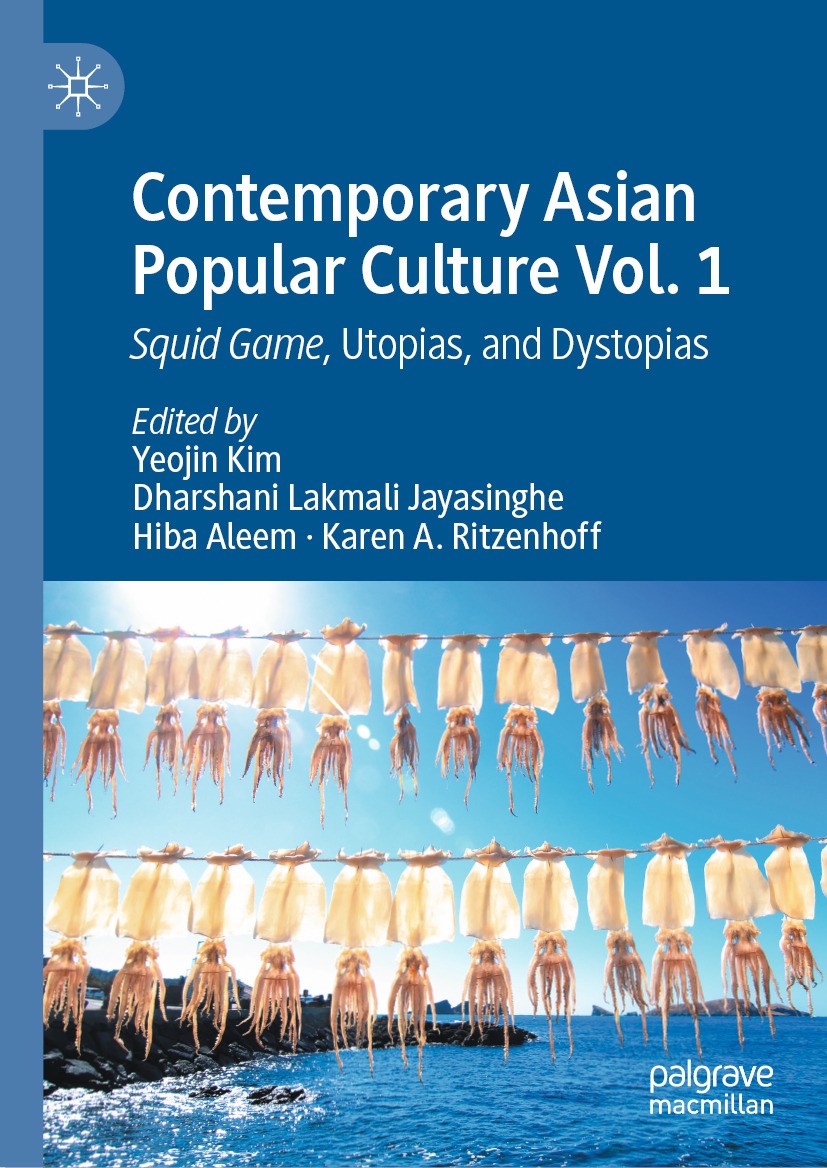
Contemporary Asian Popular Culture Vol. 1 [electronic resource] : Squid Game, Utopias, and Dystopias / edited by Yeojin Kim, Dharshani Lakmali Jayasinghe, Hiba Aleem, Karen A. Ritzenhoff.
Erişim Adresi
ISBN
9783031720659
Dil Kodu
İngilizce
Yer Numarası
EK/2994
Basım Bildirimi
1st ed. 2025.
Yayın Bilgisi
Cham : Springer Nature Switzerland : Imprint: Palgrave Macmillan, 2025.
Fiziksel Niteleme
XXXI, 292 p. 66 illus., 59 illus. in color. online resource.
İçindekiler Notu
Chapter 1: Introduction -- Part I: Sociopolitical Narratives and Critique -- Chapter 2: Diegetic Violence as Narrative Necessity in Squid Game -- Chapter 3: Precarity and the Gladiators of Contemporary Television -- Part II: Discourses and Identities -- Chapter 4: Time, love, and memories in Dystopian Hong Kong: How Wong Kar-wai’s 2046 sheds light on protestors’ affects in anti-extradition bill protests -- Chapter 5: Connecting the Past to the Present: Independent Short Documentary, Camellia Flowers -- Chapter 6: Let’s team up! Constructing narrative through alliances in Squid Game -- Part III: Class, Labor, and Environmental Perspectives -- Chapter 7: Anthony Shim’s Riceboy Sleeps (2022): Metaphors of Survival in the Korean Diasporic Experience -- Chapter 8: Exploitation and Violence: Precarious Labor in Squid Game -- Chapter 9: Navigating Labor and Environmental Justice with Eiichiro Oda’s One Piece -- Part IV: History, Nation, and Ideology -- Chapter 10: Rome as dystopia and Japan as utopia in Thermae Romae (2012) and Netflix anime series Thermae Romae Novae (2022) -- Chapter 11: Victims, Villains, Spies, and Sluts: Gendered Nationalism and the Politics of Desire in Bollywood Films -- Chapter 12: Squid Game as Reflexive Heterotopia: From Text to Context.
Özet, vb.
“The current two volumes are the most comprehensive and authoritative academic publications on Asian popular culture. They aptly document the ways in which Squid Game plays a pivotal role in shifting cultural production, and how the Korean Wave around the globe keeps going strong, both practically and academically. The readers of the books will be able to utilize cutting-edge debates and empirical studies guided by some of the finest scholars in the field.” —Dal Yong Jin, Simon Fraser University, Canada “Squid Game is a game-changer, and this essential two-volume collection pays tribute to the power of Asian popular media to speak to audiences far beyond the region about the precarious lives we share in the second decade of the twentyfirst century.” —Gina Marchetti, Pratt Institute, New York, USA “Contemporary Asian Popular Culture is essential for anyone seeking to understand the profound influence and intricate narratives of contemporary Asian popular media. Together, these volumes provide a crucial resource for scholars, students, and enthusiasts alike.” —Eunyoung Kim, Auburn University at Montgomery, USA This volume explores how contemporary Asian popular culture reflects on and critiques social issues. The authors explore how shows like Squid Game present a scathing critique of oppressive socio economic structures, conceptualize national heterotopias, utopias, and dystopias, and facilitate understanding of identity formation and discourses of resistance. Yeojin Kim is an associate professor in Communication at Central Connecticut State University, USA. Dharshani Lakmali Jayasinghe is an assistant professor of Anglophone and World Literatures in the Department of English at Central Connecticut State University, USA. Hiba Aleem is an adjunct faculty member in the Department of English, Writing, and Communication at Emmanuel College in Boston, USA. Karen A. Ritzenhoff is a professor in Communication and Women, Gender, and Sexuality Studies at Central Connecticut State University, USA.
Konu
Ethnology __ Asia.
Culture.
Motion pictures __ Asia.
Popular Culture.
Ethnology.
Asian Culture.
Asian Film and TV.
Popular Culture.
Regional Cultural Studies.
Culture.
Motion pictures __ Asia.
Popular Culture.
Ethnology.
Asian Culture.
Asian Film and TV.
Popular Culture.
Regional Cultural Studies.
Diğer Yazarlar
Kurum Adı
Eseri Alıntıla
Referansları kullanmadan önce gözden geçirmeniz ve varsa gerekli düzeltmeleri yapmanız önerilir.
Dijital Kaynak
MARC Görünümü
LEADER 05619nam a22005775i 4500
001 842757
003 TR_AnAIT
005 20260715030112
007 cr nn 008mamaa
008 250108s2025 sz | s |||| 0|eng d
020 |a9783031720659|9978-3-031-72065-9
024 7 |a10.1007/978-3-031-72065-9|2doi
041 |aeng
049 |aTürk Dil Kurumu Kütüphanesi
050 4|aGN625-635
072 7|aJFC|2bicssc
072 7|a1F|2bicssc
072 7|aSOC008020|2bisacsh
072 7|aJBCC|x1F|2thema
082 04|a306.095|223
090 |aEK/2994
245 10|aContemporary Asian Popular Culture Vol. 1|h[electronic resource] :|bSquid Game, Utopias, and Dystopias /|cedited by Yeojin Kim, Dharshani Lakmali Jayasinghe, Hiba Aleem, Karen A. Ritzenhoff.
250 |a1st ed. 2025.
264 1|aCham :|bSpringer Nature Switzerland :|bImprint: Palgrave Macmillan,|c2025.
300 |aXXXI, 292 p. 66 illus., 59 illus. in color.|bonline resource.
336 |atext|btxt|2rdacontent
337 |acomputer|bc|2rdamedia
338 |aonline resource|bcr|2rdacarrier
347 |atext file|bPDF|2rda
505 0 |aChapter 1: Introduction -- Part I: Sociopolitical Narratives and Critique -- Chapter 2: Diegetic Violence as Narrative Necessity in Squid Game -- Chapter 3: Precarity and the Gladiators of Contemporary Television -- Part II: Discourses and Identities -- Chapter 4: Time, love, and memories in Dystopian Hong Kong: How Wong Kar-wai’s 2046 sheds light on protestors’ affects in anti-extradition bill protests -- Chapter 5: Connecting the Past to the Present: Independent Short Documentary, Camellia Flowers -- Chapter 6: Let’s team up! Constructing narrative through alliances in Squid Game -- Part III: Class, Labor, and Environmental Perspectives -- Chapter 7: Anthony Shim’s Riceboy Sleeps (2022): Metaphors of Survival in the Korean Diasporic Experience -- Chapter 8: Exploitation and Violence: Precarious Labor in Squid Game -- Chapter 9: Navigating Labor and Environmental Justice with Eiichiro Oda’s One Piece -- Part IV: History, Nation, and Ideology -- Chapter 10: Rome as dystopia and Japan as utopia in Thermae Romae (2012) and Netflix anime series Thermae Romae Novae (2022) -- Chapter 11: Victims, Villains, Spies, and Sluts: Gendered Nationalism and the Politics of Desire in Bollywood Films -- Chapter 12: Squid Game as Reflexive Heterotopia: From Text to Context.
520 |a“The current two volumes are the most comprehensive and authoritative academic publications on Asian popular culture. They aptly document the ways in which Squid Game plays a pivotal role in shifting cultural production, and how the Korean Wave around the globe keeps going strong, both practically and academically. The readers of the books will be able to utilize cutting-edge debates and empirical studies guided by some of the finest scholars in the field.” —Dal Yong Jin, Simon Fraser University, Canada “Squid Game is a game-changer, and this essential two-volume collection pays tribute to the power of Asian popular media to speak to audiences far beyond the region about the precarious lives we share in the second decade of the twentyfirst century.” —Gina Marchetti, Pratt Institute, New York, USA “Contemporary Asian Popular Culture is essential for anyone seeking to understand the profound influence and intricate narratives of contemporary Asian popular media. Together, these volumes provide a crucial resource for scholars, students, and enthusiasts alike.” —Eunyoung Kim, Auburn University at Montgomery, USA This volume explores how contemporary Asian popular culture reflects on and critiques social issues. The authors explore how shows like Squid Game present a scathing critique of oppressive socio economic structures, conceptualize national heterotopias, utopias, and dystopias, and facilitate understanding of identity formation and discourses of resistance. Yeojin Kim is an associate professor in Communication at Central Connecticut State University, USA. Dharshani Lakmali Jayasinghe is an assistant professor of Anglophone and World Literatures in the Department of English at Central Connecticut State University, USA. Hiba Aleem is an adjunct faculty member in the Department of English, Writing, and Communication at Emmanuel College in Boston, USA. Karen A. Ritzenhoff is a professor in Communication and Women, Gender, and Sexuality Studies at Central Connecticut State University, USA.
650 0|aEthnology|xAsia.
650 0|aCulture.
650 0|aMotion pictures|xAsia.
650 0|aPopular Culture.
650 0|aEthnology.
650 14|aAsian Culture.
650 24|aAsian Film and TV.
650 24|aPopular Culture.
650 24|aRegional Cultural Studies.
700 1 |aKim, Yeojin.|eeditor.|4edt|4http://id.loc.gov/vocabulary/relators/edt
700 1 |aJayasinghe, Dharshani Lakmali.|eeditor.|0(orcid)0000-0002-0977-995X|1https://orcid.org/0000-0002-0977-995X|4edt|4http://id.loc.gov/vocabulary/relators/edt
700 1 |aAleem, Hiba.|eeditor.|4edt|4http://id.loc.gov/vocabulary/relators/edt
700 1 |aRitzenhoff, Karen A.|eeditor.|4edt|4http://id.loc.gov/vocabulary/relators/edt
710 2 |aSpringerLink (Online service)
773 0 |tSpringer Nature eBook
776 08|iPrinted edition:|z9783031720642
776 08|iPrinted edition:|z9783031720666
776 08|iPrinted edition:|z9783031720673
856 40|uhttps://doi.org/10.1007/978-3-031-72065-9
912 |aZDB-2-LCM
912 |aZDB-2-SXL
950 |aLiterature, Cultural and Media Studies (SpringerNature-41173)
950 |aLiterature, Cultural and Media Studies (R0) (SpringerNature-43723)
001 842757
003 TR_AnAIT
005 20260715030112
007 cr nn 008mamaa
008 250108s2025 sz | s |||| 0|eng d
020 |a9783031720659|9978-3-031-72065-9
024 7 |a10.1007/978-3-031-72065-9|2doi
041 |aeng
049 |aTürk Dil Kurumu Kütüphanesi
050 4|aGN625-635
072 7|aJFC|2bicssc
072 7|a1F|2bicssc
072 7|aSOC008020|2bisacsh
072 7|aJBCC|x1F|2thema
082 04|a306.095|223
090 |aEK/2994
245 10|aContemporary Asian Popular Culture Vol. 1|h[electronic resource] :|bSquid Game, Utopias, and Dystopias /|cedited by Yeojin Kim, Dharshani Lakmali Jayasinghe, Hiba Aleem, Karen A. Ritzenhoff.
250 |a1st ed. 2025.
264 1|aCham :|bSpringer Nature Switzerland :|bImprint: Palgrave Macmillan,|c2025.
300 |aXXXI, 292 p. 66 illus., 59 illus. in color.|bonline resource.
336 |atext|btxt|2rdacontent
337 |acomputer|bc|2rdamedia
338 |aonline resource|bcr|2rdacarrier
347 |atext file|bPDF|2rda
505 0 |aChapter 1: Introduction -- Part I: Sociopolitical Narratives and Critique -- Chapter 2: Diegetic Violence as Narrative Necessity in Squid Game -- Chapter 3: Precarity and the Gladiators of Contemporary Television -- Part II: Discourses and Identities -- Chapter 4: Time, love, and memories in Dystopian Hong Kong: How Wong Kar-wai’s 2046 sheds light on protestors’ affects in anti-extradition bill protests -- Chapter 5: Connecting the Past to the Present: Independent Short Documentary, Camellia Flowers -- Chapter 6: Let’s team up! Constructing narrative through alliances in Squid Game -- Part III: Class, Labor, and Environmental Perspectives -- Chapter 7: Anthony Shim’s Riceboy Sleeps (2022): Metaphors of Survival in the Korean Diasporic Experience -- Chapter 8: Exploitation and Violence: Precarious Labor in Squid Game -- Chapter 9: Navigating Labor and Environmental Justice with Eiichiro Oda’s One Piece -- Part IV: History, Nation, and Ideology -- Chapter 10: Rome as dystopia and Japan as utopia in Thermae Romae (2012) and Netflix anime series Thermae Romae Novae (2022) -- Chapter 11: Victims, Villains, Spies, and Sluts: Gendered Nationalism and the Politics of Desire in Bollywood Films -- Chapter 12: Squid Game as Reflexive Heterotopia: From Text to Context.
520 |a“The current two volumes are the most comprehensive and authoritative academic publications on Asian popular culture. They aptly document the ways in which Squid Game plays a pivotal role in shifting cultural production, and how the Korean Wave around the globe keeps going strong, both practically and academically. The readers of the books will be able to utilize cutting-edge debates and empirical studies guided by some of the finest scholars in the field.” —Dal Yong Jin, Simon Fraser University, Canada “Squid Game is a game-changer, and this essential two-volume collection pays tribute to the power of Asian popular media to speak to audiences far beyond the region about the precarious lives we share in the second decade of the twentyfirst century.” —Gina Marchetti, Pratt Institute, New York, USA “Contemporary Asian Popular Culture is essential for anyone seeking to understand the profound influence and intricate narratives of contemporary Asian popular media. Together, these volumes provide a crucial resource for scholars, students, and enthusiasts alike.” —Eunyoung Kim, Auburn University at Montgomery, USA This volume explores how contemporary Asian popular culture reflects on and critiques social issues. The authors explore how shows like Squid Game present a scathing critique of oppressive socio economic structures, conceptualize national heterotopias, utopias, and dystopias, and facilitate understanding of identity formation and discourses of resistance. Yeojin Kim is an associate professor in Communication at Central Connecticut State University, USA. Dharshani Lakmali Jayasinghe is an assistant professor of Anglophone and World Literatures in the Department of English at Central Connecticut State University, USA. Hiba Aleem is an adjunct faculty member in the Department of English, Writing, and Communication at Emmanuel College in Boston, USA. Karen A. Ritzenhoff is a professor in Communication and Women, Gender, and Sexuality Studies at Central Connecticut State University, USA.
650 0|aEthnology|xAsia.
650 0|aCulture.
650 0|aMotion pictures|xAsia.
650 0|aPopular Culture.
650 0|aEthnology.
650 14|aAsian Culture.
650 24|aAsian Film and TV.
650 24|aPopular Culture.
650 24|aRegional Cultural Studies.
700 1 |aKim, Yeojin.|eeditor.|4edt|4http://id.loc.gov/vocabulary/relators/edt
700 1 |aJayasinghe, Dharshani Lakmali.|eeditor.|0(orcid)0000-0002-0977-995X|1https://orcid.org/0000-0002-0977-995X|4edt|4http://id.loc.gov/vocabulary/relators/edt
700 1 |aAleem, Hiba.|eeditor.|4edt|4http://id.loc.gov/vocabulary/relators/edt
700 1 |aRitzenhoff, Karen A.|eeditor.|4edt|4http://id.loc.gov/vocabulary/relators/edt
710 2 |aSpringerLink (Online service)
773 0 |tSpringer Nature eBook
776 08|iPrinted edition:|z9783031720642
776 08|iPrinted edition:|z9783031720666
776 08|iPrinted edition:|z9783031720673
856 40|uhttps://doi.org/10.1007/978-3-031-72065-9
912 |aZDB-2-LCM
912 |aZDB-2-SXL
950 |aLiterature, Cultural and Media Studies (SpringerNature-41173)
950 |aLiterature, Cultural and Media Studies (R0) (SpringerNature-43723)
Materyaller
Depodan talep edilen materyal sadece kütüphane içerisinde kullanılmaktadır.
Materyal dışarıya ödünç verilmemektedir.
Materyal dışarıya ödünç verilmemektedir.
