

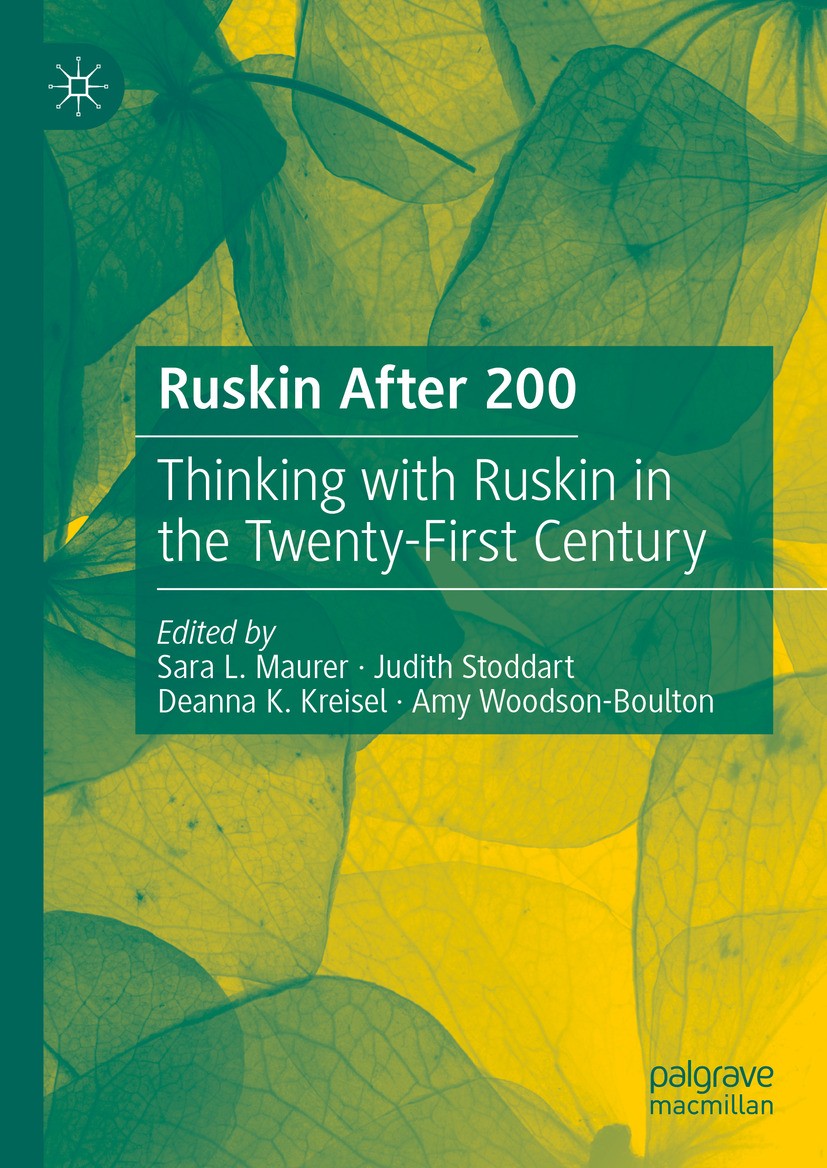
Ruskin After 200 [electronic resource] : Thinking with Ruskin in the Twenty-First Century / edited by Sara L. Maurer, Judith Stoddart, Deanna K. Kreisel, Amy Woodson-Boulton.
Erişim Adresi
ISBN
9783031724633
Dil Kodu
İngilizce
Yer Numarası
EK/3043
Basım Bildirimi
1st ed. 2025.
Yayın Bilgisi
Cham : Springer Nature Switzerland : Imprint: Palgrave Macmillan, 2025.
Fiziksel Niteleme
XVI, 248 p. 34 illus. online resource.
İçindekiler Notu
Introduction -- SECTION ONE. RUSKIN’S PROJECTS AT 200 -- 1. Ruskin’s Guild of St George, Yesterday and To-Day -- 2. The Brantwood Parables -- SECTION TWO. RUSKIN’S REACH -- 3. Ruskin, Wordsworth, Stevens, and the Pathetic Fallacy -- 4. “Him that shoots at beauty”: Thoreau on the Wings of Ruskin -- 5. Ruskin for Whitechapel -- SECTION THREE. RUSKIN AND THE ART OF TECHNOLOGY -- 6. Art and Industry: John Ruskin, George Lance, and Still-Life Painting -- 7. “Science Mixed with Feeling”: Ruskin and the Observation and Representation of the Natural World -- 8. Ruskin’s Media: Technologies of the Gothic -- 9. Ruskin’s Rubbish -- SECTION FOUR. RUSKIN, PROPHET OF THE ANTHROPOCENE -- 10. Thinking Ecologically with Ruskin and Dickens -- 11. Ruskin, Slavery, and Zombie History -- 12. Are Carbon Taxes Impious? -- 13. Ruskin in the Age of COVID-19.
Özet, vb.
This edited volume offers new models for engaging with the work of John Ruskin, the Victorian art critic, architectural and educational theorist, amateur meteorologist and naturalist who gradually became an outspoken critic of capitalist economics and industrialization’s toll on the environment. Two hundred years after Ruskin’s birth, his relevance to art, literature, history, architecture, economics and natural science has not ebbed. However, the nature of Ruskin’s relevance has evolved considerably. This volume offers a cross-section of current scholarship, showing how a range of scholars continue to engage with Ruskin’s work in their research. The chapters provide a snapshot both of what scholars need from Ruskin now and how they continue to develop methodologies that allow them to keep in honest conversation with his writing – work that is wide-ranging, visionary and nuanced, but also elusive, promiscuously mixing the symbolic and scientific, and at times, deeply marred by the shortcomings of sexism, racism and rigid hierarchical thinking. Sara L. Maurer is Associate Professor Emerita of English at the University of Notre Dame, USA. Judith Stoddart is Vice Provost for University Arts and Collections and Associate Professor of English at Michigan State University, USA. Deanna K. Kreisel is Associate Professor of English and co-director of Environmental Studies at the University of Mississippi, USA. Amy Woodson-Boulton is Professor of History at Loyola Marymount University, USA.
Konu
Literature, Modern __ 19th century.
Ecocriticism.
Comparative literature.
Art __ Philosophy.
Nineteenth-Century Literature.
Ecocriticism.
Comparative Literature.
Theory of Arts.
Ecocriticism.
Comparative literature.
Art __ Philosophy.
Nineteenth-Century Literature.
Ecocriticism.
Comparative Literature.
Theory of Arts.
Kurum Adı
Eseri Alıntıla
Referansları kullanmadan önce gözden geçirmeniz ve varsa gerekli düzeltmeleri yapmanız önerilir.
Dijital Kaynak
MARC Görünümü
LEADER 05775nam a22006735i 4500
001 842785
003 TR_AnAIT
005 20260715030300
007 cr nn 008mamaa
008 250422s2025 sz | s |||| 0|eng d
020 |a9783031724633|9978-3-031-72463-3
024 7 |a10.1007/978-3-031-72463-3|2doi
041 |aeng
049 |aTürk Dil Kurumu Kütüphanesi
050 4|aPN760.5-769
072 7|aDSBF|2bicssc
072 7|aLIT024040|2bisacsh
072 7|aDSBF|2thema
082 04|a809.034|223
090 |aEK/3043
245 10|aRuskin After 200|h[electronic resource] :|bThinking with Ruskin in the Twenty-First Century /|cedited by Sara L. Maurer, Judith Stoddart, Deanna K. Kreisel, Amy Woodson-Boulton.
250 |a1st ed. 2025.
264 1|aCham :|bSpringer Nature Switzerland :|bImprint: Palgrave Macmillan,|c2025.
300 |aXVI, 248 p. 34 illus.|bonline resource.
336 |atext|btxt|2rdacontent
337 |acomputer|bc|2rdamedia
338 |aonline resource|bcr|2rdacarrier
341 0 |bTable of contents navigation|2onix
341 0 |bSingle logical reading order|2onix
341 0 |bShort alternative textual descriptions|2onix
341 0 |bUse of color is not sole means of conveying information|2onix
341 0 |bUse of high contrast between text and background color|2onix
341 0 |bNext / Previous structural navigation|2onix
341 0 |bAll non-decorative content supports reading without sight|2onix
347 |atext file|bPDF|2rda
505 0 |aIntroduction -- SECTION ONE. RUSKIN’S PROJECTS AT 200 -- 1. Ruskin’s Guild of St George, Yesterday and To-Day -- 2. The Brantwood Parables -- SECTION TWO. RUSKIN’S REACH -- 3. Ruskin, Wordsworth, Stevens, and the Pathetic Fallacy -- 4. “Him that shoots at beauty”: Thoreau on the Wings of Ruskin -- 5. Ruskin for Whitechapel -- SECTION THREE. RUSKIN AND THE ART OF TECHNOLOGY -- 6. Art and Industry: John Ruskin, George Lance, and Still-Life Painting -- 7. “Science Mixed with Feeling”: Ruskin and the Observation and Representation of the Natural World -- 8. Ruskin’s Media: Technologies of the Gothic -- 9. Ruskin’s Rubbish -- SECTION FOUR. RUSKIN, PROPHET OF THE ANTHROPOCENE -- 10. Thinking Ecologically with Ruskin and Dickens -- 11. Ruskin, Slavery, and Zombie History -- 12. Are Carbon Taxes Impious? -- 13. Ruskin in the Age of COVID-19.
520 |aThis edited volume offers new models for engaging with the work of John Ruskin, the Victorian art critic, architectural and educational theorist, amateur meteorologist and naturalist who gradually became an outspoken critic of capitalist economics and industrialization’s toll on the environment. Two hundred years after Ruskin’s birth, his relevance to art, literature, history, architecture, economics and natural science has not ebbed. However, the nature of Ruskin’s relevance has evolved considerably. This volume offers a cross-section of current scholarship, showing how a range of scholars continue to engage with Ruskin’s work in their research. The chapters provide a snapshot both of what scholars need from Ruskin now and how they continue to develop methodologies that allow them to keep in honest conversation with his writing – work that is wide-ranging, visionary and nuanced, but also elusive, promiscuously mixing the symbolic and scientific, and at times, deeply marred by the shortcomings of sexism, racism and rigid hierarchical thinking. Sara L. Maurer is Associate Professor Emerita of English at the University of Notre Dame, USA. Judith Stoddart is Vice Provost for University Arts and Collections and Associate Professor of English at Michigan State University, USA. Deanna K. Kreisel is Associate Professor of English and co-director of Environmental Studies at the University of Mississippi, USA. Amy Woodson-Boulton is Professor of History at Loyola Marymount University, USA.
532 8 |aAccessibility summary: This PDF does not fully comply with PDF/UA standards, but does feature limited screen reader support, described non-text content (images, graphs), bookmarks for easy navigation and searchable, selectable text. Users of assistive technologies may experience difficulty navigating or interpreting content in this document. We recognize the importance of accessibility, and we welcome queries about accessibility for any of our products. If you have a question or an access need, please get in touch with us at accessibilitysupport@springernature.com.
532 8 |aNo reading system accessibility options actively disabled
532 8 |aPublisher contact for further accessibility information: accessibilitysupport@springernature.com
650 0|aLiterature, Modern|x19th century.
650 0|aEcocriticism.
650 0|aComparative literature.
650 0|aArt|xPhilosophy.
650 14|aNineteenth-Century Literature.
650 24|aEcocriticism.
650 24|aComparative Literature.
650 24|aTheory of Arts.
700 1 |aMaurer, Sara L.|eeditor.|4edt|4http://id.loc.gov/vocabulary/relators/edt
700 1 |aStoddart, Judith.|eeditor.|4edt|4http://id.loc.gov/vocabulary/relators/edt
700 1 |aK. Kreisel, Deanna.|eeditor.|4edt|4http://id.loc.gov/vocabulary/relators/edt
700 1 |aWoodson-Boulton, Amy.|eeditor.|4edt|4http://id.loc.gov/vocabulary/relators/edt
710 2 |aSpringerLink (Online service)
773 0 |tSpringer Nature eBook
776 08|iPrinted edition:|z9783031724626
776 08|iPrinted edition:|z9783031724640
776 08|iPrinted edition:|z9783031724657
856 40|uhttps://doi.org/10.1007/978-3-031-72463-3
912 |aZDB-2-LCM
912 |aZDB-2-SXL
950 |aLiterature, Cultural and Media Studies (SpringerNature-41173)
950 |aLiterature, Cultural and Media Studies (R0) (SpringerNature-43723)
001 842785
003 TR_AnAIT
005 20260715030300
007 cr nn 008mamaa
008 250422s2025 sz | s |||| 0|eng d
020 |a9783031724633|9978-3-031-72463-3
024 7 |a10.1007/978-3-031-72463-3|2doi
041 |aeng
049 |aTürk Dil Kurumu Kütüphanesi
050 4|aPN760.5-769
072 7|aDSBF|2bicssc
072 7|aLIT024040|2bisacsh
072 7|aDSBF|2thema
082 04|a809.034|223
090 |aEK/3043
245 10|aRuskin After 200|h[electronic resource] :|bThinking with Ruskin in the Twenty-First Century /|cedited by Sara L. Maurer, Judith Stoddart, Deanna K. Kreisel, Amy Woodson-Boulton.
250 |a1st ed. 2025.
264 1|aCham :|bSpringer Nature Switzerland :|bImprint: Palgrave Macmillan,|c2025.
300 |aXVI, 248 p. 34 illus.|bonline resource.
336 |atext|btxt|2rdacontent
337 |acomputer|bc|2rdamedia
338 |aonline resource|bcr|2rdacarrier
341 0 |bTable of contents navigation|2onix
341 0 |bSingle logical reading order|2onix
341 0 |bShort alternative textual descriptions|2onix
341 0 |bUse of color is not sole means of conveying information|2onix
341 0 |bUse of high contrast between text and background color|2onix
341 0 |bNext / Previous structural navigation|2onix
341 0 |bAll non-decorative content supports reading without sight|2onix
347 |atext file|bPDF|2rda
505 0 |aIntroduction -- SECTION ONE. RUSKIN’S PROJECTS AT 200 -- 1. Ruskin’s Guild of St George, Yesterday and To-Day -- 2. The Brantwood Parables -- SECTION TWO. RUSKIN’S REACH -- 3. Ruskin, Wordsworth, Stevens, and the Pathetic Fallacy -- 4. “Him that shoots at beauty”: Thoreau on the Wings of Ruskin -- 5. Ruskin for Whitechapel -- SECTION THREE. RUSKIN AND THE ART OF TECHNOLOGY -- 6. Art and Industry: John Ruskin, George Lance, and Still-Life Painting -- 7. “Science Mixed with Feeling”: Ruskin and the Observation and Representation of the Natural World -- 8. Ruskin’s Media: Technologies of the Gothic -- 9. Ruskin’s Rubbish -- SECTION FOUR. RUSKIN, PROPHET OF THE ANTHROPOCENE -- 10. Thinking Ecologically with Ruskin and Dickens -- 11. Ruskin, Slavery, and Zombie History -- 12. Are Carbon Taxes Impious? -- 13. Ruskin in the Age of COVID-19.
520 |aThis edited volume offers new models for engaging with the work of John Ruskin, the Victorian art critic, architectural and educational theorist, amateur meteorologist and naturalist who gradually became an outspoken critic of capitalist economics and industrialization’s toll on the environment. Two hundred years after Ruskin’s birth, his relevance to art, literature, history, architecture, economics and natural science has not ebbed. However, the nature of Ruskin’s relevance has evolved considerably. This volume offers a cross-section of current scholarship, showing how a range of scholars continue to engage with Ruskin’s work in their research. The chapters provide a snapshot both of what scholars need from Ruskin now and how they continue to develop methodologies that allow them to keep in honest conversation with his writing – work that is wide-ranging, visionary and nuanced, but also elusive, promiscuously mixing the symbolic and scientific, and at times, deeply marred by the shortcomings of sexism, racism and rigid hierarchical thinking. Sara L. Maurer is Associate Professor Emerita of English at the University of Notre Dame, USA. Judith Stoddart is Vice Provost for University Arts and Collections and Associate Professor of English at Michigan State University, USA. Deanna K. Kreisel is Associate Professor of English and co-director of Environmental Studies at the University of Mississippi, USA. Amy Woodson-Boulton is Professor of History at Loyola Marymount University, USA.
532 8 |aAccessibility summary: This PDF does not fully comply with PDF/UA standards, but does feature limited screen reader support, described non-text content (images, graphs), bookmarks for easy navigation and searchable, selectable text. Users of assistive technologies may experience difficulty navigating or interpreting content in this document. We recognize the importance of accessibility, and we welcome queries about accessibility for any of our products. If you have a question or an access need, please get in touch with us at accessibilitysupport@springernature.com.
532 8 |aNo reading system accessibility options actively disabled
532 8 |aPublisher contact for further accessibility information: accessibilitysupport@springernature.com
650 0|aLiterature, Modern|x19th century.
650 0|aEcocriticism.
650 0|aComparative literature.
650 0|aArt|xPhilosophy.
650 14|aNineteenth-Century Literature.
650 24|aEcocriticism.
650 24|aComparative Literature.
650 24|aTheory of Arts.
700 1 |aMaurer, Sara L.|eeditor.|4edt|4http://id.loc.gov/vocabulary/relators/edt
700 1 |aStoddart, Judith.|eeditor.|4edt|4http://id.loc.gov/vocabulary/relators/edt
700 1 |aK. Kreisel, Deanna.|eeditor.|4edt|4http://id.loc.gov/vocabulary/relators/edt
700 1 |aWoodson-Boulton, Amy.|eeditor.|4edt|4http://id.loc.gov/vocabulary/relators/edt
710 2 |aSpringerLink (Online service)
773 0 |tSpringer Nature eBook
776 08|iPrinted edition:|z9783031724626
776 08|iPrinted edition:|z9783031724640
776 08|iPrinted edition:|z9783031724657
856 40|uhttps://doi.org/10.1007/978-3-031-72463-3
912 |aZDB-2-LCM
912 |aZDB-2-SXL
950 |aLiterature, Cultural and Media Studies (SpringerNature-41173)
950 |aLiterature, Cultural and Media Studies (R0) (SpringerNature-43723)
Materyaller
Depodan talep edilen materyal sadece kütüphane içerisinde kullanılmaktadır.
Materyal dışarıya ödünç verilmemektedir.
Materyal dışarıya ödünç verilmemektedir.
