

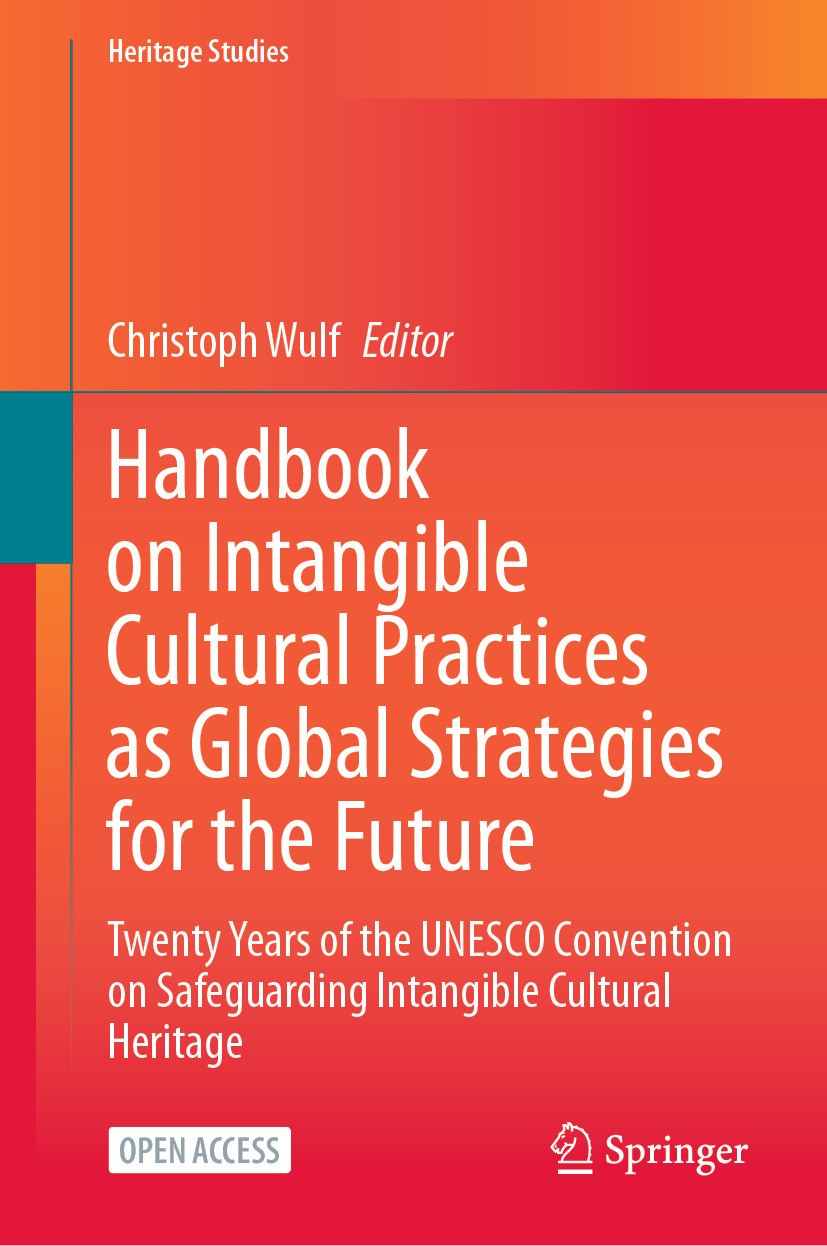
Handbook on Intangible Cultural Practices as Global Strategies for the Future [electronic resource] : Twenty Years of the UNESCO Convention on Safeguarding Intangible Cultural Heritage / edited by Christoph Wulf.
Erişim Adresi
ISBN
9783031721236
Dil Kodu
İngilizce
Yer Numarası
EK/3154
Basım Bildirimi
1st ed. 2025.
Yayın Bilgisi
Cham : Springer Nature Switzerland : Imprint: Springer, 2025.
Fiziksel Niteleme
XI, 579 p. 25 illus. online resource.
Dizi
Heritage Studies, 2946-6067
İçindekiler Notu
Chapter 1. Intangible Cultural Heritage in the Anthropocene. Taking Stock of Initiatives across the World (Christoph Wulf) -- Part I: Living Heritage as Initiator of Transition -- Chapter 2. Living Heritage – A Contribution from UNESCO (Susanne Schnüttgen) -- Chapter 3. Living Heritage as a Global Public Good and Sustainable Development (Pier Luigi Petrillo) -- Chapter 4. Giving a Voice to the People: Intangible Cultural Heritage in Transformation and Structural Change (Marlen Meissner) -- Chapter 5. World Heritage and Intangible Heritage – What Connects it and what Differentiates it? (Marie-Theres Albert) -- Chapter 6. UNESCO’s World Heritage Convention, the Intangible Heritage Convention and the Masterpiece Programme. An Analysis of Mutual Relations, References and Distinctions (Thomas Schmitt) -- Part II: Colonialism, Minorities, Inequalities, and the Struggle for Human Rights -- Chapter 7. Africa’s Response to Intangible Cultural Heritage Convention (Michael Omolewa, Emmanuel Orihentare Eregare & Rose Eyefujinrin Ebohon) -- Chapter 8. Notes Nobody Notes: Samba as Musical Heritage of African Ancestry in Brazil (Nina Graeff) -- Chapter 9. Threats and Approaches in Safeguarding of Intangible Cultural Heritage. A View from the United States (Michelle L. Stefano) -- Chapter 10. Controversial Intangible Heritage in Indonesia (Lydia Kieven & Christoph Antweiler) -- Chapter 11. Intangible Heritage and the Complexities of Inequalities in the Politics of Belonging (Kristin Kuutma & Elo-Hanna Seljamaa) -- Chapter 12. On Reaching a Consensus: A Paradigm for the Inscription of Elements on the UNESCO Lists of Intangible Cultural Heritage (Eva Kuminková, L’ubica Vol’anská, Martin Andrade Perez) -- Part III: Identity Building, Participation, and Conflicts -- Chapter 13. Twenty Years of the UNESCO 2003 Convention for the Safeguarding of the Intangible Cultural Heritage: Experiences from the Implementation of the Convention in Poland (2011-2023) (Hanna Schreiber) -- Chapter 14. Valleys Low, Mountains High. Embedding the 2003 Convention in Switzerland (Stefan Koslowski & Julien Vuilleumier) -- Chapter 15. Expanding Cultural Participation through the 2003 UNESCO Convention in Germany’s Multi-Level Governance System (Benjamin Hanke) -- Chapter 16. Making Sense – and Talking about Smell. Dynamics of the Implementation of the 2003 Convention in the Netherlands (Sophie Elpers) -- Chapter 17. An Examination of the Developmental Process and Characteristics of the Korean Intangible Cultural Heritage Protection System (Hahm, Hanhee & Yong Gu Kim) -- Chapter 18. The Special Way of Intangible Cultural Heritage Safeguarding in China and Some New Practice and Concepts (Anying Chen) -- Chapter 19. What Contribution do Intangible Cultural Heritage Practices make to Identity? Global, Regional, National, and Local Perspectives. A Colombian Case Study (Viviana Polo-Flórez) -- Chapter 20. Against All Odds: Keeping Intangible Cultural Heritage in the Arab World Vivant (Hani Hayajneh) -- Part IV: Living Culture in Aesthetic Encounters -- Chapter 21. Music as Heritage (Tiago de Oliveira Pinto) -- Chapter 22. Modern Dance Created in Germany. The Safeguarding and Creative Practice of Dance Heritage (Vicky Kämpfe) -- Chapter 23. Intangible Cultural Heritage: Challenges and Expectations. (Christoph Wulf) -- Chapter 24. Museums as Facilitators in the Safeguarding of Intangible Cultural Heritage (Hartwig Lüdtke) -- Chapter 25. The Glocal Self: Cultural Policy Concepts between Heritage and Future Using the Example of Berlin’s Humboldt Forum (Julius Heinicke) -- Chapter 26. From Communities of Belief to Artists in Performance: ‘Clear Enigma’ of Odin Teatret and the Pulluvas, or Three Transitions in Heritage (Sharmistha Saha) -- Part V: Challenging Issues, Future Developments, and New Areas of Research -- Chapter 27. Cultural Economies of Intangible Cultural Heritage as Modalities of Care. The Wealth of Networks, Community-Based Value Chains and Commoning (Gertraud Koch, Julia Rausch & Anna Stoffregen) -- Chapter 28. Deeply Entangled, Never Alone: Intangible Cultural Heritage Practices in Post-Digital and Digital Culture (Benjamin Jörissen & Leopold Klepacki) -- Chapter 29. Threats to the Transmission of Living Heritage among Children and Youth. Social Media Use, Reflections and Suggestions from a decade of Capacity-building (Suzanne Ogge) -- Chapter 30. Metaphors for the Study of Digital Heritage Cultures (Payal Arora) -- Chapter 31. Anthropology as a Catalyst in Living Heritage World-Making Projects: The Case of the Voladores Ceremony in Mexico (Cristina Amescua-Chávez & Montserrat Patricia Rebollo Cruz) -- Chapter 32. Intangible Heritage as a Factor of Cultural Resilience in Rural Areas of Germany (Manuel Trummer & Mirko Uhlig) -- Chapter 33. Restoration of Intangible Cultural Heritage and Communities after Disasters: Cases of “Soma Nomaoi” and “Obori Soma Yaki” in Fukushima Prefecture, Japan (Tomo Ishimura).
Özet, vb.
This open access handbook is the first to take stock of and to provide a comprehensive international interdisciplinary review of developments in living culture since the Convention on Safeguarding Intangible Cultural Heritage began in 2003. It is based on an expanded concept of culture, as it has been used in UNESCO since the 1980s and signed by more than 180 countries. The convention makes clear the significant role of the Global South in raising planetary awareness of the importance of intangible cultural practices. The first part of the book examines the relationship between the 1972 World Heritage Convention and the 2003 Convention on Intangible Cultural Heritage. The second part of the book focuses on colonialism, minorities, inequality, and the struggle for human rights. Perspectives from Nigeria, Brazil and the US show how colonialism still has a lasting effect today and what role the practices of intangible cultural heritage play in the struggles for the recognition of minorities. The third part looks at the contribution of intangible cultural heritage practices to the creation of meaning, community, and identity. How are these practices designed so that they allow as much participation as possible and lead to a successful handling of conflicts? The focus is on bottom-up processes. Part four examines several areas of aesthetics including music, dance, song, museum, architecture, and theater showing the importance of the aesthetic dimension and its contribution to the formation of individuals and communities. The fifth and final part of the book examines central problems of living culture and intangible cultural practices. This includes articles on new forms of community building, significance of digital and post-digital culture and metaphors. In the coming decades, intangible cultural heritage practices will become increasingly important for sustainable and peaceful planetary communication, to which the balance of this book and the perspectives based on it will make a significant contribution. .
Konu
Cultural property.
Archaeology.
Cultural Heritage.
Heritage Management.
Archaeology.
Cultural Heritage.
Heritage Management.
Diğer Yazarlar
Kurum Adı
Eseri Alıntıla
Referansları kullanmadan önce gözden geçirmeniz ve varsa gerekli düzeltmeleri yapmanız önerilir.
Dijital Kaynak
MARC Görünümü
LEADER 08974nam a22005415i 4500
001 843009
003 TR_AnAIT
005 20260715031705
007 cr nn 008mamaa
008 241214s2025 sz | s |||| 0|eng d
020 |a9783031721236|9978-3-031-72123-6
024 7 |a10.1007/978-3-031-72123-6|2doi
041 |aeng
049 |aTürk Dil Kurumu Kütüphanesi
050 4|aD1-2027
072 7|aJFC|2bicssc
072 7|aGM|2bicssc
072 7|aSOC002010|2bisacsh
072 7|aJBCC|2thema
072 7|aGLZ|2thema
082 04|a363.69|223
090 |aEK/3154
245 10|aHandbook on Intangible Cultural Practices as Global Strategies for the Future|h[electronic resource] :|bTwenty Years of the UNESCO Convention on Safeguarding Intangible Cultural Heritage /|cedited by Christoph Wulf.
250 |a1st ed. 2025.
264 1|aCham :|bSpringer Nature Switzerland :|bImprint: Springer,|c2025.
300 |aXI, 579 p. 25 illus.|bonline resource.
336 |atext|btxt|2rdacontent
337 |acomputer|bc|2rdamedia
338 |aonline resource|bcr|2rdacarrier
347 |atext file|bPDF|2rda
490 1 |aHeritage Studies,|x2946-6067
505 0 |aChapter 1. Intangible Cultural Heritage in the Anthropocene. Taking Stock of Initiatives across the World (Christoph Wulf) -- Part I: Living Heritage as Initiator of Transition -- Chapter 2. Living Heritage – A Contribution from UNESCO (Susanne Schnüttgen) -- Chapter 3. Living Heritage as a Global Public Good and Sustainable Development (Pier Luigi Petrillo) -- Chapter 4. Giving a Voice to the People: Intangible Cultural Heritage in Transformation and Structural Change (Marlen Meissner) -- Chapter 5. World Heritage and Intangible Heritage – What Connects it and what Differentiates it? (Marie-Theres Albert) -- Chapter 6. UNESCO’s World Heritage Convention, the Intangible Heritage Convention and the Masterpiece Programme. An Analysis of Mutual Relations, References and Distinctions (Thomas Schmitt) -- Part II: Colonialism, Minorities, Inequalities, and the Struggle for Human Rights -- Chapter 7. Africa’s Response to Intangible Cultural Heritage Convention (Michael Omolewa, Emmanuel Orihentare Eregare & Rose Eyefujinrin Ebohon) -- Chapter 8. Notes Nobody Notes: Samba as Musical Heritage of African Ancestry in Brazil (Nina Graeff) -- Chapter 9. Threats and Approaches in Safeguarding of Intangible Cultural Heritage. A View from the United States (Michelle L. Stefano) -- Chapter 10. Controversial Intangible Heritage in Indonesia (Lydia Kieven & Christoph Antweiler) -- Chapter 11. Intangible Heritage and the Complexities of Inequalities in the Politics of Belonging (Kristin Kuutma & Elo-Hanna Seljamaa) -- Chapter 12. On Reaching a Consensus: A Paradigm for the Inscription of Elements on the UNESCO Lists of Intangible Cultural Heritage (Eva Kuminková, L’ubica Vol’anská, Martin Andrade Perez) -- Part III: Identity Building, Participation, and Conflicts -- Chapter 13. Twenty Years of the UNESCO 2003 Convention for the Safeguarding of the Intangible Cultural Heritage: Experiences from the Implementation of the Convention in Poland (2011-2023) (Hanna Schreiber) -- Chapter 14. Valleys Low, Mountains High. Embedding the 2003 Convention in Switzerland (Stefan Koslowski & Julien Vuilleumier) -- Chapter 15. Expanding Cultural Participation through the 2003 UNESCO Convention in Germany’s Multi-Level Governance System (Benjamin Hanke) -- Chapter 16. Making Sense – and Talking about Smell. Dynamics of the Implementation of the 2003 Convention in the Netherlands (Sophie Elpers) -- Chapter 17. An Examination of the Developmental Process and Characteristics of the Korean Intangible Cultural Heritage Protection System (Hahm, Hanhee & Yong Gu Kim) -- Chapter 18. The Special Way of Intangible Cultural Heritage Safeguarding in China and Some New Practice and Concepts (Anying Chen) -- Chapter 19. What Contribution do Intangible Cultural Heritage Practices make to Identity? Global, Regional, National, and Local Perspectives. A Colombian Case Study (Viviana Polo-Flórez) -- Chapter 20. Against All Odds: Keeping Intangible Cultural Heritage in the Arab World Vivant (Hani Hayajneh) -- Part IV: Living Culture in Aesthetic Encounters -- Chapter 21. Music as Heritage (Tiago de Oliveira Pinto) -- Chapter 22. Modern Dance Created in Germany. The Safeguarding and Creative Practice of Dance Heritage (Vicky Kämpfe) -- Chapter 23. Intangible Cultural Heritage: Challenges and Expectations. (Christoph Wulf) -- Chapter 24. Museums as Facilitators in the Safeguarding of Intangible Cultural Heritage (Hartwig Lüdtke) -- Chapter 25. The Glocal Self: Cultural Policy Concepts between Heritage and Future Using the Example of Berlin’s Humboldt Forum (Julius Heinicke) -- Chapter 26. From Communities of Belief to Artists in Performance: ‘Clear Enigma’ of Odin Teatret and the Pulluvas, or Three Transitions in Heritage (Sharmistha Saha) -- Part V: Challenging Issues, Future Developments, and New Areas of Research -- Chapter 27. Cultural Economies of Intangible Cultural Heritage as Modalities of Care. The Wealth of Networks, Community-Based Value Chains and Commoning (Gertraud Koch, Julia Rausch & Anna Stoffregen) -- Chapter 28. Deeply Entangled, Never Alone: Intangible Cultural Heritage Practices in Post-Digital and Digital Culture (Benjamin Jörissen & Leopold Klepacki) -- Chapter 29. Threats to the Transmission of Living Heritage among Children and Youth. Social Media Use, Reflections and Suggestions from a decade of Capacity-building (Suzanne Ogge) -- Chapter 30. Metaphors for the Study of Digital Heritage Cultures (Payal Arora) -- Chapter 31. Anthropology as a Catalyst in Living Heritage World-Making Projects: The Case of the Voladores Ceremony in Mexico (Cristina Amescua-Chávez & Montserrat Patricia Rebollo Cruz) -- Chapter 32. Intangible Heritage as a Factor of Cultural Resilience in Rural Areas of Germany (Manuel Trummer & Mirko Uhlig) -- Chapter 33. Restoration of Intangible Cultural Heritage and Communities after Disasters: Cases of “Soma Nomaoi” and “Obori Soma Yaki” in Fukushima Prefecture, Japan (Tomo Ishimura).
506 0 |aOpen Access
520 |aThis open access handbook is the first to take stock of and to provide a comprehensive international interdisciplinary review of developments in living culture since the Convention on Safeguarding Intangible Cultural Heritage began in 2003. It is based on an expanded concept of culture, as it has been used in UNESCO since the 1980s and signed by more than 180 countries. The convention makes clear the significant role of the Global South in raising planetary awareness of the importance of intangible cultural practices. The first part of the book examines the relationship between the 1972 World Heritage Convention and the 2003 Convention on Intangible Cultural Heritage. The second part of the book focuses on colonialism, minorities, inequality, and the struggle for human rights. Perspectives from Nigeria, Brazil and the US show how colonialism still has a lasting effect today and what role the practices of intangible cultural heritage play in the struggles for the recognition of minorities. The third part looks at the contribution of intangible cultural heritage practices to the creation of meaning, community, and identity. How are these practices designed so that they allow as much participation as possible and lead to a successful handling of conflicts? The focus is on bottom-up processes. Part four examines several areas of aesthetics including music, dance, song, museum, architecture, and theater showing the importance of the aesthetic dimension and its contribution to the formation of individuals and communities. The fifth and final part of the book examines central problems of living culture and intangible cultural practices. This includes articles on new forms of community building, significance of digital and post-digital culture and metaphors. In the coming decades, intangible cultural heritage practices will become increasingly important for sustainable and peaceful planetary communication, to which the balance of this book and the perspectives based on it will make a significant contribution. .
650 0|aCultural property.
650 0|aArchaeology.
650 14|aCultural Heritage.
650 24|aHeritage Management.
700 1 |aWulf, Christoph.|eeditor.|4edt|4http://id.loc.gov/vocabulary/relators/edt
710 2 |aSpringerLink (Online service)
773 0 |tSpringer Nature eBook
776 08|iPrinted edition:|z9783031721229
776 08|iPrinted edition:|z9783031721243
776 08|iPrinted edition:|z9783031721250
830 0|aHeritage Studies,|x2946-6067
856 40|uhttps://doi.org/10.1007/978-3-031-72123-6
912 |aZDB-2-LCM
912 |aZDB-2-SXL
912 |aZDB-2-SOB
950 |aLiterature, Cultural and Media Studies (SpringerNature-41173)
950 |aLiterature, Cultural and Media Studies (R0) (SpringerNature-43723)
Materyaller
Depodan talep edilen materyal sadece kütüphane içerisinde kullanılmaktadır.
Materyal dışarıya ödünç verilmemektedir.
Materyal dışarıya ödünç verilmemektedir.
