

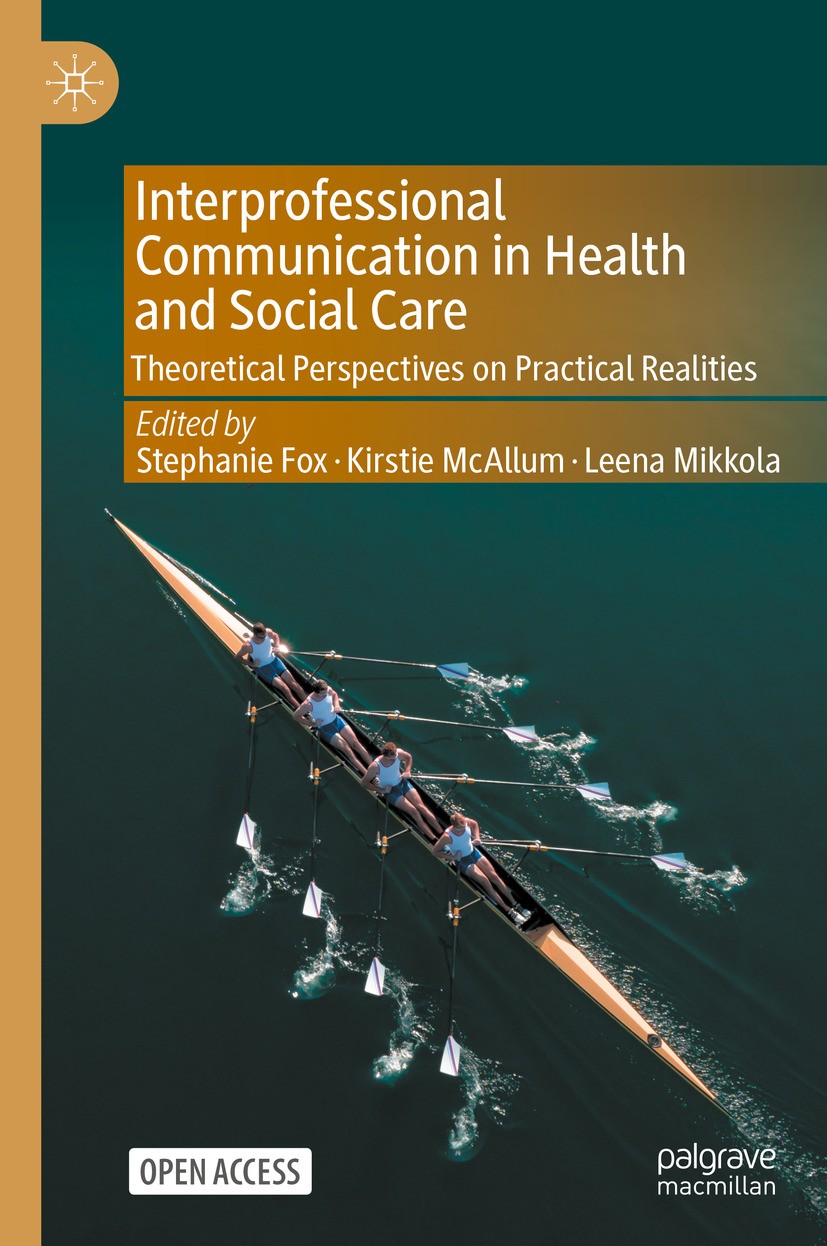
Interprofessional Communication in Health and Social Care [electronic resource] : Theoretical Perspectives on Practical Realities / edited by Stephanie Fox, Kirstie McAllum, Leena Mikkola.
Erişim Adresi
ISBN
9783031701061
Dil Kodu
İngilizce
Yer Numarası
EK/4663
Basım Bildirimi
1st ed. 2025.
Yayın Bilgisi
Cham : Springer Nature Switzerland : Imprint: Palgrave Macmillan, 2025.
Fiziksel Niteleme
XXV, 289 p. 14 illus., 8 illus. in color. online resource.
İçindekiler Notu
Part 1.Introduction to Interprofessional Communication -- Chapter 1.How to Conceptualize Communication in Interprofessional Practice -- Chapter 2.Communication and Effective Interprofessional Healthcare Teams -- Chapter 3.Interprofessional Communication: A Continuum of Intentions and Practices -- Chapter 4.Rethinking How Communication is Taught as an Interprofessional Competency -- Part 2. Fundamental Processes and Dynamics of Interprofessional Communication -- Chapter 5. Sensemaking in Interprofessional Communication -- Chapter 6.Foregrounding the Relational Dimensions of Interprofessional Collaboration: A Communication Perspective -- Chapter 7.Dialectical Tensions in Interprofessional Relationships: Understanding Relational Dialectics Theory in Health and Social Care Teams -- Chapter 8.Negotiating Power Relationships in Interprofessional Health Care Groups -- Chapter 9.Building Blocks and Weaving Threads: An Intercultural Communication Framework for the Study of Professional Identity Construction in Interprofessional Collaboration in Health Care -- Chapter 10.Shared Communication Competence: Moving Beyond the Individual in Interprofessional Communication -- Part 3. Interprofessional Communication in Specific Contexts and Practices -- Chapter 11.Case Management as a Structural Condition for Effective Interprofessional Communication -- Chapter 12.Improving Family-Centered Care through High-Reliability Interprofessional Collaboration in the NICU -- Chapter 13.Interprofessional Teamwork in Oncology: Patient-Centered Perspectives and Survivorship Care Planning -- Chapter 14.The Interprofessional Team as an Emergent Structure of Participation: A Case Study on Primary Care Visits of Unaccompanied Foreign Minors -- Chapter 15.Independent Mindedness, Patient Safety, and Interprofessional Communication within a Rural Trauma Medicine Team.-Chapter 16.Reflections on Future Directions.
Özet, vb.
This is an Open Access book. Interprofessional communication remains both under-theorized and under-researched in healthcare contexts. This book aims to fill that gap by offering practitioners, policy makers, interprofessional curriculum builders, and students in the health professions a broadened theoretical understanding and rich empirical examples of interprofessional communication across a range of health and social care contexts. Importantly, this means opening the black box of what it means for interprofessional collaboration to be “effective,” in particular, for complex, collective practices that rely on shared meanings and accountabilities. Divided into three parts, the book brings together the practical and conceptual expertise of scholars and practitioners from the fields of communication, interprofessional education, health and human sciences, and healthcare management. Stephanie Fox has studied interprofessional communication and collaboration in healthcare contexts for over 15 years. Her work focuses on collective sensemaking, narrative, leadership, team communication, and the navigation of professional hierarchies in collaborative interactions. Kirstie McAllum’s research focuses on patterns of collaborative and conflict-laden communication when groups with varied or contested professional statuses work together (e.g., volunteers/paid staff; family caregivers/healthcare professionals; frontline personal careworkers/healthcare workers with specialist training). Leena Mikkola has studied interpersonal communication both in client-provider and workplace relationships in social and health care contexts for over 15 years. Recently, her research interest has been in health care management teams and interprofessional health care teams. .
Konu
Communication in organizations.
Communication in medicine.
Social service.
Organizational and Strategic Communication.
Health Communication.
Social Care.
Communication in medicine.
Social service.
Organizational and Strategic Communication.
Health Communication.
Social Care.
Diğer Yazarlar
Kurum Adı
Eseri Alıntıla
Referansları kullanmadan önce gözden geçirmeniz ve varsa gerekli düzeltmeleri yapmanız önerilir.
Dijital Kaynak
MARC Görünümü
LEADER 07071nam a22006855i 4500
001 843061
003 TR_AnAIT
005 20260715032107
007 cr nn 008mamaa
008 250301s2025 sz | s |||| 0|eng d
020 |a9783031701061|9978-3-031-70106-1
024 7 |a10.1007/978-3-031-70106-1|2doi
041 |aeng
049 |aTürk Dil Kurumu Kütüphanesi
050 4|aHD30.3-.36
072 7|aKJP|2bicssc
072 7|aGTC|2bicssc
072 7|aBUS007000|2bisacsh
072 7|aKJP|2thema
072 7|aGTC|2thema
082 04|a658.45|223
090 |aEK/4663
245 10|aInterprofessional Communication in Health and Social Care|h[electronic resource] :|bTheoretical Perspectives on Practical Realities /|cedited by Stephanie Fox, Kirstie McAllum, Leena Mikkola.
250 |a1st ed. 2025.
264 1|aCham :|bSpringer Nature Switzerland :|bImprint: Palgrave Macmillan,|c2025.
300 |aXXV, 289 p. 14 illus., 8 illus. in color.|bonline resource.
336 |atext|btxt|2rdacontent
337 |acomputer|bc|2rdamedia
338 |aonline resource|bcr|2rdacarrier
341 0 |bTable of contents navigation|2onix
341 0 |bSingle logical reading order|2onix
341 0 |bShort alternative textual descriptions|2onix
341 0 |bUse of color is not sole means of conveying information|2onix
341 0 |bUse of high contrast between text and background color|2onix
341 0 |bNext / Previous structural navigation|2onix
341 0 |bAll non-decorative content supports reading without sight|2onix
347 |atext file|bPDF|2rda
505 0 |aPart 1.Introduction to Interprofessional Communication -- Chapter 1.How to Conceptualize Communication in Interprofessional Practice -- Chapter 2.Communication and Effective Interprofessional Healthcare Teams -- Chapter 3.Interprofessional Communication: A Continuum of Intentions and Practices -- Chapter 4.Rethinking How Communication is Taught as an Interprofessional Competency -- Part 2. Fundamental Processes and Dynamics of Interprofessional Communication -- Chapter 5. Sensemaking in Interprofessional Communication -- Chapter 6.Foregrounding the Relational Dimensions of Interprofessional Collaboration: A Communication Perspective -- Chapter 7.Dialectical Tensions in Interprofessional Relationships: Understanding Relational Dialectics Theory in Health and Social Care Teams -- Chapter 8.Negotiating Power Relationships in Interprofessional Health Care Groups -- Chapter 9.Building Blocks and Weaving Threads: An Intercultural Communication Framework for the Study of Professional Identity Construction in Interprofessional Collaboration in Health Care -- Chapter 10.Shared Communication Competence: Moving Beyond the Individual in Interprofessional Communication -- Part 3. Interprofessional Communication in Specific Contexts and Practices -- Chapter 11.Case Management as a Structural Condition for Effective Interprofessional Communication -- Chapter 12.Improving Family-Centered Care through High-Reliability Interprofessional Collaboration in the NICU -- Chapter 13.Interprofessional Teamwork in Oncology: Patient-Centered Perspectives and Survivorship Care Planning -- Chapter 14.The Interprofessional Team as an Emergent Structure of Participation: A Case Study on Primary Care Visits of Unaccompanied Foreign Minors -- Chapter 15.Independent Mindedness, Patient Safety, and Interprofessional Communication within a Rural Trauma Medicine Team.-Chapter 16.Reflections on Future Directions.
506 0 |aOpen Access
520 |aThis is an Open Access book. Interprofessional communication remains both under-theorized and under-researched in healthcare contexts. This book aims to fill that gap by offering practitioners, policy makers, interprofessional curriculum builders, and students in the health professions a broadened theoretical understanding and rich empirical examples of interprofessional communication across a range of health and social care contexts. Importantly, this means opening the black box of what it means for interprofessional collaboration to be “effective,” in particular, for complex, collective practices that rely on shared meanings and accountabilities. Divided into three parts, the book brings together the practical and conceptual expertise of scholars and practitioners from the fields of communication, interprofessional education, health and human sciences, and healthcare management. Stephanie Fox has studied interprofessional communication and collaboration in healthcare contexts for over 15 years. Her work focuses on collective sensemaking, narrative, leadership, team communication, and the navigation of professional hierarchies in collaborative interactions. Kirstie McAllum’s research focuses on patterns of collaborative and conflict-laden communication when groups with varied or contested professional statuses work together (e.g., volunteers/paid staff; family caregivers/healthcare professionals; frontline personal careworkers/healthcare workers with specialist training). Leena Mikkola has studied interpersonal communication both in client-provider and workplace relationships in social and health care contexts for over 15 years. Recently, her research interest has been in health care management teams and interprofessional health care teams. .
532 8 |aAccessibility summary: This PDF does not fully comply with PDF/UA standards, but does feature limited screen reader support, described non-text content (images, graphs), bookmarks for easy navigation and searchable, selectable text. Users of assistive technologies may experience difficulty navigating or interpreting content in this document. We recognize the importance of accessibility, and we welcome queries about accessibility for any of our products. If you have a question or an access need, please get in touch with us at accessibilitysupport@springernature.com.
532 8 |aNo reading system accessibility options actively disabled
532 8 |aPublisher contact for further accessibility information: accessibilitysupport@springernature.com
650 0|aCommunication in organizations.
650 0|aCommunication in medicine.
650 0|aSocial service.
650 14|aOrganizational and Strategic Communication.
650 24|aHealth Communication.
650 24|aSocial Care.
700 1 |aFox, Stephanie.|eeditor.|4edt|4http://id.loc.gov/vocabulary/relators/edt
700 1 |aMcAllum, Kirstie.|eeditor.|4edt|4http://id.loc.gov/vocabulary/relators/edt
700 1 |aMikkola, Leena.|eeditor.|4edt|4http://id.loc.gov/vocabulary/relators/edt
710 2 |aSpringerLink (Online service)
773 0 |tSpringer Nature eBook
776 08|iPrinted edition:|z9783031701054
776 08|iPrinted edition:|z9783031701078
776 08|iPrinted edition:|z9783031701085
856 40|uhttps://doi.org/10.1007/978-3-031-70106-1
912 |aZDB-2-LCM
912 |aZDB-2-SXL
912 |aZDB-2-SOB
950 |aLiterature, Cultural and Media Studies (SpringerNature-41173)
950 |aLiterature, Cultural and Media Studies (R0) (SpringerNature-43723)
001 843061
003 TR_AnAIT
005 20260715032107
007 cr nn 008mamaa
008 250301s2025 sz | s |||| 0|eng d
020 |a9783031701061|9978-3-031-70106-1
024 7 |a10.1007/978-3-031-70106-1|2doi
041 |aeng
049 |aTürk Dil Kurumu Kütüphanesi
050 4|aHD30.3-.36
072 7|aKJP|2bicssc
072 7|aGTC|2bicssc
072 7|aBUS007000|2bisacsh
072 7|aKJP|2thema
072 7|aGTC|2thema
082 04|a658.45|223
090 |aEK/4663
245 10|aInterprofessional Communication in Health and Social Care|h[electronic resource] :|bTheoretical Perspectives on Practical Realities /|cedited by Stephanie Fox, Kirstie McAllum, Leena Mikkola.
250 |a1st ed. 2025.
264 1|aCham :|bSpringer Nature Switzerland :|bImprint: Palgrave Macmillan,|c2025.
300 |aXXV, 289 p. 14 illus., 8 illus. in color.|bonline resource.
336 |atext|btxt|2rdacontent
337 |acomputer|bc|2rdamedia
338 |aonline resource|bcr|2rdacarrier
341 0 |bTable of contents navigation|2onix
341 0 |bSingle logical reading order|2onix
341 0 |bShort alternative textual descriptions|2onix
341 0 |bUse of color is not sole means of conveying information|2onix
341 0 |bUse of high contrast between text and background color|2onix
341 0 |bNext / Previous structural navigation|2onix
341 0 |bAll non-decorative content supports reading without sight|2onix
347 |atext file|bPDF|2rda
505 0 |aPart 1.Introduction to Interprofessional Communication -- Chapter 1.How to Conceptualize Communication in Interprofessional Practice -- Chapter 2.Communication and Effective Interprofessional Healthcare Teams -- Chapter 3.Interprofessional Communication: A Continuum of Intentions and Practices -- Chapter 4.Rethinking How Communication is Taught as an Interprofessional Competency -- Part 2. Fundamental Processes and Dynamics of Interprofessional Communication -- Chapter 5. Sensemaking in Interprofessional Communication -- Chapter 6.Foregrounding the Relational Dimensions of Interprofessional Collaboration: A Communication Perspective -- Chapter 7.Dialectical Tensions in Interprofessional Relationships: Understanding Relational Dialectics Theory in Health and Social Care Teams -- Chapter 8.Negotiating Power Relationships in Interprofessional Health Care Groups -- Chapter 9.Building Blocks and Weaving Threads: An Intercultural Communication Framework for the Study of Professional Identity Construction in Interprofessional Collaboration in Health Care -- Chapter 10.Shared Communication Competence: Moving Beyond the Individual in Interprofessional Communication -- Part 3. Interprofessional Communication in Specific Contexts and Practices -- Chapter 11.Case Management as a Structural Condition for Effective Interprofessional Communication -- Chapter 12.Improving Family-Centered Care through High-Reliability Interprofessional Collaboration in the NICU -- Chapter 13.Interprofessional Teamwork in Oncology: Patient-Centered Perspectives and Survivorship Care Planning -- Chapter 14.The Interprofessional Team as an Emergent Structure of Participation: A Case Study on Primary Care Visits of Unaccompanied Foreign Minors -- Chapter 15.Independent Mindedness, Patient Safety, and Interprofessional Communication within a Rural Trauma Medicine Team.-Chapter 16.Reflections on Future Directions.
506 0 |aOpen Access
520 |aThis is an Open Access book. Interprofessional communication remains both under-theorized and under-researched in healthcare contexts. This book aims to fill that gap by offering practitioners, policy makers, interprofessional curriculum builders, and students in the health professions a broadened theoretical understanding and rich empirical examples of interprofessional communication across a range of health and social care contexts. Importantly, this means opening the black box of what it means for interprofessional collaboration to be “effective,” in particular, for complex, collective practices that rely on shared meanings and accountabilities. Divided into three parts, the book brings together the practical and conceptual expertise of scholars and practitioners from the fields of communication, interprofessional education, health and human sciences, and healthcare management. Stephanie Fox has studied interprofessional communication and collaboration in healthcare contexts for over 15 years. Her work focuses on collective sensemaking, narrative, leadership, team communication, and the navigation of professional hierarchies in collaborative interactions. Kirstie McAllum’s research focuses on patterns of collaborative and conflict-laden communication when groups with varied or contested professional statuses work together (e.g., volunteers/paid staff; family caregivers/healthcare professionals; frontline personal careworkers/healthcare workers with specialist training). Leena Mikkola has studied interpersonal communication both in client-provider and workplace relationships in social and health care contexts for over 15 years. Recently, her research interest has been in health care management teams and interprofessional health care teams. .
532 8 |aAccessibility summary: This PDF does not fully comply with PDF/UA standards, but does feature limited screen reader support, described non-text content (images, graphs), bookmarks for easy navigation and searchable, selectable text. Users of assistive technologies may experience difficulty navigating or interpreting content in this document. We recognize the importance of accessibility, and we welcome queries about accessibility for any of our products. If you have a question or an access need, please get in touch with us at accessibilitysupport@springernature.com.
532 8 |aNo reading system accessibility options actively disabled
532 8 |aPublisher contact for further accessibility information: accessibilitysupport@springernature.com
650 0|aCommunication in organizations.
650 0|aCommunication in medicine.
650 0|aSocial service.
650 14|aOrganizational and Strategic Communication.
650 24|aHealth Communication.
650 24|aSocial Care.
700 1 |aFox, Stephanie.|eeditor.|4edt|4http://id.loc.gov/vocabulary/relators/edt
700 1 |aMcAllum, Kirstie.|eeditor.|4edt|4http://id.loc.gov/vocabulary/relators/edt
700 1 |aMikkola, Leena.|eeditor.|4edt|4http://id.loc.gov/vocabulary/relators/edt
710 2 |aSpringerLink (Online service)
773 0 |tSpringer Nature eBook
776 08|iPrinted edition:|z9783031701054
776 08|iPrinted edition:|z9783031701078
776 08|iPrinted edition:|z9783031701085
856 40|uhttps://doi.org/10.1007/978-3-031-70106-1
912 |aZDB-2-LCM
912 |aZDB-2-SXL
912 |aZDB-2-SOB
950 |aLiterature, Cultural and Media Studies (SpringerNature-41173)
950 |aLiterature, Cultural and Media Studies (R0) (SpringerNature-43723)
Materyaller
Depodan talep edilen materyal sadece kütüphane içerisinde kullanılmaktadır.
Materyal dışarıya ödünç verilmemektedir.
Materyal dışarıya ödünç verilmemektedir.
