

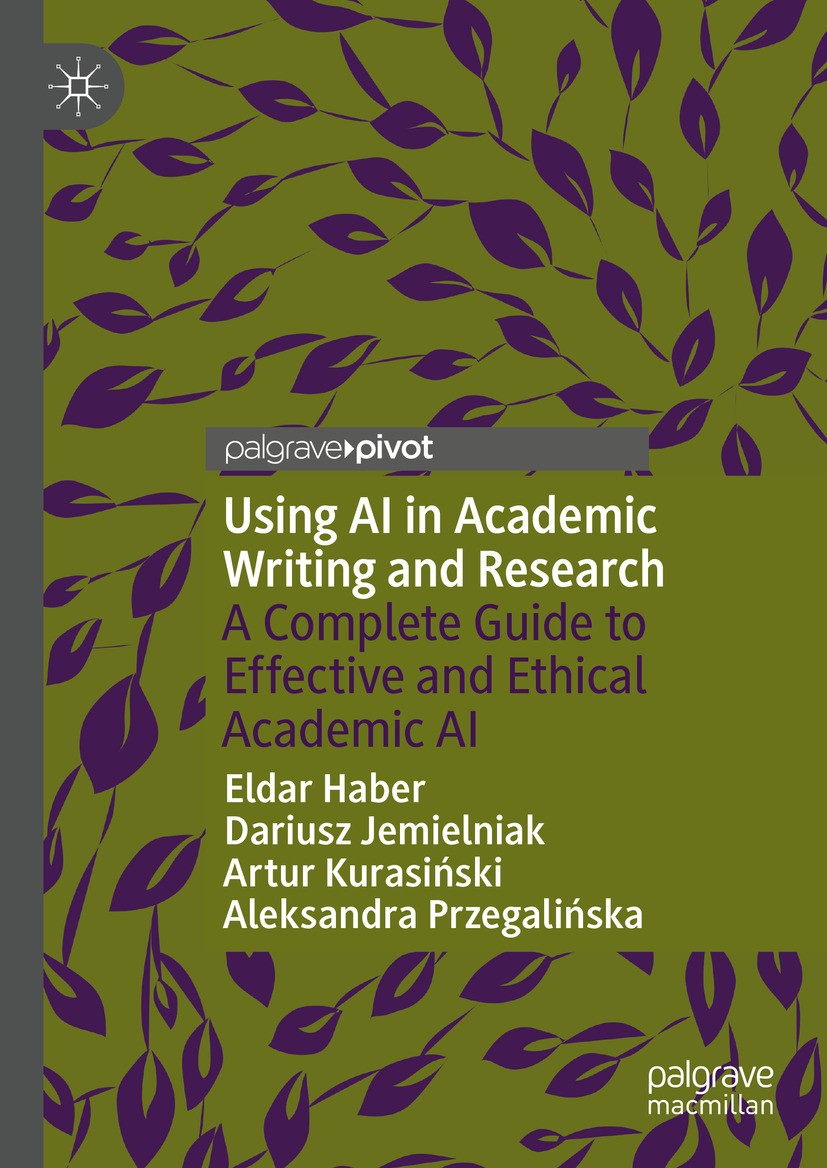
Using AI in Academic Writing and Research [electronic resource] : A Complete Guide to Effective and Ethical Academic AI / by Eldar Haber, Dariusz Jemielniak, Artur Kurasiński, Aleksandra Przegalińska.
Erişim Adresi
ISBN
9783031917059
Dil Kodu
İngilizce
Yer Numarası
EK/6257
Basım Bildirimi
1st ed. 2025.
Yayın Bilgisi
Cham : Springer Nature Switzerland : Imprint: Palgrave Macmillan, 2025.
Fiziksel Niteleme
IX, 147 p. online resource.
İçindekiler Notu
Introduction: Generative AI in Academia – A Transformative Frontier -- Chapter 1: The Evolution of Artificial Intelligence: From Winter to Renaissance -- Chapter 2: generative AI for research -- Chapter 3: Writing and Publishing with Generative AI -- Chapter 4: AI in Data Management and Analysis -- Chapter 5: Presentations -- Chapter 6: Future Trends and Emerging Tools -- Chapter 7: Practical Tips and Resources -- Chapter 8: Navigating the Regulatory and Ethical Landscape of AI in Academia -- Conclusions: The Dawn of Generative AI in Academia.
Özet, vb.
This book comprehensively explores how AI tools can revolutionize academic writing, research, grant proposals, and educational practices. With a focus on practical applications, ethical considerations, and future trends, the book serves as an indispensable roadmap for academics, researchers, and educators eager to integrate AI into their work. Whether you're looking to enhance your research capabilities, craft compelling grant proposals, personalize learning experiences, or lead your institution into the future, this book provides the insights and tools necessary to navigate and shape the AI-enhanced landscape of academia. It demonstrates how to redefine scholarly work with cutting-edge AI innovations through real-life, practical examples, yet keeping the level of generalization high enough to keep it relevant for a few years. By balancing specific, actionable insights with broader perspectives, this book equips readers to not only adapt to but actively influence the evolving role of AI in higher education, research, and funding acquisition, ensuring its value as a resource both now and in the coming years. Eldar Haber is an Associate Professor at the Faculty of Law, University of Haifa, and the co-director of the Haifa Center for Law & Technology (HCLT). Dariusz Jemielniak is a Full Professor and head of the Management in Networked and Digital Environments (MINDS) department at Kozminski University and a faculty associate at Berkman-Klein Center for Internet and Society, Harvard University. Artur Kurasiński is an entrepreneur, creator, investor, observer, and critic of phenomena related to technology. Aleksandra Przegalińska is a philosopher and data scientist. She is the Vice-Rector of Kozminski University and Senior Research Associate at Harvard University. She is a co-founder of the AI in Management program and was recently a Research Fellow at MIT's Center for Collective Intelligence.
Konu
Communication.
Artificial intelligence.
Communication __ Methodology.
Mass media __ Moral and ethical aspects.
Media and Communication.
Artificial Intelligence.
Media and Communication Methods.
Media Ethics.
Artificial intelligence.
Communication __ Methodology.
Mass media __ Moral and ethical aspects.
Media and Communication.
Artificial Intelligence.
Media and Communication Methods.
Media Ethics.
Diğer Yazarlar
Kurum Adı
Eseri Alıntıla
Referansları kullanmadan önce gözden geçirmeniz ve varsa gerekli düzeltmeleri yapmanız önerilir.
Dijital Kaynak
MARC Görünümü
LEADER 05946nam a22006615i 4500
001 843071
003 TR_AnAIT
005 20260715032134
007 cr nn 008mamaa
008 250524s2025 sz | s |||| 0|eng d
020 |a9783031917059|9978-3-031-91705-9
024 7 |a10.1007/978-3-031-91705-9|2doi
041 |aeng
049 |aTürk Dil Kurumu Kütüphanesi
050 4|aP87-96
072 7|aJFD|2bicssc
072 7|aSOC052000|2bisacsh
072 7|aJBCT|2thema
082 04|a302.2|223
090 |aEK/6257
100 1 |aHaber, Eldar.|eauthor.|0(orcid)0000-0002-1513-551X|1https://orcid.org/0000-0002-1513-551X|4aut|4http://id.loc.gov/vocabulary/relators/aut
245 10|aUsing AI in Academic Writing and Research|h[electronic resource] :|bA Complete Guide to Effective and Ethical Academic AI /|cby Eldar Haber, Dariusz Jemielniak, Artur Kurasiński, Aleksandra Przegalińska.
250 |a1st ed. 2025.
264 1|aCham :|bSpringer Nature Switzerland :|bImprint: Palgrave Macmillan,|c2025.
300 |aIX, 147 p.|bonline resource.
336 |atext|btxt|2rdacontent
337 |acomputer|bc|2rdamedia
338 |aonline resource|bcr|2rdacarrier
341 0 |bTable of contents navigation|2onix
341 0 |bSingle logical reading order|2onix
341 0 |bUse of color is not sole means of conveying information|2onix
341 0 |bUse of high contrast between text and background color|2onix
341 0 |bNext / Previous structural navigation|2onix
341 0 |bAll non-decorative content supports reading without sight|2onix
347 |atext file|bPDF|2rda
505 0 |a Introduction: Generative AI in Academia – A Transformative Frontier -- Chapter 1: The Evolution of Artificial Intelligence: From Winter to Renaissance -- Chapter 2: generative AI for research -- Chapter 3: Writing and Publishing with Generative AI -- Chapter 4: AI in Data Management and Analysis -- Chapter 5: Presentations -- Chapter 6: Future Trends and Emerging Tools -- Chapter 7: Practical Tips and Resources -- Chapter 8: Navigating the Regulatory and Ethical Landscape of AI in Academia -- Conclusions: The Dawn of Generative AI in Academia.
520 |aThis book comprehensively explores how AI tools can revolutionize academic writing, research, grant proposals, and educational practices. With a focus on practical applications, ethical considerations, and future trends, the book serves as an indispensable roadmap for academics, researchers, and educators eager to integrate AI into their work. Whether you're looking to enhance your research capabilities, craft compelling grant proposals, personalize learning experiences, or lead your institution into the future, this book provides the insights and tools necessary to navigate and shape the AI-enhanced landscape of academia. It demonstrates how to redefine scholarly work with cutting-edge AI innovations through real-life, practical examples, yet keeping the level of generalization high enough to keep it relevant for a few years. By balancing specific, actionable insights with broader perspectives, this book equips readers to not only adapt to but actively influence the evolving role of AI in higher education, research, and funding acquisition, ensuring its value as a resource both now and in the coming years. Eldar Haber is an Associate Professor at the Faculty of Law, University of Haifa, and the co-director of the Haifa Center for Law & Technology (HCLT). Dariusz Jemielniak is a Full Professor and head of the Management in Networked and Digital Environments (MINDS) department at Kozminski University and a faculty associate at Berkman-Klein Center for Internet and Society, Harvard University. Artur Kurasiński is an entrepreneur, creator, investor, observer, and critic of phenomena related to technology. Aleksandra Przegalińska is a philosopher and data scientist. She is the Vice-Rector of Kozminski University and Senior Research Associate at Harvard University. She is a co-founder of the AI in Management program and was recently a Research Fellow at MIT's Center for Collective Intelligence.
532 8 |aAccessibility summary: This PDF does not fully comply with PDF/UA standards, but does feature limited screen reader support, bookmarks for easy navigation and searchable, selectable text. Users of assistive technologies may experience difficulty navigating or interpreting content in this document. We recognize the importance of accessibility, and we welcome queries about accessibility for any of our products. If you have a question or an access need, please get in touch with us at accessibilitysupport@springernature.com.
532 8 |aNo reading system accessibility options actively disabled
532 8 |aPublisher contact for further accessibility information: accessibilitysupport@springernature.com
650 0|aCommunication.
650 0|aArtificial intelligence.
650 0|aCommunication|xMethodology.
650 0|aMass media|xMoral and ethical aspects.
650 14|aMedia and Communication.
650 24|aArtificial Intelligence.
650 24|aMedia and Communication Methods.
650 24|aMedia Ethics.
700 1 |aJemielniak, Dariusz.|eauthor.|0(orcid)0000-0002-3745-7931|1https://orcid.org/0000-0002-3745-7931|4aut|4http://id.loc.gov/vocabulary/relators/aut
700 1 |aKurasiński, Artur.|eauthor.|4aut|4http://id.loc.gov/vocabulary/relators/aut
700 1 |aPrzegalińska, Aleksandra.|eauthor.|4aut|4http://id.loc.gov/vocabulary/relators/aut
710 2 |aSpringerLink (Online service)
773 0 |tSpringer Nature eBook
776 08|iPrinted edition:|z9783031917042
776 08|iPrinted edition:|z9783031917066
776 08|iPrinted edition:|z9783031917073
856 40|uhttps://doi.org/10.1007/978-3-031-91705-9
912 |aZDB-2-LCM
912 |aZDB-2-SXL
950 |aLiterature, Cultural and Media Studies (SpringerNature-41173)
950 |aLiterature, Cultural and Media Studies (R0) (SpringerNature-43723)
001 843071
003 TR_AnAIT
005 20260715032134
007 cr nn 008mamaa
008 250524s2025 sz | s |||| 0|eng d
020 |a9783031917059|9978-3-031-91705-9
024 7 |a10.1007/978-3-031-91705-9|2doi
041 |aeng
049 |aTürk Dil Kurumu Kütüphanesi
050 4|aP87-96
072 7|aJFD|2bicssc
072 7|aSOC052000|2bisacsh
072 7|aJBCT|2thema
082 04|a302.2|223
090 |aEK/6257
100 1 |aHaber, Eldar.|eauthor.|0(orcid)0000-0002-1513-551X|1https://orcid.org/0000-0002-1513-551X|4aut|4http://id.loc.gov/vocabulary/relators/aut
245 10|aUsing AI in Academic Writing and Research|h[electronic resource] :|bA Complete Guide to Effective and Ethical Academic AI /|cby Eldar Haber, Dariusz Jemielniak, Artur Kurasiński, Aleksandra Przegalińska.
250 |a1st ed. 2025.
264 1|aCham :|bSpringer Nature Switzerland :|bImprint: Palgrave Macmillan,|c2025.
300 |aIX, 147 p.|bonline resource.
336 |atext|btxt|2rdacontent
337 |acomputer|bc|2rdamedia
338 |aonline resource|bcr|2rdacarrier
341 0 |bTable of contents navigation|2onix
341 0 |bSingle logical reading order|2onix
341 0 |bUse of color is not sole means of conveying information|2onix
341 0 |bUse of high contrast between text and background color|2onix
341 0 |bNext / Previous structural navigation|2onix
341 0 |bAll non-decorative content supports reading without sight|2onix
347 |atext file|bPDF|2rda
505 0 |a Introduction: Generative AI in Academia – A Transformative Frontier -- Chapter 1: The Evolution of Artificial Intelligence: From Winter to Renaissance -- Chapter 2: generative AI for research -- Chapter 3: Writing and Publishing with Generative AI -- Chapter 4: AI in Data Management and Analysis -- Chapter 5: Presentations -- Chapter 6: Future Trends and Emerging Tools -- Chapter 7: Practical Tips and Resources -- Chapter 8: Navigating the Regulatory and Ethical Landscape of AI in Academia -- Conclusions: The Dawn of Generative AI in Academia.
520 |aThis book comprehensively explores how AI tools can revolutionize academic writing, research, grant proposals, and educational practices. With a focus on practical applications, ethical considerations, and future trends, the book serves as an indispensable roadmap for academics, researchers, and educators eager to integrate AI into their work. Whether you're looking to enhance your research capabilities, craft compelling grant proposals, personalize learning experiences, or lead your institution into the future, this book provides the insights and tools necessary to navigate and shape the AI-enhanced landscape of academia. It demonstrates how to redefine scholarly work with cutting-edge AI innovations through real-life, practical examples, yet keeping the level of generalization high enough to keep it relevant for a few years. By balancing specific, actionable insights with broader perspectives, this book equips readers to not only adapt to but actively influence the evolving role of AI in higher education, research, and funding acquisition, ensuring its value as a resource both now and in the coming years. Eldar Haber is an Associate Professor at the Faculty of Law, University of Haifa, and the co-director of the Haifa Center for Law & Technology (HCLT). Dariusz Jemielniak is a Full Professor and head of the Management in Networked and Digital Environments (MINDS) department at Kozminski University and a faculty associate at Berkman-Klein Center for Internet and Society, Harvard University. Artur Kurasiński is an entrepreneur, creator, investor, observer, and critic of phenomena related to technology. Aleksandra Przegalińska is a philosopher and data scientist. She is the Vice-Rector of Kozminski University and Senior Research Associate at Harvard University. She is a co-founder of the AI in Management program and was recently a Research Fellow at MIT's Center for Collective Intelligence.
532 8 |aAccessibility summary: This PDF does not fully comply with PDF/UA standards, but does feature limited screen reader support, bookmarks for easy navigation and searchable, selectable text. Users of assistive technologies may experience difficulty navigating or interpreting content in this document. We recognize the importance of accessibility, and we welcome queries about accessibility for any of our products. If you have a question or an access need, please get in touch with us at accessibilitysupport@springernature.com.
532 8 |aNo reading system accessibility options actively disabled
532 8 |aPublisher contact for further accessibility information: accessibilitysupport@springernature.com
650 0|aCommunication.
650 0|aArtificial intelligence.
650 0|aCommunication|xMethodology.
650 0|aMass media|xMoral and ethical aspects.
650 14|aMedia and Communication.
650 24|aArtificial Intelligence.
650 24|aMedia and Communication Methods.
650 24|aMedia Ethics.
700 1 |aJemielniak, Dariusz.|eauthor.|0(orcid)0000-0002-3745-7931|1https://orcid.org/0000-0002-3745-7931|4aut|4http://id.loc.gov/vocabulary/relators/aut
700 1 |aKurasiński, Artur.|eauthor.|4aut|4http://id.loc.gov/vocabulary/relators/aut
700 1 |aPrzegalińska, Aleksandra.|eauthor.|4aut|4http://id.loc.gov/vocabulary/relators/aut
710 2 |aSpringerLink (Online service)
773 0 |tSpringer Nature eBook
776 08|iPrinted edition:|z9783031917042
776 08|iPrinted edition:|z9783031917066
776 08|iPrinted edition:|z9783031917073
856 40|uhttps://doi.org/10.1007/978-3-031-91705-9
912 |aZDB-2-LCM
912 |aZDB-2-SXL
950 |aLiterature, Cultural and Media Studies (SpringerNature-41173)
950 |aLiterature, Cultural and Media Studies (R0) (SpringerNature-43723)
Materyaller
Depodan talep edilen materyal sadece kütüphane içerisinde kullanılmaktadır.
Materyal dışarıya ödünç verilmemektedir.
Materyal dışarıya ödünç verilmemektedir.
