

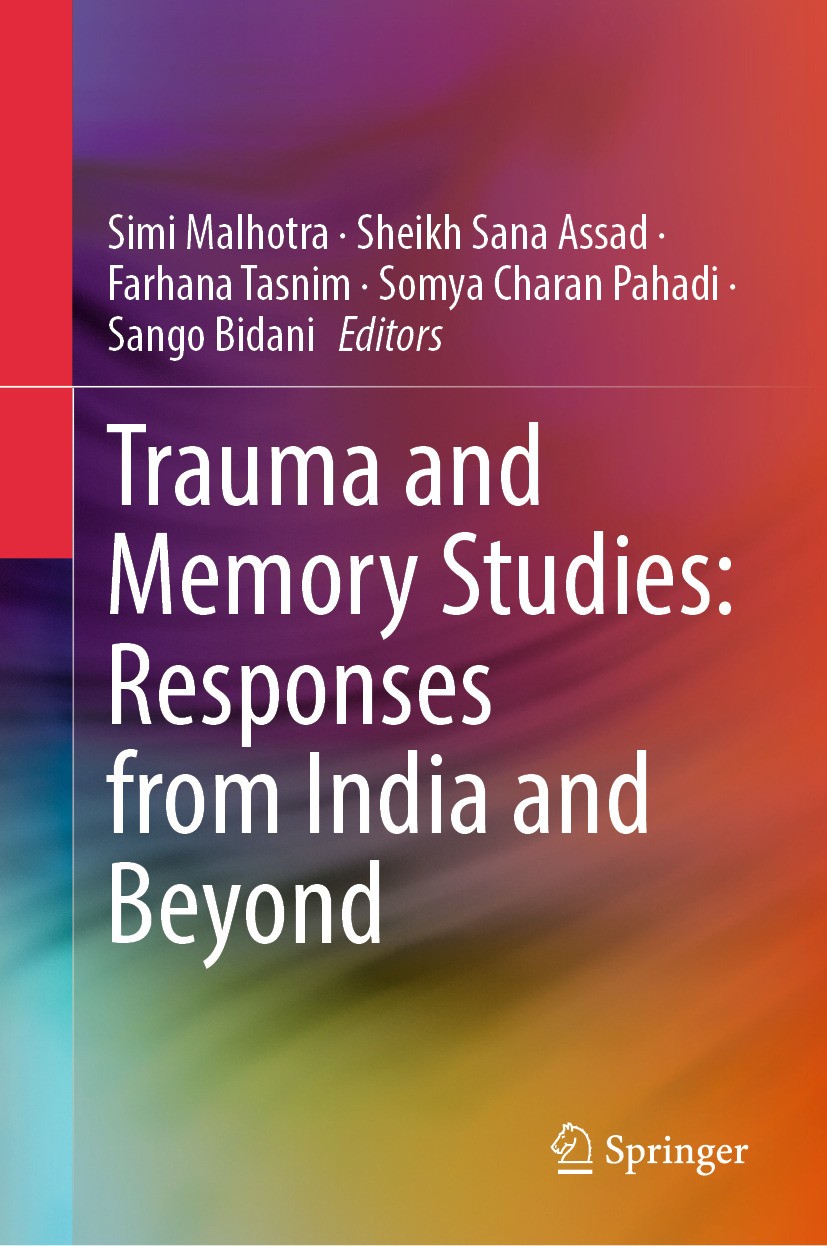
Trauma and Memory Studies: Responses from India and Beyond [electronic resource] / edited by Simi Malhotra, Sheikh Sana Assad, Farhana Tasnim, Somya Charan Pahadi, Sango Bidani.
Erişim Adresi
ISBN
9789819663743
Dil Kodu
İngilizce
Yer Numarası
EK/4913
Basım Bildirimi
1st ed. 2025.
Yayın Bilgisi
Singapore : Springer Nature Singapore : Imprint: Springer, 2025.
Fiziksel Niteleme
XVII, 334 p. 13 illus., 12 illus. in color. online resource.
İçindekiler Notu
Towards an Aesthetics and Atmosphere of Remembrance: Memorialising the Trauma of Jallianwala Bagh -- Secondary Trauma, Famine, and the Hindi Literati: Hindi Narrative of the Bengal Famine in Hams Literary Magazine -- Telling the Untold: Preserving Memories and Quiet Amnesias of the Partition -- Climate Change and the Experiences of the Marginalised South Pacific Islanders: Tales of Fear, Suffering and Resistance in Literature -- Witnessing, Trauma and Private Memories of Public Terror: Reading Selected Witness Narratives of the 26/11 Mumbai Attacks -- Muharram in Kashmir: Historical Trauma, Performance and Resistance -- Harmonies of Subversion: Exploring Kashmiri Songs as Sonic Archives -- Hand-Crafted Memories: Remembering Voices from Shaheen Bagh and The Bhopal Gas Disaster through Avant-garde Feminist Media -- Maps of Coffee: Diasporas of Trauma in Selected Poems of Mahmoud Darwish -- Storytelling as Protest: Counter-Narratives from Kenya in Yvonne Adhiambo Ouwur’s Dust -- Revisioning Biblical Women: Retelling Memory in Jeet Thayil’s Names of the Women -- Transgenerational Trauma: The Entanglement of Family Memories in 21st Century Diasporic Women’s Literatures from the Global South -- War and Memory: Remembering Women’s Bodies in War through a Reading of Brian De Palma’s Casualties of War -- From Delhi with (Co)Creativity: Literary Texts as Material Evidence of Urban Memories and Experiences -- Remembering and Forgetting War Memory in Nayomi Munaweera’s Island of a Thousand Mirrors -- Unveiling Alterity: Exploring the Palestinian and Israeli Multifaceted Memories, Identities and Geopolitics through Select Children’s Films -- Remembering, Forgetting, Forgiving: Perspectives from Philosophy, Psychology, and Manto’s spasmodic short stories on the 1947 Partition -- Articulating Humiliation: Trauma and Acousmatic Agency in Selected Life Writings of Harishankar Jaladas -- This is My Story: Role of Tibet Museum in Preserving Memory in Exile -- Unveiling Cancer, Trauma, and Recovery: A Study of Manisha Koirala and Lisa Ray’s Autobiographies -- Understanding Intersections of Caste, Gender and Migration in Uttarakhand through Cinematic Representations of Trauma and Memory in Dev Bhoomi.
Özet, vb.
This edited volume offers a comprehensive revaluation of Trauma and Memory Studies, foregrounding perspectives from India and beyond. It critically interrogates the prevailing Euro-centric paradigm within the field, advocating for the amplification and contextualization of voices originating from South Asian spatial and temporal contexts. Departing from conventional West/North-centric narratives, the text prioritizes the narratives of historically marginalized survivor groups, encompassing individuals affected by pivotal events such as the 26/11 terror attacks in Mumbai, the Bengal famine, the dispersion of the Indian diaspora, and the experiences of incarcerated populations in Iran, Kenya, Palestine, etc. Through an in-depth exploration of societal mechanisms for remembrance and coping strategies vis-à-vis traumatic episodes, such as the Jallianwala Bagh massacre, the book unveils the intricate interplay of political, cultural, and social dynamics. It explores the complicated dynamics of post-colonial and post-conflict societies in India by using a range of interdisciplinary methodologies, such as examining artistic expressions, oral histories, and digital media. It discusses the ongoing debate between hegemonic historical narratives and the often-marginalized voices of subaltern communities. This book serves as an indispensable resource for academics, students, and researchers committed to the exploration of trauma and memory within non-Western contexts.
Konu
Collective memory.
Culture __ Study and teaching.
Culture.
Memory Studies.
Cultural Studies.
Sociology of Culture.
Culture __ Study and teaching.
Culture.
Memory Studies.
Cultural Studies.
Sociology of Culture.
Diğer Yazarlar
Kurum Adı
Eseri Alıntıla
Referansları kullanmadan önce gözden geçirmeniz ve varsa gerekli düzeltmeleri yapmanız önerilir.
Dijital Kaynak
MARC Görünümü
LEADER 07176nam a22006735i 4500
001 843087
003 TR_AnAIT
005 20260715032241
007 cr nn 008mamaa
008 250820s2025 si | s |||| 0|eng d
020 |a9789819663743|9978-981-96-6374-3
024 7 |a10.1007/978-981-96-6374-3|2doi
041 |aeng
049 |aTürk Dil Kurumu Kütüphanesi
050 4|aD16.9
072 7|aHBAH|2bicssc
072 7|aHIS016000|2bisacsh
072 7|aNHAH|2thema
082 04|a907.2|223
090 |aEK/4913
245 10|aTrauma and Memory Studies: Responses from India and Beyond|h[electronic resource] /|cedited by Simi Malhotra, Sheikh Sana Assad, Farhana Tasnim, Somya Charan Pahadi, Sango Bidani.
250 |a1st ed. 2025.
264 1|aSingapore :|bSpringer Nature Singapore :|bImprint: Springer,|c2025.
300 |aXVII, 334 p. 13 illus., 12 illus. in color.|bonline resource.
336 |atext|btxt|2rdacontent
337 |acomputer|bc|2rdamedia
338 |aonline resource|bcr|2rdacarrier
341 0 |bPDF/UA-1|2onix
341 0 |bTable of contents navigation|2onix
341 0 |bSingle logical reading order|2onix
341 0 |bShort alternative textual descriptions|2onix
341 0 |bUse of color is not sole means of conveying information|2onix
341 0 |bUse of high contrast between text and background color|2onix
341 0 |bNext / Previous structural navigation|2onix
341 0 |bAll non-decorative content supports reading without sight|2onix
347 |atext file|bPDF|2rda
505 0 |aTowards an Aesthetics and Atmosphere of Remembrance: Memorialising the Trauma of Jallianwala Bagh -- Secondary Trauma, Famine, and the Hindi Literati: Hindi Narrative of the Bengal Famine in Hams Literary Magazine -- Telling the Untold: Preserving Memories and Quiet Amnesias of the Partition -- Climate Change and the Experiences of the Marginalised South Pacific Islanders: Tales of Fear, Suffering and Resistance in Literature -- Witnessing, Trauma and Private Memories of Public Terror: Reading Selected Witness Narratives of the 26/11 Mumbai Attacks -- Muharram in Kashmir: Historical Trauma, Performance and Resistance -- Harmonies of Subversion: Exploring Kashmiri Songs as Sonic Archives -- Hand-Crafted Memories: Remembering Voices from Shaheen Bagh and The Bhopal Gas Disaster through Avant-garde Feminist Media -- Maps of Coffee: Diasporas of Trauma in Selected Poems of Mahmoud Darwish -- Storytelling as Protest: Counter-Narratives from Kenya in Yvonne Adhiambo Ouwur’s Dust -- Revisioning Biblical Women: Retelling Memory in Jeet Thayil’s Names of the Women -- Transgenerational Trauma: The Entanglement of Family Memories in 21st Century Diasporic Women’s Literatures from the Global South -- War and Memory: Remembering Women’s Bodies in War through a Reading of Brian De Palma’s Casualties of War -- From Delhi with (Co)Creativity: Literary Texts as Material Evidence of Urban Memories and Experiences -- Remembering and Forgetting War Memory in Nayomi Munaweera’s Island of a Thousand Mirrors -- Unveiling Alterity: Exploring the Palestinian and Israeli Multifaceted Memories, Identities and Geopolitics through Select Children’s Films -- Remembering, Forgetting, Forgiving: Perspectives from Philosophy, Psychology, and Manto’s spasmodic short stories on the 1947 Partition -- Articulating Humiliation: Trauma and Acousmatic Agency in Selected Life Writings of Harishankar Jaladas -- This is My Story: Role of Tibet Museum in Preserving Memory in Exile -- Unveiling Cancer, Trauma, and Recovery: A Study of Manisha Koirala and Lisa Ray’s Autobiographies -- Understanding Intersections of Caste, Gender and Migration in Uttarakhand through Cinematic Representations of Trauma and Memory in Dev Bhoomi.
520 |aThis edited volume offers a comprehensive revaluation of Trauma and Memory Studies, foregrounding perspectives from India and beyond. It critically interrogates the prevailing Euro-centric paradigm within the field, advocating for the amplification and contextualization of voices originating from South Asian spatial and temporal contexts. Departing from conventional West/North-centric narratives, the text prioritizes the narratives of historically marginalized survivor groups, encompassing individuals affected by pivotal events such as the 26/11 terror attacks in Mumbai, the Bengal famine, the dispersion of the Indian diaspora, and the experiences of incarcerated populations in Iran, Kenya, Palestine, etc. Through an in-depth exploration of societal mechanisms for remembrance and coping strategies vis-à-vis traumatic episodes, such as the Jallianwala Bagh massacre, the book unveils the intricate interplay of political, cultural, and social dynamics. It explores the complicated dynamics of post-colonial and post-conflict societies in India by using a range of interdisciplinary methodologies, such as examining artistic expressions, oral histories, and digital media. It discusses the ongoing debate between hegemonic historical narratives and the often-marginalized voices of subaltern communities. This book serves as an indispensable resource for academics, students, and researchers committed to the exploration of trauma and memory within non-Western contexts.
532 8 |aAccessibility summary: This PDF has been created in accordance with the PDF/UA-1 standard to enhance accessibility, including screen reader support, described non-text content (images, graphs), bookmarks for easy navigation, keyboard-friendly links and forms and searchable, selectable text. We recognize the importance of accessibility, and we welcome queries about accessibility for any of our products. If you have a question or an access need, please get in touch with us at accessibilitysupport@springernature.com. Please note that a more accessible version of this eBook is available as ePub.
532 8 |aNo reading system accessibility options actively disabled
532 8 |aPublisher contact for further accessibility information: accessibilitysupport@springernature.com
650 0|aCollective memory.
650 0|aCulture|xStudy and teaching.
650 0|aCulture.
650 14|aMemory Studies.
650 24|aCultural Studies.
650 24|aSociology of Culture.
700 1 |aMalhotra, Simi.|eeditor.|4edt|4http://id.loc.gov/vocabulary/relators/edt
700 1 |aAssad, Sheikh Sana.|eeditor.|4edt|4http://id.loc.gov/vocabulary/relators/edt
700 1 |aTasnim, Farhana.|eeditor.|4edt|4http://id.loc.gov/vocabulary/relators/edt
700 1 |aPahadi, Somya Charan.|eeditor.|4edt|4http://id.loc.gov/vocabulary/relators/edt
700 1 |aBidani, Sango.|eeditor.|4edt|4http://id.loc.gov/vocabulary/relators/edt
710 2 |aSpringerLink (Online service)
773 0 |tSpringer Nature eBook
776 08|iPrinted edition:|z9789819663736
776 08|iPrinted edition:|z9789819663750
776 08|iPrinted edition:|z9789819663767
856 40|uhttps://doi.org/10.1007/978-981-96-6374-3
912 |aZDB-2-LCM
912 |aZDB-2-SXL
950 |aLiterature, Cultural and Media Studies (SpringerNature-41173)
950 |aLiterature, Cultural and Media Studies (R0) (SpringerNature-43723)
001 843087
003 TR_AnAIT
005 20260715032241
007 cr nn 008mamaa
008 250820s2025 si | s |||| 0|eng d
020 |a9789819663743|9978-981-96-6374-3
024 7 |a10.1007/978-981-96-6374-3|2doi
041 |aeng
049 |aTürk Dil Kurumu Kütüphanesi
050 4|aD16.9
072 7|aHBAH|2bicssc
072 7|aHIS016000|2bisacsh
072 7|aNHAH|2thema
082 04|a907.2|223
090 |aEK/4913
245 10|aTrauma and Memory Studies: Responses from India and Beyond|h[electronic resource] /|cedited by Simi Malhotra, Sheikh Sana Assad, Farhana Tasnim, Somya Charan Pahadi, Sango Bidani.
250 |a1st ed. 2025.
264 1|aSingapore :|bSpringer Nature Singapore :|bImprint: Springer,|c2025.
300 |aXVII, 334 p. 13 illus., 12 illus. in color.|bonline resource.
336 |atext|btxt|2rdacontent
337 |acomputer|bc|2rdamedia
338 |aonline resource|bcr|2rdacarrier
341 0 |bPDF/UA-1|2onix
341 0 |bTable of contents navigation|2onix
341 0 |bSingle logical reading order|2onix
341 0 |bShort alternative textual descriptions|2onix
341 0 |bUse of color is not sole means of conveying information|2onix
341 0 |bUse of high contrast between text and background color|2onix
341 0 |bNext / Previous structural navigation|2onix
341 0 |bAll non-decorative content supports reading without sight|2onix
347 |atext file|bPDF|2rda
505 0 |aTowards an Aesthetics and Atmosphere of Remembrance: Memorialising the Trauma of Jallianwala Bagh -- Secondary Trauma, Famine, and the Hindi Literati: Hindi Narrative of the Bengal Famine in Hams Literary Magazine -- Telling the Untold: Preserving Memories and Quiet Amnesias of the Partition -- Climate Change and the Experiences of the Marginalised South Pacific Islanders: Tales of Fear, Suffering and Resistance in Literature -- Witnessing, Trauma and Private Memories of Public Terror: Reading Selected Witness Narratives of the 26/11 Mumbai Attacks -- Muharram in Kashmir: Historical Trauma, Performance and Resistance -- Harmonies of Subversion: Exploring Kashmiri Songs as Sonic Archives -- Hand-Crafted Memories: Remembering Voices from Shaheen Bagh and The Bhopal Gas Disaster through Avant-garde Feminist Media -- Maps of Coffee: Diasporas of Trauma in Selected Poems of Mahmoud Darwish -- Storytelling as Protest: Counter-Narratives from Kenya in Yvonne Adhiambo Ouwur’s Dust -- Revisioning Biblical Women: Retelling Memory in Jeet Thayil’s Names of the Women -- Transgenerational Trauma: The Entanglement of Family Memories in 21st Century Diasporic Women’s Literatures from the Global South -- War and Memory: Remembering Women’s Bodies in War through a Reading of Brian De Palma’s Casualties of War -- From Delhi with (Co)Creativity: Literary Texts as Material Evidence of Urban Memories and Experiences -- Remembering and Forgetting War Memory in Nayomi Munaweera’s Island of a Thousand Mirrors -- Unveiling Alterity: Exploring the Palestinian and Israeli Multifaceted Memories, Identities and Geopolitics through Select Children’s Films -- Remembering, Forgetting, Forgiving: Perspectives from Philosophy, Psychology, and Manto’s spasmodic short stories on the 1947 Partition -- Articulating Humiliation: Trauma and Acousmatic Agency in Selected Life Writings of Harishankar Jaladas -- This is My Story: Role of Tibet Museum in Preserving Memory in Exile -- Unveiling Cancer, Trauma, and Recovery: A Study of Manisha Koirala and Lisa Ray’s Autobiographies -- Understanding Intersections of Caste, Gender and Migration in Uttarakhand through Cinematic Representations of Trauma and Memory in Dev Bhoomi.
520 |aThis edited volume offers a comprehensive revaluation of Trauma and Memory Studies, foregrounding perspectives from India and beyond. It critically interrogates the prevailing Euro-centric paradigm within the field, advocating for the amplification and contextualization of voices originating from South Asian spatial and temporal contexts. Departing from conventional West/North-centric narratives, the text prioritizes the narratives of historically marginalized survivor groups, encompassing individuals affected by pivotal events such as the 26/11 terror attacks in Mumbai, the Bengal famine, the dispersion of the Indian diaspora, and the experiences of incarcerated populations in Iran, Kenya, Palestine, etc. Through an in-depth exploration of societal mechanisms for remembrance and coping strategies vis-à-vis traumatic episodes, such as the Jallianwala Bagh massacre, the book unveils the intricate interplay of political, cultural, and social dynamics. It explores the complicated dynamics of post-colonial and post-conflict societies in India by using a range of interdisciplinary methodologies, such as examining artistic expressions, oral histories, and digital media. It discusses the ongoing debate between hegemonic historical narratives and the often-marginalized voices of subaltern communities. This book serves as an indispensable resource for academics, students, and researchers committed to the exploration of trauma and memory within non-Western contexts.
532 8 |aAccessibility summary: This PDF has been created in accordance with the PDF/UA-1 standard to enhance accessibility, including screen reader support, described non-text content (images, graphs), bookmarks for easy navigation, keyboard-friendly links and forms and searchable, selectable text. We recognize the importance of accessibility, and we welcome queries about accessibility for any of our products. If you have a question or an access need, please get in touch with us at accessibilitysupport@springernature.com. Please note that a more accessible version of this eBook is available as ePub.
532 8 |aNo reading system accessibility options actively disabled
532 8 |aPublisher contact for further accessibility information: accessibilitysupport@springernature.com
650 0|aCollective memory.
650 0|aCulture|xStudy and teaching.
650 0|aCulture.
650 14|aMemory Studies.
650 24|aCultural Studies.
650 24|aSociology of Culture.
700 1 |aMalhotra, Simi.|eeditor.|4edt|4http://id.loc.gov/vocabulary/relators/edt
700 1 |aAssad, Sheikh Sana.|eeditor.|4edt|4http://id.loc.gov/vocabulary/relators/edt
700 1 |aTasnim, Farhana.|eeditor.|4edt|4http://id.loc.gov/vocabulary/relators/edt
700 1 |aPahadi, Somya Charan.|eeditor.|4edt|4http://id.loc.gov/vocabulary/relators/edt
700 1 |aBidani, Sango.|eeditor.|4edt|4http://id.loc.gov/vocabulary/relators/edt
710 2 |aSpringerLink (Online service)
773 0 |tSpringer Nature eBook
776 08|iPrinted edition:|z9789819663736
776 08|iPrinted edition:|z9789819663750
776 08|iPrinted edition:|z9789819663767
856 40|uhttps://doi.org/10.1007/978-981-96-6374-3
912 |aZDB-2-LCM
912 |aZDB-2-SXL
950 |aLiterature, Cultural and Media Studies (SpringerNature-41173)
950 |aLiterature, Cultural and Media Studies (R0) (SpringerNature-43723)
Materyaller
Depodan talep edilen materyal sadece kütüphane içerisinde kullanılmaktadır.
Materyal dışarıya ödünç verilmemektedir.
Materyal dışarıya ödünç verilmemektedir.
