

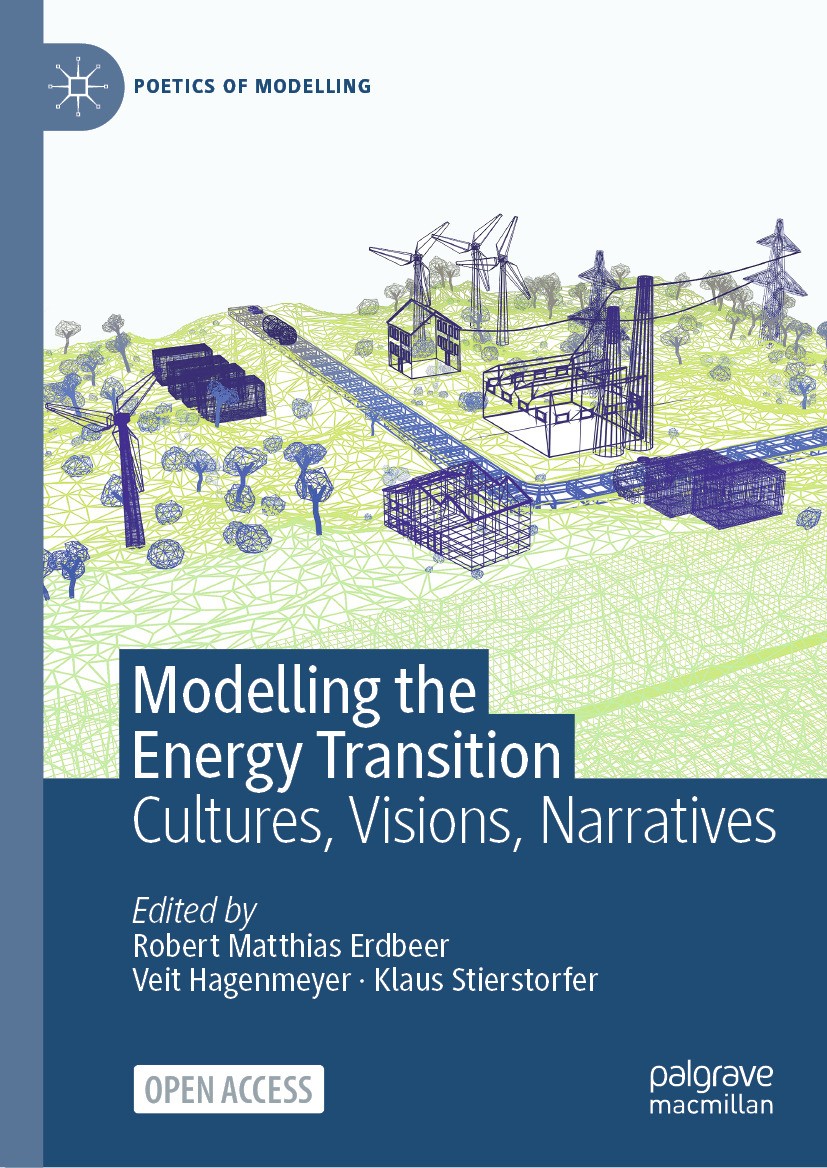
Modelling the Energy Transition [electronic resource] : Cultures, Visions, Narratives / edited by Robert Matthias Erdbeer, Veit Hagenmeyer, Klaus Stierstorfer.
Erişim Adresi
ISBN
9783031690310
Dil Kodu
İngilizce
Yer Numarası
EK/6327
Basım Bildirimi
1st ed. 2025.
Yayın Bilgisi
Cham : Springer Nature Switzerland : Imprint: Palgrave Macmillan, 2025.
Fiziksel Niteleme
XXXI, 408 p. 51 illus., 42 illus. in color. online resource.
Dizi
Poetics of Modelling, 3059-3085
İçindekiler Notu
Introduction: Modelling the Energy Transition: Cultures - Visions - Narratives, R. M, Erdbeer, V. Hagenmeyer and K. Stierstorfer -- Part I: Transparent Modelling: Revisiting Model Theory -- Theories, Modelling and Empirical Support, B. van Fraassen -- Modelling in Experimentation, H-J. Rheinberger -- Model-Based Science as Epistemic Warfare: Scientific Models in a Static and a Dynamic Perspective, L. Magnani -- Modelling Objectively, N, Cartwright, F. Ray -- Basic Operations of Model Building in Literary Studies, D. Tenev -- Part II: Modelling the Energy Transition 1: Technology and Practice -- On the Art of Electric Power System Modelling and Simulation for Integrated Transmission-Distribution Analysis, U. Kuehnapfel, V. Hagemeyer -- Daily Streamflow Forecasting using an Enhanced LSTM Neural Network Model, V. Eniola et al -- Open Models areNot Enough: Advancing Energy System Modelling Towards Practical Usefulness, F. Lombardi et al -- Part III: Modelling the Energy Transition 2: Societal and Cultural Perspectives -- Backcasting: Prototyping Future Ontologies by Backward Chaining Possible Futures, G. Gramelsberger -- Indicator Politics: Modelling Societal Problems under Real-World Conditions, S. Boeschen -- Understanding Petromodernity: Oil as a Medium between Geology, Technology, and Different Types of History, B. Steininger -- Part IV: The Energy Imaginary: Model Media in Literature and Art -- Literary Models of/for Resilience in Juliana Spahr's "The Transformation" and Kim Stanley Robinson's "The Ministry for the Future", J. Dorson -- Modelling the Future with Miniature Worlds, O. Eide -- Models in Art: A Visual Approach to Energy Transition, T. Becker.
Özet, vb.
This open access book reconfigures Energy Transition as a global discourse from a multidisciplinary perspective. Energy Transition is not only one of the most daring technological endeavours of the present, it is also its new master narrative. Focusing on modelling both as a cultural technique and as a strategy of innovation, the chapters provided in this volume throw into relief the visions, but also the blind spots of modelling the challenges of climate change. Thus, in a rare encounter, major voices from the Sciences and the Humanities, from Energy Systems Design, Mechanical Engineering, Theory of Science, Science and Technology Studies, Literary Studies and the Arts, have gathered here to overcome the cultural divide between the technological and the societal dimensions of this global task. In doing so, they offer a new form of model criticism, pointing to the impacts of what may be termed the ‘Energy Imaginary’ on the technosocial mindsets of our time. Robert Matthias Erdbeer is a professor for German literature and literary theory at the University of Münster, Germany. His research covers literary form and modelling, experimental video games, but also the extensive contact zone of literature, philosophy of nature, and scientific thought. He has been the spokesperson of the Münster Center for Philosophy of Science. Veit Hagenmeyer holds the Chair of Energy Informatics and is the director of the Institute for Automation and Applied Informatics at Karlsruhe Institute of Technology (KIT), Germany. He is the spokesperson of the German federal national research programme ‘Energy System Design’ of the Helmholtz Association and a Director of the Energy Lab at KIT. Klaus Stierstorfer is Chair of British Studies at the University of Münster, Germany. He has published widely on literary history, literary and cultural theory, law and literature, and has an interest in literary modelling. He has been spokesperson of the Collaborative Research Centre ‘Law and Literature’ and is director of the EU CoFund Project ‘Migration, Diaspora, Citizenship’.
Konu
Literature.
Literature and technology.
Mass media and literature.
Energy policy.
Energy and state.
Ecology __ Methodology.
Science __ Philosophy.
Literary Methods.
Literature and Technology.
Energy Policy, Economics and Management.
Ecological Modelling.
Philosophy of Science.
Literature and technology.
Mass media and literature.
Energy policy.
Energy and state.
Ecology __ Methodology.
Science __ Philosophy.
Literary Methods.
Literature and Technology.
Energy Policy, Economics and Management.
Ecological Modelling.
Philosophy of Science.
Kurum Adı
Eseri Alıntıla
Referansları kullanmadan önce gözden geçirmeniz ve varsa gerekli düzeltmeleri yapmanız önerilir.
Dijital Kaynak
MARC Görünümü
LEADER 07464nam a22007695i 4500
001 843184
003 TR_AnAIT
005 20260715032646
007 cr nn 008mamaa
008 250705s2025 sz | s |||| 0|eng d
020 |a9783031690310|9978-3-031-69031-0
024 7 |a10.1007/978-3-031-69031-0|2doi
041 |aeng
049 |aTürk Dil Kurumu Kütüphanesi
050 4|aPN1-6790
072 7|aDSA|2bicssc
072 7|aLAN000000|2bisacsh
072 7|aDSA|2thema
082 04|a807.21|223
090 |aEK/6327
245 10|aModelling the Energy Transition|h[electronic resource] :|bCultures, Visions, Narratives /|cedited by Robert Matthias Erdbeer, Veit Hagenmeyer, Klaus Stierstorfer.
250 |a1st ed. 2025.
264 1|aCham :|bSpringer Nature Switzerland :|bImprint: Palgrave Macmillan,|c2025.
300 |aXXXI, 408 p. 51 illus., 42 illus. in color.|bonline resource.
336 |atext|btxt|2rdacontent
337 |acomputer|bc|2rdamedia
338 |aonline resource|bcr|2rdacarrier
341 0 |bPDF/UA-1|2onix
341 0 |bTable of contents navigation|2onix
341 0 |bSingle logical reading order|2onix
341 0 |bShort alternative textual descriptions|2onix
341 0 |bUse of color is not sole means of conveying information|2onix
341 0 |bUse of high contrast between text and background color|2onix
341 0 |bNext / Previous structural navigation|2onix
341 0 |bAll non-decorative content supports reading without sight|2onix
347 |atext file|bPDF|2rda
490 1 |aPoetics of Modelling,|x3059-3085
505 0 |aIntroduction: Modelling the Energy Transition: Cultures - Visions - Narratives, R. M, Erdbeer, V. Hagenmeyer and K. Stierstorfer -- Part I: Transparent Modelling: Revisiting Model Theory -- Theories, Modelling and Empirical Support, B. van Fraassen -- Modelling in Experimentation, H-J. Rheinberger -- Model-Based Science as Epistemic Warfare: Scientific Models in a Static and a Dynamic Perspective, L. Magnani -- Modelling Objectively, N, Cartwright, F. Ray -- Basic Operations of Model Building in Literary Studies, D. Tenev -- Part II: Modelling the Energy Transition 1: Technology and Practice -- On the Art of Electric Power System Modelling and Simulation for Integrated Transmission-Distribution Analysis, U. Kuehnapfel, V. Hagemeyer -- Daily Streamflow Forecasting using an Enhanced LSTM Neural Network Model, V. Eniola et al -- Open Models areNot Enough: Advancing Energy System Modelling Towards Practical Usefulness, F. Lombardi et al -- Part III: Modelling the Energy Transition 2: Societal and Cultural Perspectives -- Backcasting: Prototyping Future Ontologies by Backward Chaining Possible Futures, G. Gramelsberger -- Indicator Politics: Modelling Societal Problems under Real-World Conditions, S. Boeschen -- Understanding Petromodernity: Oil as a Medium between Geology, Technology, and Different Types of History, B. Steininger -- Part IV: The Energy Imaginary: Model Media in Literature and Art -- Literary Models of/for Resilience in Juliana Spahr's "The Transformation" and Kim Stanley Robinson's "The Ministry for the Future", J. Dorson -- Modelling the Future with Miniature Worlds, O. Eide -- Models in Art: A Visual Approach to Energy Transition, T. Becker.
506 0 |aOpen Access
520 |aThis open access book reconfigures Energy Transition as a global discourse from a multidisciplinary perspective. Energy Transition is not only one of the most daring technological endeavours of the present, it is also its new master narrative. Focusing on modelling both as a cultural technique and as a strategy of innovation, the chapters provided in this volume throw into relief the visions, but also the blind spots of modelling the challenges of climate change. Thus, in a rare encounter, major voices from the Sciences and the Humanities, from Energy Systems Design, Mechanical Engineering, Theory of Science, Science and Technology Studies, Literary Studies and the Arts, have gathered here to overcome the cultural divide between the technological and the societal dimensions of this global task. In doing so, they offer a new form of model criticism, pointing to the impacts of what may be termed the ‘Energy Imaginary’ on the technosocial mindsets of our time. Robert Matthias Erdbeer is a professor for German literature and literary theory at the University of Münster, Germany. His research covers literary form and modelling, experimental video games, but also the extensive contact zone of literature, philosophy of nature, and scientific thought. He has been the spokesperson of the Münster Center for Philosophy of Science. Veit Hagenmeyer holds the Chair of Energy Informatics and is the director of the Institute for Automation and Applied Informatics at Karlsruhe Institute of Technology (KIT), Germany. He is the spokesperson of the German federal national research programme ‘Energy System Design’ of the Helmholtz Association and a Director of the Energy Lab at KIT. Klaus Stierstorfer is Chair of British Studies at the University of Münster, Germany. He has published widely on literary history, literary and cultural theory, law and literature, and has an interest in literary modelling. He has been spokesperson of the Collaborative Research Centre ‘Law and Literature’ and is director of the EU CoFund Project ‘Migration, Diaspora, Citizenship’.
532 8 |aAccessibility summary: This PDF has been created in accordance with the PDF/UA-1 standard to enhance accessibility, including screen reader support, described non-text content (images, graphs), bookmarks for easy navigation, keyboard-friendly links and forms and searchable, selectable text. We recognize the importance of accessibility, and we welcome queries about accessibility for any of our products. If you have a question or an access need, please get in touch with us at accessibilitysupport@springernature.com. Please note that a more accessible version of this eBook is available as ePub.
532 8 |aNo reading system accessibility options actively disabled
532 8 |aPublisher contact for further accessibility information: accessibilitysupport@springernature.com
650 0|aLiterature.
650 0|aLiterature and technology.
650 0|aMass media and literature.
650 0|aEnergy policy.
650 0|aEnergy and state.
650 0|aEcology|xMethodology.
650 0|aScience|xPhilosophy.
650 14|aLiterary Methods.
650 24|aLiterature and Technology.
650 24|aEnergy Policy, Economics and Management.
650 24|aEcological Modelling.
650 24|aPhilosophy of Science.
700 1 |aErdbeer, Robert Matthias.|eeditor.|4edt|4http://id.loc.gov/vocabulary/relators/edt
700 1 |aHagenmeyer, Veit.|eeditor.|4edt|4http://id.loc.gov/vocabulary/relators/edt
700 1 |aStierstorfer, Klaus.|eeditor.|4edt|4http://id.loc.gov/vocabulary/relators/edt
710 2 |aSpringerLink (Online service)
773 0 |tSpringer Nature eBook
776 08|iPrinted edition:|z9783031690303
776 08|iPrinted edition:|z9783031690327
776 08|iPrinted edition:|z9783031690334
830 0|aPoetics of Modelling,|x3059-3085
856 40|uhttps://doi.org/10.1007/978-3-031-69031-0
912 |aZDB-2-LCM
912 |aZDB-2-SXL
912 |aZDB-2-SOB
950 |aLiterature, Cultural and Media Studies (SpringerNature-41173)
950 |aLiterature, Cultural and Media Studies (R0) (SpringerNature-43723)
001 843184
003 TR_AnAIT
005 20260715032646
007 cr nn 008mamaa
008 250705s2025 sz | s |||| 0|eng d
020 |a9783031690310|9978-3-031-69031-0
024 7 |a10.1007/978-3-031-69031-0|2doi
041 |aeng
049 |aTürk Dil Kurumu Kütüphanesi
050 4|aPN1-6790
072 7|aDSA|2bicssc
072 7|aLAN000000|2bisacsh
072 7|aDSA|2thema
082 04|a807.21|223
090 |aEK/6327
245 10|aModelling the Energy Transition|h[electronic resource] :|bCultures, Visions, Narratives /|cedited by Robert Matthias Erdbeer, Veit Hagenmeyer, Klaus Stierstorfer.
250 |a1st ed. 2025.
264 1|aCham :|bSpringer Nature Switzerland :|bImprint: Palgrave Macmillan,|c2025.
300 |aXXXI, 408 p. 51 illus., 42 illus. in color.|bonline resource.
336 |atext|btxt|2rdacontent
337 |acomputer|bc|2rdamedia
338 |aonline resource|bcr|2rdacarrier
341 0 |bPDF/UA-1|2onix
341 0 |bTable of contents navigation|2onix
341 0 |bSingle logical reading order|2onix
341 0 |bShort alternative textual descriptions|2onix
341 0 |bUse of color is not sole means of conveying information|2onix
341 0 |bUse of high contrast between text and background color|2onix
341 0 |bNext / Previous structural navigation|2onix
341 0 |bAll non-decorative content supports reading without sight|2onix
347 |atext file|bPDF|2rda
490 1 |aPoetics of Modelling,|x3059-3085
505 0 |aIntroduction: Modelling the Energy Transition: Cultures - Visions - Narratives, R. M, Erdbeer, V. Hagenmeyer and K. Stierstorfer -- Part I: Transparent Modelling: Revisiting Model Theory -- Theories, Modelling and Empirical Support, B. van Fraassen -- Modelling in Experimentation, H-J. Rheinberger -- Model-Based Science as Epistemic Warfare: Scientific Models in a Static and a Dynamic Perspective, L. Magnani -- Modelling Objectively, N, Cartwright, F. Ray -- Basic Operations of Model Building in Literary Studies, D. Tenev -- Part II: Modelling the Energy Transition 1: Technology and Practice -- On the Art of Electric Power System Modelling and Simulation for Integrated Transmission-Distribution Analysis, U. Kuehnapfel, V. Hagemeyer -- Daily Streamflow Forecasting using an Enhanced LSTM Neural Network Model, V. Eniola et al -- Open Models areNot Enough: Advancing Energy System Modelling Towards Practical Usefulness, F. Lombardi et al -- Part III: Modelling the Energy Transition 2: Societal and Cultural Perspectives -- Backcasting: Prototyping Future Ontologies by Backward Chaining Possible Futures, G. Gramelsberger -- Indicator Politics: Modelling Societal Problems under Real-World Conditions, S. Boeschen -- Understanding Petromodernity: Oil as a Medium between Geology, Technology, and Different Types of History, B. Steininger -- Part IV: The Energy Imaginary: Model Media in Literature and Art -- Literary Models of/for Resilience in Juliana Spahr's "The Transformation" and Kim Stanley Robinson's "The Ministry for the Future", J. Dorson -- Modelling the Future with Miniature Worlds, O. Eide -- Models in Art: A Visual Approach to Energy Transition, T. Becker.
506 0 |aOpen Access
520 |aThis open access book reconfigures Energy Transition as a global discourse from a multidisciplinary perspective. Energy Transition is not only one of the most daring technological endeavours of the present, it is also its new master narrative. Focusing on modelling both as a cultural technique and as a strategy of innovation, the chapters provided in this volume throw into relief the visions, but also the blind spots of modelling the challenges of climate change. Thus, in a rare encounter, major voices from the Sciences and the Humanities, from Energy Systems Design, Mechanical Engineering, Theory of Science, Science and Technology Studies, Literary Studies and the Arts, have gathered here to overcome the cultural divide between the technological and the societal dimensions of this global task. In doing so, they offer a new form of model criticism, pointing to the impacts of what may be termed the ‘Energy Imaginary’ on the technosocial mindsets of our time. Robert Matthias Erdbeer is a professor for German literature and literary theory at the University of Münster, Germany. His research covers literary form and modelling, experimental video games, but also the extensive contact zone of literature, philosophy of nature, and scientific thought. He has been the spokesperson of the Münster Center for Philosophy of Science. Veit Hagenmeyer holds the Chair of Energy Informatics and is the director of the Institute for Automation and Applied Informatics at Karlsruhe Institute of Technology (KIT), Germany. He is the spokesperson of the German federal national research programme ‘Energy System Design’ of the Helmholtz Association and a Director of the Energy Lab at KIT. Klaus Stierstorfer is Chair of British Studies at the University of Münster, Germany. He has published widely on literary history, literary and cultural theory, law and literature, and has an interest in literary modelling. He has been spokesperson of the Collaborative Research Centre ‘Law and Literature’ and is director of the EU CoFund Project ‘Migration, Diaspora, Citizenship’.
532 8 |aAccessibility summary: This PDF has been created in accordance with the PDF/UA-1 standard to enhance accessibility, including screen reader support, described non-text content (images, graphs), bookmarks for easy navigation, keyboard-friendly links and forms and searchable, selectable text. We recognize the importance of accessibility, and we welcome queries about accessibility for any of our products. If you have a question or an access need, please get in touch with us at accessibilitysupport@springernature.com. Please note that a more accessible version of this eBook is available as ePub.
532 8 |aNo reading system accessibility options actively disabled
532 8 |aPublisher contact for further accessibility information: accessibilitysupport@springernature.com
650 0|aLiterature.
650 0|aLiterature and technology.
650 0|aMass media and literature.
650 0|aEnergy policy.
650 0|aEnergy and state.
650 0|aEcology|xMethodology.
650 0|aScience|xPhilosophy.
650 14|aLiterary Methods.
650 24|aLiterature and Technology.
650 24|aEnergy Policy, Economics and Management.
650 24|aEcological Modelling.
650 24|aPhilosophy of Science.
700 1 |aErdbeer, Robert Matthias.|eeditor.|4edt|4http://id.loc.gov/vocabulary/relators/edt
700 1 |aHagenmeyer, Veit.|eeditor.|4edt|4http://id.loc.gov/vocabulary/relators/edt
700 1 |aStierstorfer, Klaus.|eeditor.|4edt|4http://id.loc.gov/vocabulary/relators/edt
710 2 |aSpringerLink (Online service)
773 0 |tSpringer Nature eBook
776 08|iPrinted edition:|z9783031690303
776 08|iPrinted edition:|z9783031690327
776 08|iPrinted edition:|z9783031690334
830 0|aPoetics of Modelling,|x3059-3085
856 40|uhttps://doi.org/10.1007/978-3-031-69031-0
912 |aZDB-2-LCM
912 |aZDB-2-SXL
912 |aZDB-2-SOB
950 |aLiterature, Cultural and Media Studies (SpringerNature-41173)
950 |aLiterature, Cultural and Media Studies (R0) (SpringerNature-43723)
Materyaller
Depodan talep edilen materyal sadece kütüphane içerisinde kullanılmaktadır.
Materyal dışarıya ödünç verilmemektedir.
Materyal dışarıya ödünç verilmemektedir.
