LEADER 03493naaaa2200373aa54500
001 848212
003 TR_AnAIT
005 20260910115540
006 aobd|e |||| 001 0d
007 ta
008 260903s2026 ne obd|e |||| 001 0deng c
020 |a9789004763807
020 |a9789004763814|q(PDF)
040 |aTTK
041 |aeng
049 |aTürk Tarih Kurumu Kütüphanesi
090 |aA.X/3181
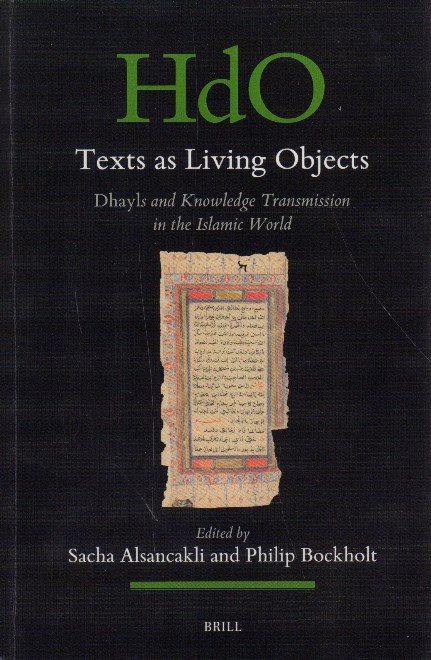
245 00|aTexts as living objects :|bdhayls and knowledge transmission in the Islamic world /|cedited by Sacha Alsancakli, Philip Bockholt.
246 1 |aDhayls and knowledge transmission in the Islamic world
260 |aLeiden :|bBrill,|c©2026.
300 |axii, 270 sayfa :|bresim, minyatür, harita, şema, tıpkıbasım, tablo ;|c24 cm.
490 1 |aHandbook of Oriental Studies =|aHandbuch der Orientalistik. Section one.|aThe Near and Middle East,|x0169-9423 ;|vvolume 204
500 |aİndeks s. [251]-270.
504 |aBibliyografya makale sonlarındadır.
505 |tIntroduction : Supplements Matter : a Conceptual Approach to Dhayls in Islamic Manuscript Tradition /|rSacha Alsancakli and Philip Bockholt --|tAdding Supplements to Tradition : Ẕayls in Persian Historiography /|rChristoph U. Werner --|tA Ẕayl That Never Was : Amīr Maḥmūd’s Tārīkh-i Shāh Ismāʿīl va Shāh Ṭahmāsb /|rPhilip Bockholt --|tAcknowledging the Addition? The Dhayl in Arabic Lexicography /|rColinda Lindermann --|tThe Scholar’s Companion : Some Reflections on the Compilation and Transmission of Supplements to Works on Astronomy /|rNadine Löhr --|tWhat Belongs in a Ẕeyl? Authorial Intent behind Nevʿizāde ʿAṭāʾī’s Portrayals of Pīr Meḥmed Efendi in Ḥadāʾiḳu’l-Ḥaḳāʾiḳ and Nefḥatü’l-Ezhār /|rZeynep Tezer --|tContextualising the Ẕeyl Works of Şeyḫī Meḥmed b. Ḥasan and Delving into the Queries Surrounding His Cihānnümā-i Avrupa /|rFikret Turan --|tThe Majmaʿ al-Gharāʾib : a Case Study in Textual Transmission /|rGuglielmo Zucconi --|tThree Centuries of Ẕayls of Bidlīsī’s Sharafnāma /|rSacha Alsancakli --|tContinued Pasts : Samaritan Tolidah Extensions and Self-Reflections on History /|rRoy Marom.
520 |a“Texts as Living Objects brings together nine contributions on dhayls (supplements) and textual transmission in the Islamic world. Integrating case studies of texts in Arabic, Persian, Turkish, and Samaritan Hebrew, and spanning a wide geographical and chronological scope, the volume proposes a renewed definition and understanding of dhayls as cultural and historical phenomena. Rather than examining supplementation in isolation, the volume also considers other forms of textual modification, such as commentary and translation, with which the production of supplements often overlapped. This approach underscores the dynamic yet persistent nature of authorship and knowledge production in the Islamic world and sheds light on the remarkable stability and cohesiveness of a plurisecular written production and its cultural milieu“ --|cArka kapak.
650 4|aİslam dünyası|xBilgi üretimi.
700 1 |aAlsancakli, Sacha,|eeditör.
700 1 |aBockholt, Philip,|eeditör.
830 0|aHandbook of Oriental Studies.|nSection 1,|pThe Near and Middle East ;|vvolume 204.
830 0|aHandbuch der Orientalistik.|nSection 1,|pThe Near and Middle East ;|vvolume 204.
830 0|aHdO.|nI ;|vvol. 204.
830 0|aHdO.|n1 ;|vvol. 204.